 blog
blog
Bulk Packaging Solutions vs Standard Retail Supply: 2026 Guide
Table of Contents
- Bulk Packaging Solutions vs Standard Retail Supply: The Core Differences
- Packaging Cost Comparison: Bulk vs Standard Retail Supply
- Minimum Order Quantity for Packaging: What to Expect
- Retail Packaging Storage Requirements: Space, Conditions and Handling
- Packaging Inventory Management: Keeping Bulk Stock Under Control
- Decision Framework: Which Supply Model Fits Your Business?
- Conclusion: Choosing the Right Packaging Supply Model
- Frequently Asked Questions
Last Updated: October 7, 2026
Bulk Packaging Solutions vs Standard Retail Supply: The Core Differences
Bulk packaging solutions vs standard retail supply is the choice between buying operational and packaging stock in large, cost-efficient quantities directly from a wholesaler, or topping up in small amounts through standard retail channels.
The core difference comes down to four variables: price per unit, order size, storage needs, and how much control you keep over your own stock.
Irish Government supports for small business
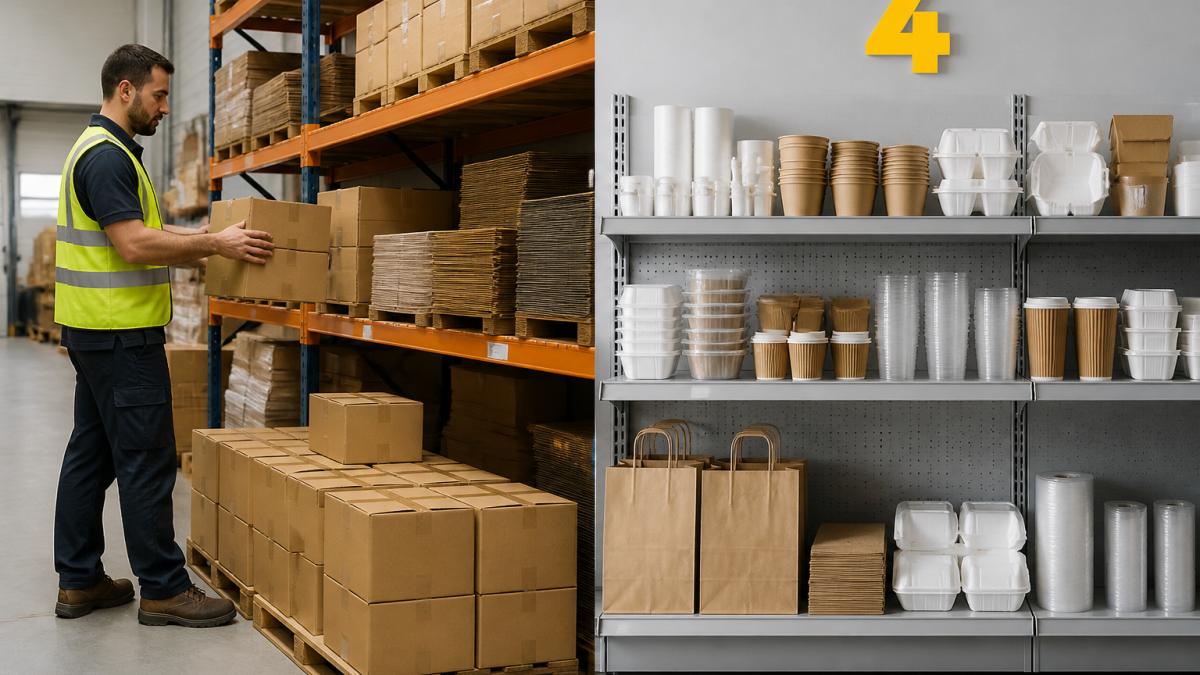
That trade-off explains why most busy retail and hospitality operations eventually move toward bulk for their everyday consumables. It also explains why some never do.
Packaging Cost Comparison: Bulk vs Standard Retail Supply
Bulk buying wins on unit price almost every time, but unit price is the least interesting number in this comparison. The saving comes from how suppliers price in volume: larger orders spread freight, handling, and admin costs across more units, so the supplier passes some of that back to you. The question is whether the saving survives the costs you take on by holding more stock.
A simple way to compare is to work out your true cost per unit, not just the sticker price:
| Cost factor | Bulk supply | Standard retail supply |
|---|---|---|
| Unit price | Lower per item | Higher per item |
| Delivery | Often free or discounted above a threshold | Charged per order |
| Storage | You provide the space | Minimal space needed |
| Handling | Cases, pallets, manual lifting | Small parcels, easy to move |
| Damage and waste | Higher exposure if stored badly | Lower, because you hold less |
| Admin time | Fewer, larger orders | More frequent reordering |
| Cash flow | Larger upfront spend | Smaller, frequent spend |
The total cost of ownership calculation
Most buyers compare the headline price and stop there. A more honest comparison is total cost of ownership, which adds six things to the unit price:
- Freight per unit, divide the delivery charge by the number of units in the order. A €15 delivery on 20 units adds €0.75 per unit; the same charge on 200 units adds €0.075.
- Storage cost per unit, estimate the floor or shelf space a case occupies, and what that space would otherwise be used for. A stockroom is not free real estate.
- Handling labour, time spent receiving, unpacking, stacking, and rotating stock. Bulk adds minutes per delivery but fewer deliveries.
- Damage and shrinkage, paper and board absorb moisture, and crushed cases cannot be sold or used. The more you hold, the more you expose.
- Packaging waste, outer cases, pallet wrap, and pallets themselves have a disposal or recycling cost.
- Cash tied up, money sitting in stock is money not available for wages, rent, or marketing.
A worked break-even example
Suppose a business uses 40 units of a consumable each week. Standard retail supply costs €1.20 per unit plus €6 delivery on a weekly order.
- Standard retail: 40 × €1.20 = €48 per week, plus €6 delivery = €54 per week, or about €2,808 over a year.
- Bulk: 160 units per month at €0.85 = €136 per month, or about €1,632 over a year.
- Difference: roughly €1,176 a year before storage and handling.
Now subtract the costs bulk adds. If the shelf space would otherwise hold sellable stock worth €200 a year in margin, and handling costs the equivalent of €150 a year in staff time, the net saving is closer to €826.
The break-even point is the order size at which the bulk discount exactly covers the extra storage, handling, and cash-flow cost. Below that size, retail supply is cheaper once you count everything.
Where the comparison usually flips
The gap widens in favour of bulk when usage is high, predictable, and the product does not degrade. It narrows or reverses when usage is low, spiky, or the product is perishable, moisture-sensitive, or subject to frequent specification changes. A café that uses a few rolls a month should not be forced into pallet quantities it cannot store, and for that business, the retail channel is genuinely the cheaper option once storage and waste are counted.
Minimum Order Quantity for Packaging: What to Expect
The minimum order quantity for packaging is the smallest number of units a supplier will sell in one order. It exists because suppliers need to cover their own handling and freight costs.
What you can expect varies by supplier and product type. Lightweight items like polythene bags often carry higher unit minimums because they are cheap to produce. Bulkier goods like boxes may have lower counts but higher value thresholds.
Before you commit, confirm three things with any supplier:
- The minimum order value or quantity
- Whether mixed-product orders count toward it
- What happens to the price if you order below the minimum
This matters most for smaller operations. A café that uses a few rolls a month should not be forced into pallet quantities it cannot store.
Retail Packaging Storage Requirements: Space, Conditions and Handling
Retail packaging storage requirements cover the space, conditions, and handling rules you need to keep bulk stock usable. Bulk buying only works if you can store what you buy without damage or waste.
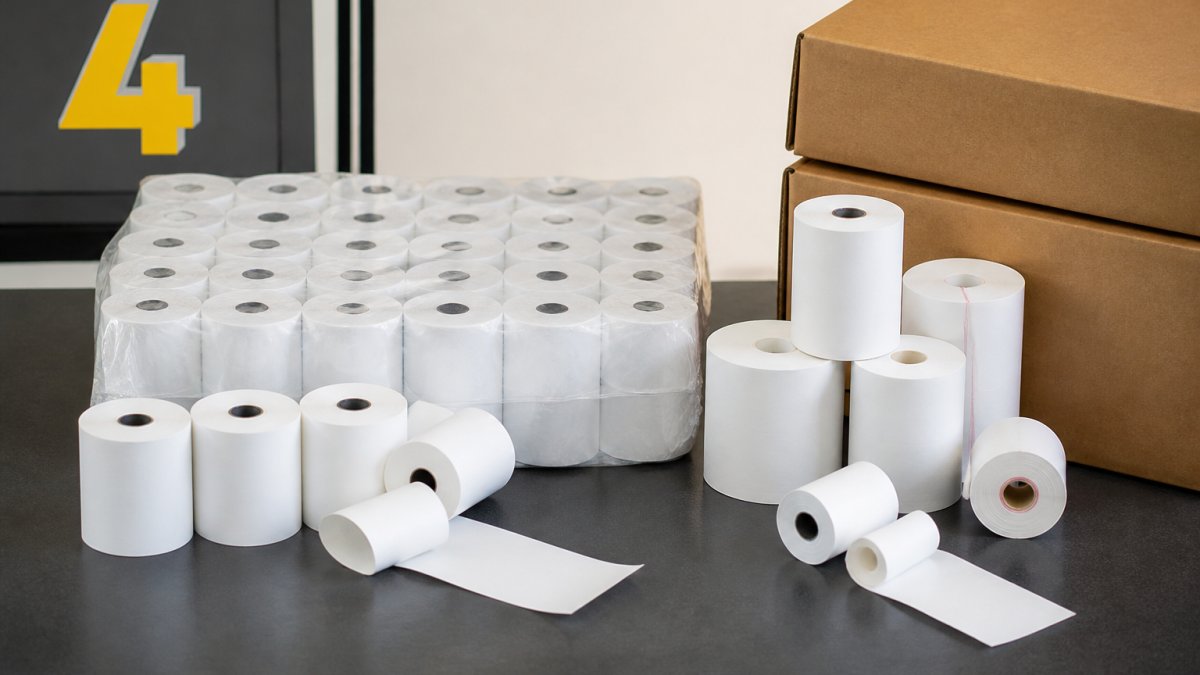
Cardboard and paper-based packaging is vulnerable to damp. Till rolls and receipt paper are especially sensitive: moisture and heat can affect how they feed and print.
Space is the real constraint. Before scaling up an order, measure where the stock will live and how you will move it.
Health and Safety Authority guidance on manual handling
Packaging Inventory Management: Keeping Bulk Stock Under Control
Packaging inventory management is how you track what you have, what you use, and when to reorder so you never run out and never over-order. Bulk stock only saves money if it is controlled.
A workable system needs three numbers per product: your average weekly use, your lead time from order to delivery, and a safety buffer for busy periods. Multiply weekly use by lead time, then add the buffer.
- Set a reorder point for every high-use item
- Rotate stock so oldest items are used first
- Review usage monthly and adjust quantities
- Keep one supplier for core consumables to simplify reordering
The biggest risk with bulk is tying up cash in stock you do not move. The second is running out because nobody checked. A simple reorder point solves both.
Decision Framework: Which Supply Model Fits Your Business?
Use volume, storage, and channel requirements to decide, not habit. There is no single right answer, but there is a clear fit for most operations, and the fit changes depending on what you sell and to whom.
The three questions that decide it
- How predictable is your usage? Steady daily use favours bulk. Spiky or seasonal use favours retail or a hybrid.
- How much space can you dedicate? If you cannot store a month of stock without blocking access or exposing it to damp, bulk will cost you more than it saves.
- Does your channel impose packaging rules? This is the question most buyers miss, and it can override the first two entirely.
Retail compliance and case-pack rules
If you supply retailers, your packaging is not just a cost decision, it is a compliance decision. Retailers commonly specify:
- Case pack quantities that match their shelf or pallet configuration, so a case of 12 may be required where a case of 10 is cheaper.
- Barcodes at both unit and case level, with the case barcode printed in the correct position and format.
- Labelling including product description, quantity, batch or best-before information, and country of origin where applicable.
- Shelf-ready or retail-ready formats that allow the case to be opened and placed directly on shelf without repacking.
- Pallet and layer specifications for distribution centres, including height limits and stacking rules.
Bulk packaging that does not meet these specifications may be unusable without repacking, which erases the unit-price saving and adds labour. Before committing to a bulk format, confirm the retailer's packaging specification in writing. If you sell only direct to consumers or through your own premises, these constraints do not apply, and bulk formats are far more flexible.
Fit by business type
| Business type | Typical best model | Why |
|---|---|---|
| Manufacturer or producer | Bulk, with buffer stock | High, predictable input use; space usually available |
| Wholesaler or distributor | Bulk, central store | Volume pricing is core to margin; distribution already in place |
| Ecommerce seller | Hybrid | Bulk for high-turnover lines, retail for slow or seasonal SKUs |
| Retailer with own shelves | Bulk for core, retail for niche | No external compliance rules, but shelf space is finite |
| Café, salon, or small service business | Retail or small-case bulk | Low usage, tight storage, cash flow matters more than unit price |
| Multi-site operator | Bulk plus central store | Consistent pricing and controlled distribution across sites |
A practical starting rule
If you use a product every day, buy it in bulk. If you use it occasionally, buy it as you need it. If you are somewhere in between, start with bulk on your top three items only and keep retail supply for the rest.
This is where a single supplier pays off. Shop4Rolls.ie stocks over 3,000 products, including the country's largest range of till rolls and card machine receipt rolls, so you can mix bulk and top-up items in one order.
Conclusion: Choosing the Right Packaging Supply Model
The right model comes down to how much you use, how much space you have, and how much control you want over your cash. Get those three right and the cost savings follow.
Shop4Rolls.ie makes the switch simple. We offer a lowest price guarantee, hassle-free restocking of everyday products, quick and easy online ordering, and reliable stock availability from our purpose-built warehouse. Our customer care team answers the phones when you need to confirm a size or a reorder.
Sign up now and keep your business moving forward.
Frequently Asked Questions
What is the difference between bulk and standard retail packaging supply?
Bulk packaging supply means ordering larger quantities of packaging materials, often at a lower per-unit cost, directly from a supplier or wholesaler. Standard retail supply involves buying smaller packs from a retail outlet or cash-and-carry, usually at a higher unit price. Bulk orders typically come with minimum order quantities and require storage space, while standard supply offers flexibility and immediate availability. The right choice depends on your order volume, storage capacity and how quickly you need stock.
Is buying packaging in bulk cheaper for a small business?
It can be, but only if your usage rate justifies the larger order. Bulk packaging usually lowers the per-unit cost, but you may face a minimum order quantity and need storage space. For a small business with steady, predictable usage, bulk can reduce long-term costs. If your usage is low or irregular, standard retail supply may be more cost-effective because you avoid tying up cash in stock that sits for months. Compare your monthly usage against the minimum order quantity before deciding.
What should retailers consider before placing a bulk packaging order?
Before ordering in bulk, check your storage capacity, the minimum order quantity for packaging, lead times and your expected usage over the next few months. Consider whether the per-unit savings outweigh the cost of holding extra stock and the risk of damage during storage. Also review supplier reliability and whether they can deliver consistently. A packaging cost comparison that includes freight and storage, not just the unit price, gives a clearer picture of the true cost.
How much storage space do bulk packaging supplies require?
Storage needs depend on the size and quantity of the packaging you order. Flat-packed boxes and polythene bags take up less room than pre-formed items. As a rule, calculate the cubic volume of a full order and compare it to your available dry, secure storage. Retail packaging storage requirements also include keeping stock away from damp, direct sunlight and pests. If you lack space, a smaller bulk order or a just-in-time arrangement with your supplier may work better.