 ultimate-guide
How to Reduce Retail Packaging Costs: A 2026 Guide
Table of Contents
- Understanding the True Cost of Your Packaging
- Right-Sizing Packaging to Match Your Products
- Optimising Material Usage and Reducing Waste
- Sourcing Best Wholesale Packaging Supplies
- Sustainable Packaging Solutions for Small Business
- Packaging Design Optimisation for Cost Efficiency
- Measuring and Tracking Your Packaging Savings
- Conclusion
Last Updated: August 29, 2026
Understanding the True Cost of Your Packaging
The real expense of packaging extends far beyond the unit cost of a box or roll. Most retailers focus narrowly on the price per item, missing the broader financial picture that includes storage, handling, damage, waste, and logistics. This is where understanding the true cost of your packaging becomes critical to reducing retail packaging costs effectively.
Total Cost of Ownership (TCO) captures everything: material costs, labour to handle and store inventory, warehouse space consumed, damage rates during transit, returns management, and even regulatory compliance. A cheaper box that damages easily, requires more protective padding, or takes up excessive warehouse space may ultimately cost significantly more than a slightly pricier alternative.
Shop4Rolls.ie helps retailers move beyond unit price comparison by offering a range of packaging solutions designed to optimise the entire supply chain. When you evaluate packaging decisions through a TCO lens, you're making strategic choices rather than reactive ones.
To start measuring your true packaging costs, gather data across these categories:
- Material costs (purchase price per unit)
- Storage and handling labour
- Warehouse space utilisation
- Damage and loss rates
- Return and replacement frequency
- Shipping weight and dimensional charges
- Setup and changeover costs
Once you have baseline numbers, you can identify where your biggest cost drivers sit. Many retailers discover that reducing inventory levels or improving storage density delivers more savings than negotiating a lower unit price.
Right-Sizing Packaging to Match Your Products
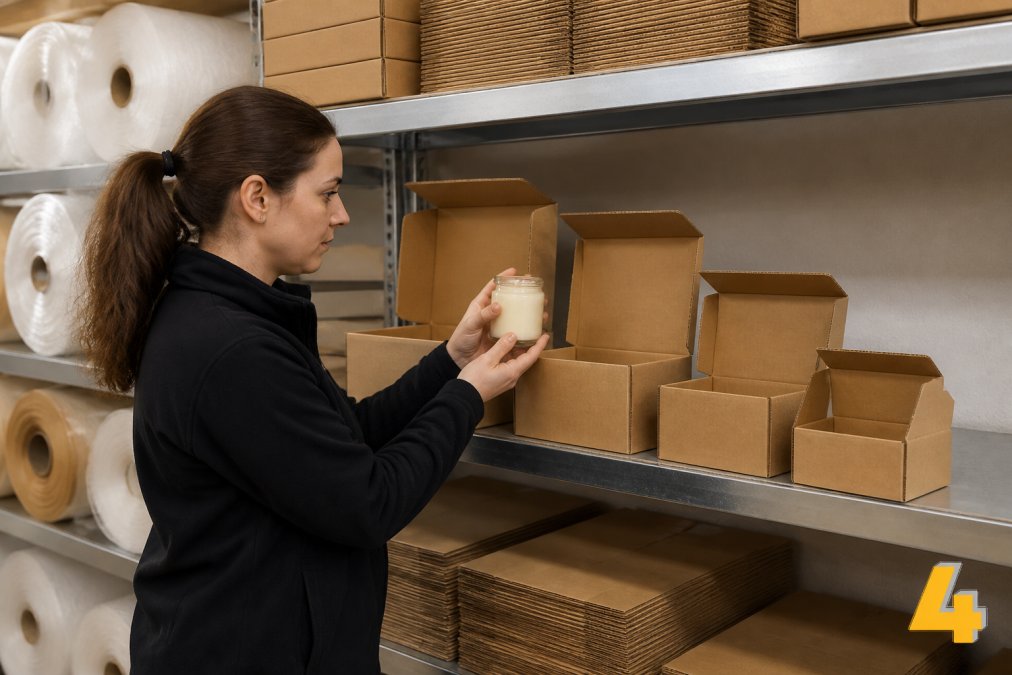
Right-sizing means selecting packaging dimensions that match your actual product with minimal excess space. Oversized packaging wastes material, increases shipping weight, consumes more warehouse space, and raises dimensional weight charges. Undersized packaging leads to damage and returns, which cost far more to manage than the material you'd have saved.
The principle is straightforward: the package should protect the product efficiently without significant empty space. For a shirt, this might mean a flat mailer rather than a box. For fragile items, it might mean a sturdy box with targeted protective padding rather than excessive filler.
To right-size effectively, start by auditing your current product-to-packaging ratios:
- Measure your most frequently shipped products
- Compare current packaging dimensions to product dimensions
- Calculate wasted space as a percentage
- Test smaller alternatives with a sample shipment
- Track damage rates and customer feedback
- Adjust specifications based on results
Dimensional weight pricing, where carriers charge based on package size rather than actual weight, makes right-sizing financially urgent. A package that's 20% oversized might trigger a 30-40% shipping surcharge. Over thousands of shipments, this compounds quickly.
Common mistakes include keeping packaging sizes standardised for convenience rather than product fit, and assuming larger packaging prevents damage when targeted protective materials do the job better. Retailers who invest time in packaging redesign typically see reductions in per-unit shipping costs.
Optimising Material Usage and Reducing Waste
Material waste in packaging operations occurs at multiple points: overordering that expires or becomes obsolete, damaged stock that can't be used, inefficient cutting or folding processes, and excess protective materials. Reducing waste directly lowers your cost per shipment and improves sustainability, a growing concern for customers.
Start by examining your current material usage patterns. Track how much protective packaging you use per shipment, how often you discard damaged or expired stock, and whether your packaging design creates unnecessary offcuts or waste during production.
Common optimisation strategies include:
- Consolidating SKU counts: If you stock five sizes of boxes when three would cover 95% of shipments, you're carrying unnecessary inventory and complexity. Standardising around core sizes reduces setup costs and improves warehouse throughput.
- Right-sizing protective materials: Many retailers use excessive bubble wrap, foam, or paper when strategic placement of smaller amounts works equally well. Test reduced protective material volumes to find the threshold where damage rates remain acceptable.
- Improving inventory turnover: Slow-moving packaging inventory ties up cash and warehouse space. Implement a reorder schedule that matches actual usage rates rather than bulk-discount purchasing that creates overstock.
- Reducing print finishes: Elaborate printing, custom colours, or specialty finishes add cost. Evaluate whether simpler designs deliver the same brand impact at lower expense.
Source reduction, using less material overall, is often more effective than switching to recycled alternatives. A smaller, lighter package made from standard materials frequently outperforms a larger package made from recycled content when you factor in total cost.
Sourcing Best Wholesale Packaging Supplies
Finding the right wholesale supplier is foundational to reducing retail packaging costs. The best supplier isn't necessarily the cheapest, it's the one that delivers consistent quality, reliable stock availability, competitive pricing on the products you actually use, and reasonable minimum orders.

When evaluating wholesale suppliers, compare across these dimensions:
| Criterion | What to Assess | Impact on TCO |
|---|---|---|
| Product Range | Do they stock your core materials in one place? | Reduces supplier fragmentation and ordering complexity |
| Pricing Structure | Transparent pricing vs. quote-based; volume discounts; minimum orders | Affects per-unit cost and cash flow |
| Stock Availability | Next-day delivery capability; backup stock for emergencies | Prevents costly rush orders and production delays |
| Quality Consistency | Defect rates; damage in transit; material specifications | Reduces returns and customer complaints |
| Minimum Orders | Do they serve small businesses or only large chains? | Determines feasibility for your operation |
| Support | Responsive customer service; technical guidance on sizing | Saves time troubleshooting issues |
Shop4Rolls.ie operates as a one-stop solution for Irish retailers, stocking over 3,000 products including till rolls, receipt paper, Jiffy bags, and protective packaging. The combination of cash-and-carry and e-commerce ordering means you can access next-day delivery without committing to large minimum orders, a significant advantage for smaller operations managing tight cash flow.
A common objection is switching suppliers. The perceived disruption cost often exceeds the actual switching cost. Most wholesale suppliers handle account setup and initial ordering within days. The real question is whether your current supplier's pricing and service justify staying, or whether consolidating suppliers actually simplifies your operation.
Sustainable Packaging Solutions for Small Business
Sustainable packaging, materials that are recyclable, compostable, or made from recycled content, appeals to environmentally conscious customers and increasingly aligns with regulatory expectations. The question for small retailers is whether sustainability adds cost or creates opportunity.
The answer depends on your market. If your customer base values sustainability and will pay a small premium or choose you based on environmental credentials, sustainable packaging can be a differentiator. If price is the primary driver and customers don't care, sustainable materials may not be worth the cost premium.
Sustainable alternatives worth evaluating:
- Recycled cardboard: Often costs more than virgin material but appeals to eco-conscious brands. Quality is comparable for most applications.
- Compostable mailers: Increasingly price-competitive with plastic alternatives, especially for smaller volumes. Require clear customer communication about disposal.
- Reduced-material designs: Switching from a five-layer box to a three-layer design cuts material cost while reducing environmental impact. Win-win scenarios exist if you're willing to test.
- Reusable packaging systems: Require customer participation and reverse logistics infrastructure, making them viable mainly for subscription or repeat-order models.
The regulatory environment is shifting toward mandatory sustainability requirements. The EU's Single-Use Plastics Directive and similar frameworks are influencing packaging standards across Ireland and the broader market. Staying ahead of these changes positions you to adapt without costly emergency redesigns.
Many retailers find that modest sustainability improvements, switching to recycled content, reducing excess packaging, or eliminating unnecessary print finishes, deliver both cost savings and environmental benefits simultaneously.
Packaging Design Optimisation for Cost Efficiency
Packaging design influences both material costs and operational efficiency. A poorly designed package might look good but create problems during fulfilment, storage, or transit. Strategic design optimisation balances aesthetics, functionality, and cost.
Start by auditing your current designs for unnecessary complexity:
- Structural elements: Do you need that fold, flap, or divider? Can you achieve the same function with simpler geometry?
- Print specifications: Are you using four-colour printing when two colours work? Can you reduce print area without losing brand identity?
- Material grade: Are you using heavier material than necessary for structural integrity? Thinner material costs less and reduces shipping weight.
- Customisation: Is custom sizing worth the setup cost, or would standard sizes with minor personalisation work?
Packaging automation ROI becomes relevant at scale. If you're manually assembling, folding, or packing items into custom packaging, automation equipment might pay for itself quickly. However, this applies mainly to larger operations; smaller retailers often find that standardised packaging from a reliable supplier eliminates the need for in-house assembly.
Test design changes incrementally. A reduction in material thickness, a simplified fold pattern, or a smaller print area might seem minor but compounds across thousands of shipments. Document the changes and track customer feedback and damage rates to ensure cost reduction doesn't compromise quality.
Measuring and Tracking Your Packaging Savings
Without measurement, you can't know whether your optimisation efforts are working. Establish baseline metrics before making changes, then track progress systematically.
Essential metrics to monitor:
- Cost per shipment: Total packaging cost divided by number of shipments. Track this monthly to spot trends.
- Damage rate: Number of damaged items returned as a percentage of total shipments. Lower damage rate justifies protective packaging investment.
- Inventory turnover: How quickly you move through packaging stock. Slower turnover ties up cash and warehouse space.
- Waste percentage: Unusable or discarded packaging as a percentage of total purchased. Target: under 5%.
- Shipping cost per unit: Total shipping cost divided by items shipped. This captures the impact of right-sizing and weight reduction.
- Storage density: How much packaging you fit into available warehouse space. Better density reduces rent or allows space for other inventory.
Set up a simple tracking system, a spreadsheet is sufficient, that captures these metrics monthly. Compare quarter-over-quarter to identify whether changes are delivering results.
Common measurement mistakes include tracking only material cost while ignoring labour and storage, or measuring savings without accounting for quality changes (e.g., higher damage rates offset cheaper packaging). True cost reduction requires holistic measurement.
Many retailers find that the biggest savings come not from negotiating lower prices but from reducing volume through right-sizing, standardisation, and waste elimination. A reduction in packaging per shipment, achieved through design optimisation, often exceeds a price reduction negotiated with suppliers.
Reducing retail packaging costs requires moving beyond unit price comparison to understand the total cost of your packaging system. By right-sizing to match products, optimising material usage, sourcing from reliable wholesale suppliers, and measuring progress systematically, you can achieve meaningful savings while maintaining quality and customer satisfaction.
Shop4Rolls.ie's approach, combining a vast product range with reliable next-day delivery and transparent pricing, eliminates the fragmentation that drives costs up for many retailers. Whether you're consolidating suppliers, redesigning packaging, or simply implementing better inventory management, the foundation is data-driven decision-making and a partner you can trust to support your operation consistently.
Start by auditing your current packaging costs across all dimensions. Identify your biggest cost drivers. Test one or two optimisations with measurable targets. Then scale what works. Small improvements compound quickly across thousands of shipments, and the time you invest in optimisation pays dividends month after month.
Irish Environmental Protection Agency guidance on packaging waste provides regulatory context for sustainable packaging decisions in your market. Sustainable Packaging Coalition resources offers frameworks for evaluating material alternatives. For operational best practices, Institute of Packaging Professionals guidelines covers design and efficiency standards used across the industry.
Frequently Asked Questions
What's the best way to calculate the true cost of packaging?
Total Cost of Ownership (TCO) includes the unit price of packaging materials, shipping weight impact on logistics, storage density in your warehouse, and damage rates during delivery. Many retailers focus only on material cost and miss a significant portion of actual expenses. Track these separately: cost per unit, cost per shipment, handling labour, and returns due to packaging failure. Review quarterly to identify trends.
How can small businesses reduce packaging waste and costs simultaneously?
Start with right-sizing: audit your current packaging against actual product dimensions. Oversized packaging inflates shipping weight and storage space. Next, standardise your SKU packaging sizes to reduce the variety you stock. Finally, switch to best wholesale packaging supplies that offer bulk discounts without forcing you to buy excessive quantities. Many small retailers save by consolidating suppliers and eliminating duplicate stock.
What's the difference between sustainable packaging solutions for small business and standard packaging?
Sustainable packaging uses recycled or biodegradable materials, often reducing your environmental footprint. The cost difference is narrowing: recycled cardboard and kraft paper now cost only slightly more than virgin materials. Benefits include lower disposal fees, potential tax incentives, and stronger customer loyalty. For small businesses, the real saving comes from source reduction (using less material) rather than switching material type alone.
How does packaging design optimisation actually reduce shipping costs?
Lighter packaging reduces dimensional weight charges from carriers. Compact design lowers storage density requirements, freeing warehouse space. Better protective design reduces damage claims and returns, cutting reverse logistics costs. Standardised packaging specifications reduce setup time and labour. A well-optimised design can cut total shipping volume without compromising product protection.
Should I switch suppliers to reduce packaging costs, and what's the actual risk?
Switching has real costs: account setup, staff training, system integration, and the risk of service disruption. However, consolidating multiple suppliers into one wholesale provider typically saves on unit costs and eliminates duplicate ordering. Evaluate based on your current supplier's responsiveness, your inventory turnover, and whether you can absorb a brief transition period. Request a trial order before committing.
What's the ROI timeline for investing in packaging automation?
Packaging automation (machines for sealing, labelling, or filling) has high upfront costs but pays back over time if you ship high volumes weekly. For smaller volumes, outsourcing packaging or using pre-assembled materials is more cost-effective. Calculate your labour savings against equipment cost, including maintenance. Many small retailers find that optimising manual processes first, right-sizing, material reduction, supplier consolidation, delivers faster returns.
This article was written using GrandRanker