 listicle
Benefits of Buying Wholesale Till Rolls
Table of Contents
- Why Buying Wholesale Till Rolls Makes Business Sense
- Cost-Efficiency and Per-Unit Savings
- Operational Reliability and Stock Management
- Is There a Minimum Order Quantity for Wholesale Till Rolls?
- How to Choose the Right Till Roll Size for Your Business
- Thermal Paper Roll Storage Best Practices
- Calculating ROI: When Bulk Purchasing Pays Off
- Conclusion
Last Updated: August 28, 2026
Why Buying Wholesale Till Rolls Makes Business Sense
Retail operations depend on consistent, reliable till roll supplies. Yet many business owners order small quantities from whoever's convenient and pay premium prices for the privilege. Buying wholesale till rolls transforms how you manage costs, inventory, and operational continuity, it's about building predictability into your supply chain, reducing restocking friction, and freeing up cash for other business needs.
At Shop4Rolls.ie, we work with hundreds of retailers across Ireland who've made this shift. Once they switch to wholesale purchasing, they wonder why they didn't do it sooner. This guide covers why that happens, what the real financial impact looks like, and how to navigate bulk purchasing without common pitfalls.
Cost-Efficiency and Per-Unit Savings
The per-unit cost difference between retail and wholesale is compelling. When you buy till rolls individually or in small quantities, you're paying a markup that reflects retailer overhead, storage, and logistics. Wholesale pricing strips away those layers.
A café ordering 10 rolls monthly at retail prices pays significantly more per roll than a venue ordering 200 rolls at wholesale rates. Wholesale suppliers often offer free or flat-rate delivery on bulk orders, whereas small orders attract per-unit shipping charges that inflate the final cost. You also know exactly what you'll pay for three months' supply without price fluctuations or surprise surcharges, improving cash flow predictability.
Buying wholesale in advance lets you stock up during quieter periods without pressure for last-minute, premium-priced emergency orders.
Operational Reliability and Stock Management

Running out of till rolls mid-shift damages customer experience and grinds transactions to a halt. Wholesale purchasing eliminates this risk by building a buffer into your inventory. When you buy in bulk, you maintain stock depth that absorbs unexpected demand spikes or temporary supply delays.
Wholesale suppliers like Shop4Rolls.ie maintain larger inventories precisely because they serve multiple customers, with typically higher stock availability than smaller retailers. Consistent supply from a single wholesale provider means your staff uses the same roll dimensions, coating specifications, and paper quality, preventing subtle problems that emerge when sourcing from multiple suppliers.
Is There a Minimum Order Quantity for Wholesale Till Rolls?
Most wholesale suppliers impose a minimum order quantity, but it's rarely the barrier business owners fear. The minimum typically reflects what's economically sensible to ship, usually between 20 and 100 rolls depending on the supplier and roll size.
For a small café using 10 rolls per month, a 20-roll minimum means ordering every two months. For a larger venue using 50 rolls monthly, a 100-roll minimum represents two months' supply. These minimums align with natural purchasing cycles for most businesses.
Shop4Rolls.ie maintains stock flexibility because we serve the full spectrum of Irish retailers, from single-location independents to multi-branch chains. Our minimum order quantities accommodate genuine small businesses without forcing excessive inventory that ties up working capital.
How to Choose the Right Till Roll Size for Your Business
Till roll dimensions matter more than most business owners realise. The two most common sizes are 80mm x 70mm and 80mm x 80mm. The 80mm x 70mm roll is the standard for most modern EPOS systems and card machines. The 80mm x 80mm roll is larger in diameter, lasting longer before requiring a change, but only fits equipment specifically designed for the larger diameter.
Choosing correctly is straightforward: check your equipment manual or the specification label on your existing till roll. Thermal paper rolls come in different coating specifications too. Standard thermal coating works for most receipts, while BPA-free thermal coating is increasingly common for health and environmental reasons.
When buying wholesale, confirm the exact specification with your supplier before placing a large order. Shop4Rolls.ie's customer care team can verify your equipment type and recommend the correct roll specification, eliminating guesswork that leads to costly mistakes.
Thermal Paper Roll Storage Best Practices
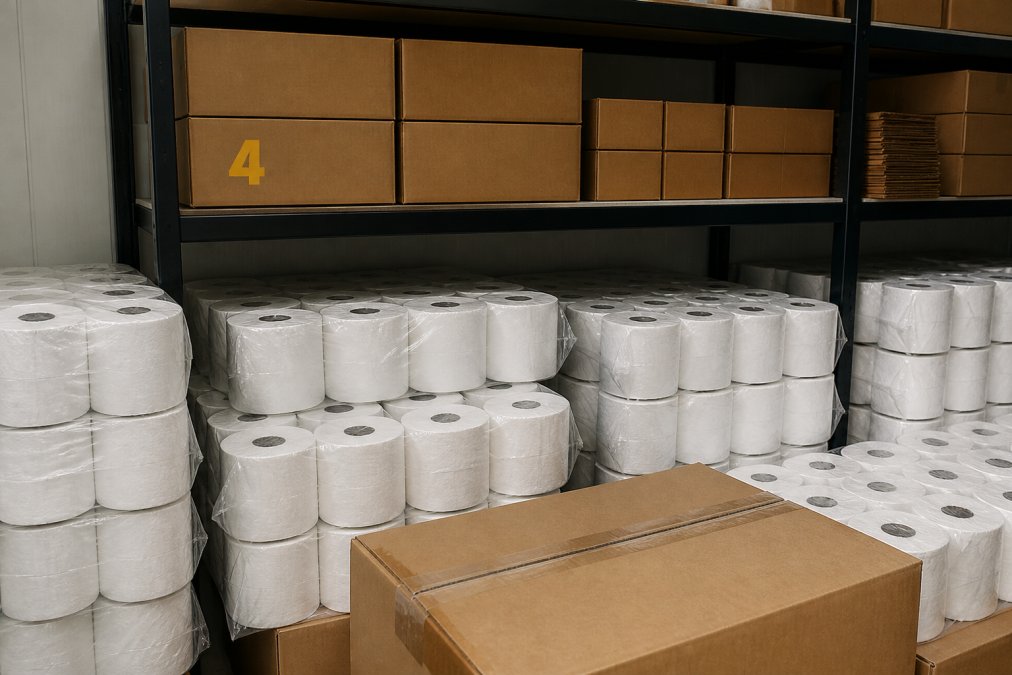
Thermal paper is chemically sensitive in ways that directly undermine wholesale purchasing economics. The thermal coating reacts to heat to produce the receipt image, but that same coating degrades when exposed to heat, humidity, light, or oxidation. Poor storage can render rolls unusable before consumption, turning cost savings into waste.
Temperature sensitivity is the primary concern. Thermal coatings begin to fade noticeably above 25°C and accelerate degradation significantly above 30°C (peer-reviewed research on thermal paper degradation). The ideal storage temperature is 15-25°C, with 20°C as the sweet spot. Keep rolls away from radiators, boilers, direct sunlight, and kitchen heat sources. If your storage area is in or adjacent to a kitchen, consider a separate cool cupboard or sealed storage cabinet with passive cooling.
Humidity control is equally critical. Thermal paper absorbs moisture in humid environments (above 65% relative humidity), causing the coating to become oversensitive (peer-reviewed research on thermal paper degradation). Receipts fade within days of printing rather than weeks or months. If your storage area is naturally damp, use silica gel packs or a small dehumidifier to maintain humidity below 60%.
Light exposure accelerates fading through UV radiation and ambient light. Keep rolls in their original cardboard packaging until use; the packaging provides physical protection and light buffering.
Stacking and pressure matter more than many retailers realise. Vertical stacking (rolls standing upright) prevents deformation that causes paper jams. Use shelving that distributes weight evenly and avoid stacking rolls more than 1.5 metres high.
Shelf-life in practice depends on storage conditions. Under ideal conditions (15-25°C, 45-60% humidity, no light exposure), thermal paper remains usable for 2-3 years. Under poor conditions, shelf-life drops to 6-12 months. For most businesses, a 3-month supply is the comfortable upper limit; for high-volume venues, 6 months is acceptable if storage conditions are controlled.
Stock rotation discipline is essential. When new rolls arrive, place them at the back of your storage area and use older stock first (FIFO: first in, first out). Label boxes with the delivery date so staff can identify which rolls to use first.
Calculating ROI: When Bulk Purchasing Pays Off
The financial case for wholesale till roll purchasing is compelling for most businesses. Working through the numbers for your specific situation reveals exactly how much you'll save.
Step 1: Calculate your current monthly spend. Gather till roll invoices from the last three months and calculate an average. If you don't have recent invoices, estimate based on usage: multiply the number of rolls you use per week by 4.3 (average weeks per month), then multiply by the per-roll price you currently pay.
Example: A small café uses 8 rolls per week at €2.50 per roll (retail price). Monthly spend = 8 × 4.3 × €2.50 = €86.
Step 2: Obtain a wholesale quote. Contact a wholesale supplier and request a quote for the same monthly volume. Ask for the per-unit cost and total cost for a bulk order (typically 3 months' supply).
Example: The same café receives a wholesale quote of €1.80 per roll for a 100-roll order. Monthly equivalent cost = €1.80 × 34.4 rolls per month = €61.92.
Step 3: Calculate monthly and annual savings.
Monthly saving = €86 − €61.92 = €24.08 Annual saving = €24.08 × 12 = €288.96
This represents a 28% reduction in till roll costs, which is typical for small businesses switching to wholesale.
Step 4: Account for setup costs or changes in ordering frequency. If switching suppliers requires no investment beyond time, your ROI is immediate. If there are minimal setup costs, calculate the payback period:
Payback period (months) = Setup cost ÷ Monthly saving
Example: If account setup takes 2 hours of staff time at €15/hour (€30 cost), payback = €30 ÷ €24.08 = 1.25 months.
When wholesale purchasing is not worth it:
-
Very low usage: If you use fewer than 5 rolls per month, minimum order quantities may force excessive inventory, risking thermal degradation before use.
-
Unreliable storage conditions: If you cannot maintain proper storage temperature and humidity, thermal paper degrades faster, reducing shelf-life from 2-3 years to 6-12 months.
-
Inconsistent demand: If till roll usage fluctuates significantly, bulk purchasing may leave excess stock that degrades.
-
Supplier reliability concerns: If your wholesale supplier has inconsistent delivery times or quality issues, operational savings may be offset by disruption costs.
Real-world break-even thresholds:
-
Monthly spend under €50: Wholesale savings are modest. Setup effort and working capital considerations may outweigh the benefit.
-
Monthly spend €50-€150: Wholesale purchasing typically pays for itself within 1-3 months. This is the "sweet spot" for small independent retailers and hospitality venues.
-
Monthly spend €150-€500: Wholesale purchasing delivers substantial annual savings (€300-€2,000+). The financial case is compelling.
-
Monthly spend above €500: Wholesale purchasing is essential. Even a 15% discount translates to €900+ annual savings.
Conclusion
Wholesale till roll purchasing addresses a fundamental business need: keeping your operations running smoothly while controlling costs. The per-unit savings are real, the supply reliability is tangible, and the operational simplification is immediate.
Shop4Rolls.ie's purpose-built warehouse, lowest price guarantee, and next-day delivery mean you can access wholesale pricing without traditional bulk purchasing friction. Our customer care team handles the technical details, confirming your roll size, verifying specifications, and ensuring your first order arrives ready to use. Start with Shop4Rolls.ie's till rolls selection and see how much your business can save.
Frequently Asked Questions
How much can businesses save by purchasing till rolls in bulk?
Savings depend on your current purchase volume and supplier pricing. Buying wholesale till rolls typically reduces per-unit cost significantly compared to retail purchases. The larger your order, the greater the discount. To see exact savings on your specific products and order volumes, check current pricing on Shop4Rolls.ie and compare against your existing supplier's rates using the lowest price guarantee.
Is there a minimum order quantity for wholesale receipt rolls?
Minimum order quantities vary by supplier and product type. Many wholesalers offer flexible ordering to suit businesses of all sizes, from small cafés ordering just a few boxes monthly to large retail chains. Shop4Rolls.ie serves businesses at every scale. Contact the customer care team or check the product pages to confirm minimum orders for your specific till roll size and quantity needs.
What is the shelf life of thermal till rolls when stored in bulk?
Thermal paper rolls typically have a shelf life of 2-3 years when stored correctly in cool, dry conditions away from direct sunlight, heat, and moisture. Proper storage is essential to maintain print quality and prevent fading. Follow best practices for thermal paper roll storage to maximise the lifespan of your bulk stock.
How do I determine the correct till roll size for my card machine or EPOS system?
Check your equipment's documentation or the existing roll currently in use, the width and diameter are usually printed on the packaging or the roll itself. Common sizes include 80mm x 70mm and 80mm x 80mm. If unsure, measure your current roll or contact the equipment manufacturer. Shop4Rolls.ie's customer care team can help you identify the correct size before ordering to avoid mistakes and returns.
This article was written using GrandRanker