 listicle
Essential Retail Supplies for New Shops: 2026 Checklist
Table of Contents
- The Essential Retail Supplies Checklist for a New Shop
- Choosing Wholesale Till Rolls Ireland Suppliers Can Rely On
- Retail Shop Fittings Checklist: What to Buy Before You Open
- Retail Packaging Supplies Wholesale: Bags, Boxes and Wrapping
- Budgeting and ROI for Your First Equipment Order
- Sustainability and Omnichannel: Two Angles New Shops Miss
- Maintenance and Lifecycle: Keeping Supplies Flowing
- Frequently Asked Questions
Last Updated: September 16, 2026
The Essential Retail Supplies Checklist for a New Shop
Opening a new shop means every euro counts, and a smooth launch comes down to ordering the right retail supplies before day one. This guide covers the essentials, from point of sale hardware to packaging and signage.

Point of Sale and Transaction Essentials
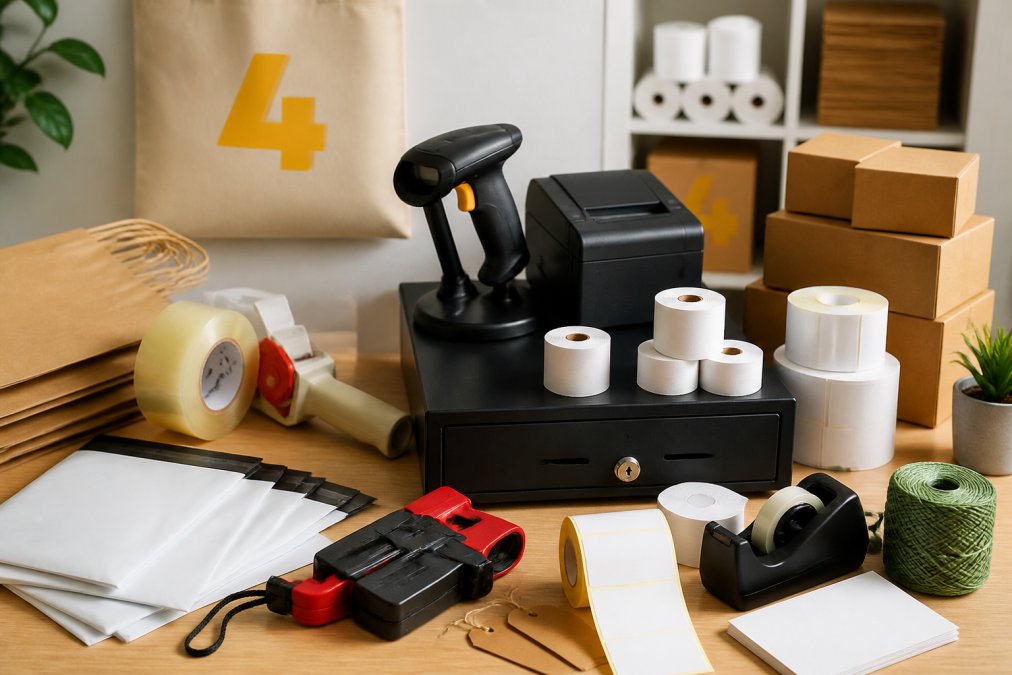
A working checkout is non-negotiable. Your point of sale setup needs a card machine or terminal, a receipt printer, a cash drawer, and thermal till rolls that match your hardware. Getting the roll size wrong is one of the most common mistakes new shop owners make.
- Card machine or payment terminal
- Receipt printer and compatible till rolls
- Lockable cash drawer
- Barcode scanner
- POS software subscription
Display and Merchandising Must-Haves
Shelving and display units shape how customers move through your store. Slatwall panels, gondola shelving, countertop display stands, and mannequins form the backbone of retail fixtures. Pair these with price tagging systems, shelf-edge label holders, and shelf talkers to keep products organised and encourage browsing.
- Slatwall panels and accessories
- Gondola or metal shelving units
- Countertop display cases
- Price tag holders and shelf talkers
- Signage holders for promotions
Choosing Wholesale Till Rolls Ireland Suppliers Can Rely On
Reliability separates a good supplier from a frustrating one. When you buy wholesale till rolls in Ireland, you need consistent stock availability, correct roll specifications, and delivery you can plan around. Running out of receipt paper on a busy Saturday stops your checkout entirely.
| Supply Need | What to Check | Why It Matters |
|---|---|---|
| Till rolls | Width, diameter, core size | Prevents printer jams |
| Card machine rolls | Terminal model match | Keeps payments running |
| Packaging | Order volume and lead time | Avoids stockouts |
| Signage | Durability for footfall | Reduces replacement costs |
Matching Rolls to Your Card Machine and POS Printer
Thermal paper rolls come in several standard sizes, and matching the roll to your hardware prevents wasted orders. Check three measurements: roll width, roll diameter, and core diameter. A roll that's too wide won't fit the printer housing, while one with the wrong core will spin loosely and feed unevenly. Most suppliers list compatible terminal models.
Retail Shop Fittings Checklist: What to Buy Before You Open
Shop fittings cover everything from the checkout counter to the shelving that holds your stock, and they are usually the largest capital line in a new shop's opening budget. A complete checklist includes:
- Checkout counter with space for POS hardware, a card machine and a bagging area
- Shelving units sized to your product dimensions and load weight
- Display stands for featured or seasonal items
- Fitting rooms if you sell clothing
- Storage racks for back-of-house stock
- Floor signage and directional markers
- A stockroom workbench for unpacking and pricing deliveries
Measure Before You Order
Measure your floor space before ordering anything, and measure the actual product you intend to display. Fittings that look right in a catalogue can overwhelm a small retail environment, and returns on bulky items are expensive.
Three measurements matter most:
- Aisle width. Allow at least 1.2 metres for a main customer aisle and 900 mm for secondary aisles. Anything narrower and two shoppers cannot pass without turning sideways, which suppresses browsing.
- Shelf depth. Standard gondola shelving is typically 300 mm to 600 mm deep. Deep shelves suit bulky goods; shallow shelves stop small products disappearing into a row.
- Load rating. Check the uniform distributed load per shelf, usually printed on the specification. A shelf rated for 50 kg will bow under a stack of tinned goods or bottled drinks.
Accessibility and Fire Safety
Fittings are not purely a merchandising decision. Under the Equal Status Acts, a shop providing goods to the public must make reasonable provision so that a person with a disability can access those goods.
Budget Tiers for Fittings
Fittings costs vary enormously depending on whether you buy new, buy ex-display, or lease a fitted unit. Split the spend into three tiers:
| Tier | What It Covers | Typical Approach |
|---|---|---|
| Startup | Second-hand gondola bays, basic wall shelving, a simple counter | Buy ex-retail stock or auction lots; accept cosmetic wear |
| Established | New modular shelving, branded counter, professional signage | Buy new from a shopfitting supplier with a warranty |
| Premium | Bespoke joinery, integrated lighting, custom display cases | Commission a shopfitter; expect a lead time of several weeks |
The Order of Operations
Fit out in this sequence to avoid rework:
- Confirm the lease, insurance and fire risk assessment are in place.
- Measure and draw the floor plan.
- Install wall-fixed shelving and any electrical work first.
- Position freestanding gondola runs and display stands.
- Install the counter and run cabling for the POS, card machine and receipt printer.
- Add signage, price tag holders and shelf talkers last.
Doing the counter before the shelving is a common mistake: the counter position determines where customers queue, which determines where impulse-purchase displays should sit.
Retail Packaging Supplies Wholesale: Bags, Boxes and Wrapping
Packaging is where customer experience meets operational efficiency, and where new shop owners most often overspend without noticing. Retail packaging supplies bought at wholesale include carrier bags, tissue paper, boxes, jiffy bags, and polythene bags for shipping. For shops handling online orders alongside in-store sales, packaging stock disappears faster than expected.
The Sustainability Angle Most Guides Skip
Most retail supply guides treat packaging as a commodity: buy bags, buy boxes, move on. That misses two things that affect both your costs and your customers' perception of your shop.
Choosing Between Paper, Reusable and Polythene
| Option | Best For | Trade-off |
|---|---|---|
| Paper carrier bags | General retail, gifting, food | Higher unit cost, not waterproof |
| Reusable woven or cotton bags | Branded merchandise, premium positioning | Highest unit cost, but customers keep and reuse them |
| Recyclable plastic bags | High-volume, low-margin retail | Subject to the levy; must be itemised and remitted |
| Polythene mailing bags | Online order fulfilment | Lightweight and weatherproof, but poor kerbside recyclability |
| Cardboard boxes | Shipping, fragile goods | Bulky to store; buy flat-packed where possible |
A practical approach is to stock two bag sizes in paper or reusable for in-store use, and keep a separate, clearly labelled packaging station for online orders. Mixing the two stocks is how shops end up using premium retail bags to ship a single low-value item.
Waste and Packaging Obligations
If your shop handles packaging, you may fall within the scope of extended producer responsibility rules for packaging waste, which place obligations on businesses that place packaging on the market. Thresholds and registration requirements have changed in recent years, so don't assume packaging is a purely commercial decision with no reporting attached.
Wholesale Buying Mechanics
Buying retail packaging supplies wholesale reduces per-unit cost, but watch minimum order quantities. Smaller shops should balance bulk savings against storage space and cash flow. Three rules of thumb:
-
Calculate cost per unit, not cost per box. A larger carton at a lower headline price can be worse value if the bags inside are thinner or smaller.
-
Check the lead time, not just the price. Packaging that arrives three weeks late is more expensive than packaging that costs 10% more and arrives on time.
-
Store paper and cardboard off the floor. Damp packaging tears, jams and looks unprofessional at the till.
-
Paper and reusable carrier bags
-
Tissue paper and wrapping
-
Cardboard boxes in multiple sizes
-
Jiffy bags for fragile items
-
Polythene bags for weatherproofing
-
A till line for recording any leviable bags
Budgeting and ROI for Your First Equipment Order
Your first equipment order is a capital decision, not a grocery run. Split spending into three buckets: one-time hardware (POS terminal, shelving, signage), recurring consumables (till rolls, bags, receipt paper), and software subscriptions. Hardware costs hit once; consumables repeat monthly.
Sustainability and Omnichannel: Two Angles New Shops Miss
Two operational areas separate shops that scale from those that stall. The first is sustainability: customers increasingly notice packaging choices, and eco-friendly bags, recyclable boxes, and reduced plastic use influence buying decisions. Sustainable packaging also aligns with waste reduction regulations that apply to retail businesses.
- Choose recyclable or reusable packaging where possible
- Track packaging waste and adjust order volumes
- Connect POS inventory to online sales channels
- Use one stock system across all sales points
Maintenance and Lifecycle: Keeping Supplies Flowing
Supplies run out quietly until they don't. Set reorder points for consumables based on your average weekly usage, and review them monthly.
Frequently Asked Questions
What equipment is legally required to open a retail shop?
You need a functioning POS system for transactions, a card payment terminal, and a secure cash drawer. Revenue requires you to issue receipts, so a thermal receipt printer and till rolls are essential. If you sell food, you may need a food safety certificate. You also need appropriate insurance and, depending on your premises, planning permission. Check with your local authority and Revenue for specific requirements.
How do I choose the right till rolls for my POS system?
Check your printer model's specification for roll width, diameter, and core size. Common widths are 57mm and 80mm. Using the wrong size can jam the printer or damage the print head. If you're unsure, measure an empty roll from your current setup or check the printer manual. Buying from a supplier that stocks a wide range of thermal rolls reduces the risk of ordering the wrong size.
What are the essential packaging supplies for small retail businesses?
At minimum, you need carrier bags in a few sizes, tissue paper for fragile items, and boxes or mailers if you ship orders. For clothing, add garment bags. For food, use greaseproof paper and food-safe containers. Buying retail packaging supplies wholesale lowers your per-unit cost. Start with a small range and expand based on what customers actually need.
How can I streamline my retail supply procurement process?
Consolidate orders with one supplier that stocks till rolls, packaging, and shop fittings. This cuts delivery times and admin work. Set up a standing order for high-use items like receipt paper and bags so you never run out. Keep a simple inventory sheet and reorder when stock hits a set level. A one-stop supplier with next-day delivery makes this much easier to manage.
Opening a shop is demanding enough without supply problems slowing you down. Shop4Rolls.ie gives you one place to restock till rolls, card machine receipt rolls, and packaging supplies, with a lowest price guarantee, next-day delivery from a purpose-built warehouse, and a customer care team that answers the phone. Sign up now and keep your business moving forward.