 ultimate-guide
Best Thermal Paper Rolls for High Volume Retail in 2026
Table of Contents
- What Separates the Best Thermal Paper Rolls for High Volume Retail
- Quick Comparison: Thermal Paper Rolls for High Volume Retail
- How to Measure Till Roll Diameter Accurately
- BPA-Free Thermal Paper Benefits for Retailers
- Thermal Paper Roll Storage Best Practices
- Total Cost of Ownership: What High Volume Retailers Actually Save
- Choosing the Right Thermal Paper Rolls for Your Retail Environment
- Frequently Asked Questions
Last Updated: September 15, 2026
What Separates the Best Thermal Paper Rolls for High Volume Retail
The best thermal paper rolls for high volume retail combine a high-sensitivity thermal coating, consistent GSM, and a tight core, the factors that decide whether a till roll lasts a full shift or fails mid-rush. This Shop4Rolls.ie guide covers buying thermal paper rolls by the pallet.
The cheapest roll per case is rarely the cheapest per receipt: jams, fading, and short rolls cost staff time, reprints, and frustrated customers, and at hundreds of transactions a day that gap adds up fast.
Thermal Coating, Image Density and Printhead Longevity
Thermal coating is the chemical layer that darkens when the printhead heats it. Image density is how dark and sharp that mark is; printhead longevity is how many million lines the head survives.
A poor coating forces the printhead to run hotter, wearing it faster and producing lighter, patchier text. A quality coating prints crisp at lower energy settings, extending printhead life and reducing paper dust.
Paper Thickness, GSM and Dust Control
GSM (grams per square metre) measures paper thickness and density. Standard till rolls sit around 48-55gsm; heavier 60-70gsm stock feels sturdier but needs a printer that can handle it.
Thicker paper isn't automatically better: a heavy roll through a printer calibrated for lighter stock causes feed problems and jams. The right GSM is the one your printer's OEM specifications call for.
Dust control matters too. Cheap paper sheds coating particles that collect on the printhead and cause streaking; low-dust thermal paper keeps the head clean longer and cuts maintenance downtime.
Quick Comparison: Thermal Paper Rolls for High Volume Retail
| Option | Best For | Key Strength | Watch Out For |
|---|---|---|---|
| Shop4Rolls.ie Thermal Till Rolls | High-volume retail, wholesale orders | Largest range of till rolls and card machine receipt rolls, lowest price guarantee | Pricing requires a quote |
| Hansol Thermal Paper Rolls | Large retail chains wanting consistency | High-brightness surface, strong archival properties | Sold mainly through distributors |
| TK Thermal King Receipt Paper | Compact card terminals | Wide terminal compatibility, jam-free performance | Limited to specific sizes |
| PaperRollsPlus Linerless Labels | Retailers needing receipts and labels | Linerless design cuts waste | Needs compatible printer settings |
For most Irish retailers buying in bulk, Shop4Rolls.ie is a strong starting point: the country's largest range of till rolls and card machine receipt rolls, stock in a purpose-built warehouse, and a lowest price guarantee. Pricing is available on the website.
How to Measure Till Roll Diameter Accurately
To measure till roll diameter accurately, lay the roll flat and run a tape measure across the widest point of the wound paper, outer edge to outer edge, excluding the core. Record it in millimetres, repeat at three points, and take the largest reading, an out-of-round roll can measure 1-2mm differently depending on where you place the tape.
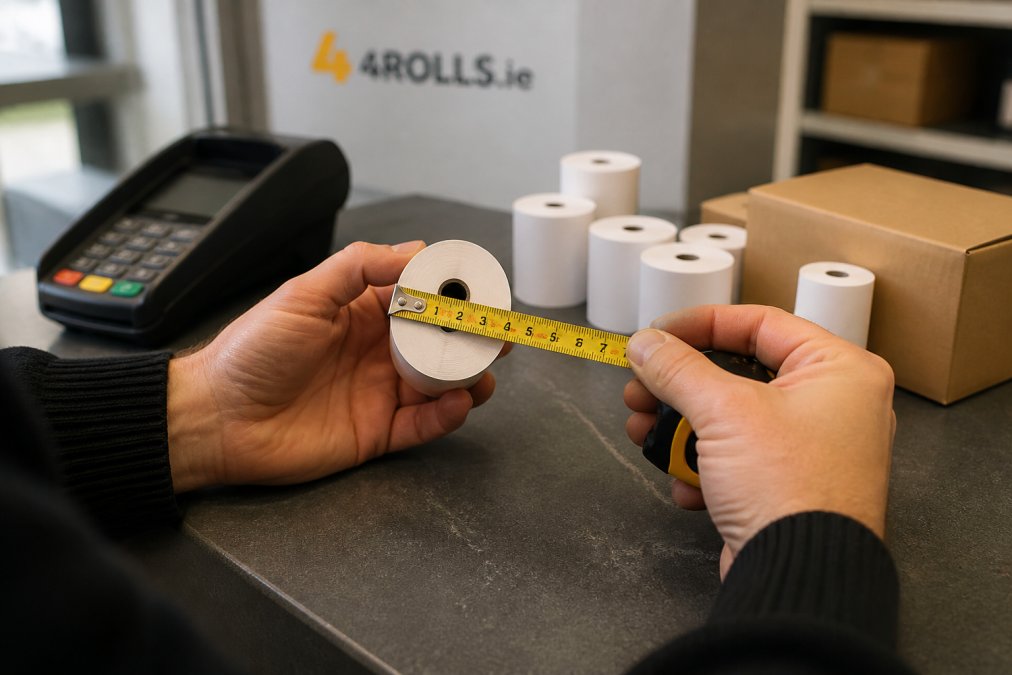
Three measurements matter when you reorder:
- Roll diameter: the full outer width of the wound paper, in millimetres
- Paper width: the width of the roll face, such as 80mm or 57mm
- Core size: the inner cardboard tube, commonly 12mm or 25mm
Get any one of these wrong and the roll either won't fit the spindle or won't sit in the printer bay.
Why Diameter Alone Doesn't Tell You What You're Buying
The trap is assuming a bigger roll means more receipts. Diameter is only one of three variables determining paper length, alongside paper width and GSM.
An 80mm x 80mm roll at 48gsm holds noticeably more linear metres than the same roll at 70gsm, because heavier paper takes up more space per turn. Two rolls can share an identical diameter yet differ by 20-30% in receipts, so comparing on diameter or case price alone misleads.
To compare like for like, ask the supplier for the linear metre count per roll, not just dimensions. Reputable trade suppliers publish this; if a supplier can't tell you the metre count, that tells you how well they know their stock.
Matching Roll Dimensions and Core Size to Your Printer
Check the printer's model number against the roll dimensions before ordering: most counter-mounted till printers take 80mm x 80mm rolls, while handheld card terminals typically use 57mm x 40mm.
Core size is the detail people miss: a 25mm core roll won't fit a printer built for a 12mm core, even when the outer diameter matches. Wrong core size is a leading cause of a roll that "doesn't fit" when it should.
Two further fit variables matter before you commit to a pallet:
- Maximum roll diameter the bay accepts. A printer rated for 80mm diameter will not close its lid on a 90mm roll, even if the width and core are correct. Oversized rolls are a common cause of lid strain and feed motor wear.
- Spindle or drop-in loading. Some terminals use a spindle through the core; others drop the roll into a cradle. Spindle printers are less tolerant of a core that is even slightly undersized, because the roll spins on the spindle rather than the cradle.
A Quick Spec-Matching Routine for Reorders
When setting up a reorder, work through this in order and keep the answers on file:
- Note the printer make and model from the label on the base.
- Note the required paper width (usually 80mm or 57mm).
- Note the required core size (usually 12mm or 25mm).
- Note the maximum roll diameter the bay accepts.
- Note the GSM range the manufacturer specifies.
- Record the linear metres per roll from the supplier's spec sheet.
- Calculate cost per linear metre, not cost per case.
That last step changes buying decisions: a case that looks 10% cheaper per roll but delivers 20% fewer metres costs more per receipt, before jams or reprints.
BPA-Free Thermal Paper Benefits for Retailers
BPA-free thermal paper removes bisphenol A from the coating, so staff handling rolls all day aren't absorbing it through their skin. BPA is a known endocrine disruptor, and till staff handle receipts constantly, making the switch a straightforward health measure.
The benefits go beyond staff safety: BPA-free rolls are increasingly the default for retailers ahead of customer expectations on chemical exposure, and perform as well as standard coated paper when coating quality is good.
Environmental Impact and Recycling
Standard thermal paper is hard to recycle because the coating and BPA contaminate the pulp stream. BPA-free and phenol-free rolls are easier to process, and linerless options cut waste per transaction.
Thermal Paper Roll Storage Best Practices
What Actually Degrades Thermal Paper
The main culprits in a retail back office:
Practical Storage Rules for High-Volume Retail
Stock Rotation and the Hidden Cost of Over-Ordering
A workable rotation policy for a busy retail operation:
Durability and Image Retention Standards
Total Cost of Ownership: What High Volume Retailers Actually Save
Troubleshooting Common Printer Issues
Quick fixes worth trying before you call an engineer:
Choosing the Right Thermal Paper Rolls for Your Retail Environment
Work through this before you order:
Frequently Asked Questions
What are the disadvantages of thermal paper rolls?
Thermal paper rolls can fade over time if exposed to heat, sunlight or friction, and some standard coatings contain BPA. Paper dust from low-quality rolls can also build up on printheads and shorten printer life. Choosing BPA-free thermal paper with a smooth surface and storing rolls correctly reduces these issues for high volume retail use.
How do I determine the correct till roll size for my printer?
Check your printer or POS manual for the paper width (commonly 57mm or 80mm), roll diameter and core size. Measure an existing roll with a ruler if the manual is missing. Getting these three measurements right prevents jams and wasted stock, and it is the first step before buying thermal paper rolls in bulk.
How should thermal paper rolls be stored to prevent fading?
Keep rolls in a cool, dry place away from direct sunlight, heat sources and moisture. Store them in their original packaging until use, and avoid stacking heavy items on top. These thermal paper roll storage best practices protect image density and keep receipts readable for longer.
Are there eco-friendly thermal paper options available for retail?
Yes. BPA-free thermal paper rolls are widely available and reduce the chemical content of standard receipts. Linerless options cut paper waste, and many thermal paper rolls can be recycled through standard paper recycling where local facilities accept them. Combining BPA-free stock with correct storage extends roll life and reduces overall waste.
Running out of till rolls mid-shift is the kind of problem that costs you customers and staff goodwill, and it's entirely avoidable with the right supplier behind you. Shop4Rolls.ie carries the country's largest range of till rolls and card machine receipt rolls, backs every order with a lowest price guarantee, and keeps stock moving from a purpose-built warehouse so your counter never goes quiet. Sign up now and get hassle-free restocking with reliable next-day availability.