 ultimate-guide
Blue Roll: The Complete 2026 Buying Guide
Table of Contents
- Blue Roll Explained: What It Is and Why It Dominates Commercial Cleaning
- Why Blue and Not White?
- Product Specifications: Ply, Length and Sheet Count
- Centrefeed Design: Dispenser Compatibility and Benefits
- Food Grade Paper Towel Standards: What to Look For
- Minimum Order Quantity for Business Supplies: What to Expect
- Cost-Effective Operational Supplies: Getting the Most from Every Roll
- Disposal and Recycling: What Happens After the Roll Is Finished
- Frequently Asked Questions
Last Updated: October 3, 2026
Blue Roll Explained: What It Is and Why It Dominates Commercial Cleaning
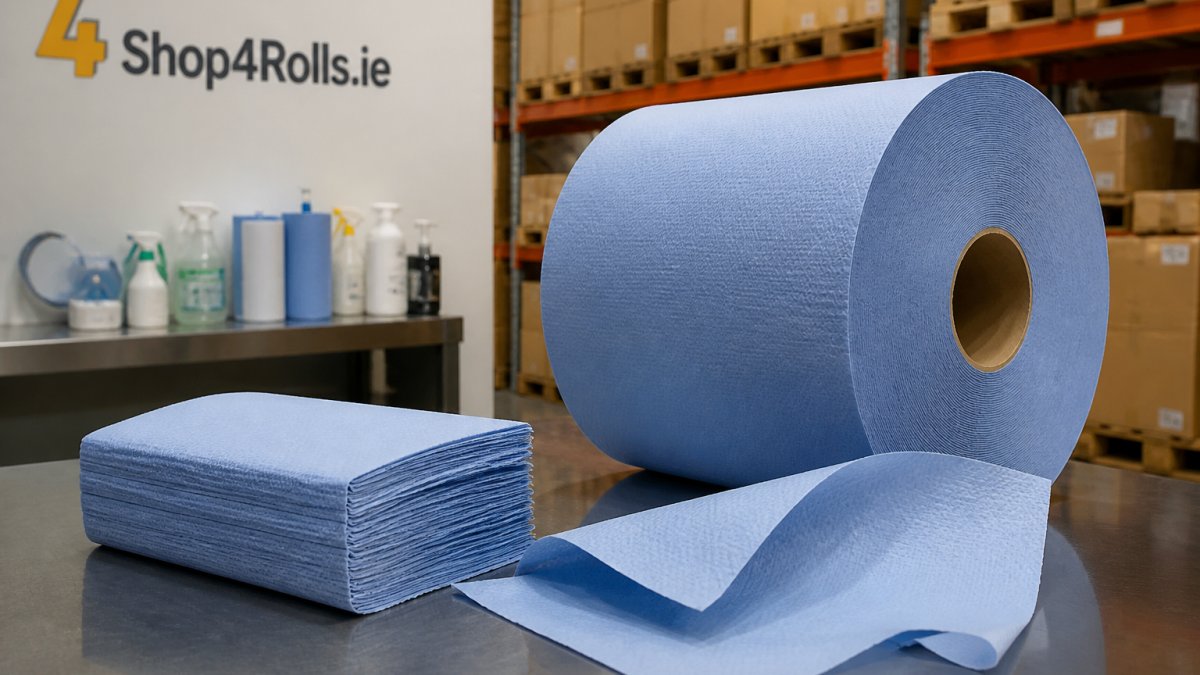
Blue roll is a commercial-grade paper towel supplied on a roll, most commonly in centrefeed format, and it has become the default wiping paper for kitchens, workshops and retail floors. At Shop4Rolls.ie, we supply blue roll to businesses every week, and the questions are always the same: which ply, which length, which dispenser, and what a case costs per sheet.
Blue roll dominates because of the format, not the colour. A centrefeed roll pulls from the middle, so it keeps working when the outer layers are wet, and it can be wall-mounted, trolley-mounted or carried loose to a spill.
That visibility matters more than most buyers realise. In food handling areas, a colour-coded wiping paper is one of the simplest ways to keep cleaning cloths separated by zone, as set out in the Food Safety Authority of Ireland guidance on hygiene in food businesses.
Why Blue and Not White?
Blue roll is chosen for contrast and zone separation, not absorbency. Blue and white rolls of the same specification perform identically; the difference is what the colour tells your staff.
A white roll disappears against a white worktop, apron and tile floor; a blue sheet does not. In a busy kitchen, that half-second of recognition decides whether a cloth goes back on the prep bench or in the bin.
One caveat: some blue dyes transfer onto wet surfaces if the paper is left soaking. For wiping and drying this is not an issue, but for a saturated sheet left on a polished counter, use a plain white roll instead.
Product Specifications: Ply, Length and Sheet Count
Blue roll specifications come down to four numbers: ply, roll length, sheet count and roll diameter. Get those right and you will not order the wrong case again.
Ply is how many layers of paper are bonded together. Roll length is the total metres on the core. Sheet count is how many perforated sheets that length produces. Roll diameter determines dispenser fit.
| Specification | What It Affects | Typical Options |
|---|---|---|
| Ply | Strength, absorbency, cost | 1-ply, 2-ply |
| Roll length | How long a roll lasts | 100m to 300m+ |
| Sheet count | Cost-per-sheet maths | Varies with length and sheet size |
| Roll diameter | Dispenser fit | Matches dispenser model |
| Core type | Dispenser compatibility | Cored or coreless |
1-Ply vs 2-Ply: Which Do You Need?
Choose 1-ply for high-volume, low-mess wiping such as drying hands or light surfaces, and 2-ply for spillage control, grease and heavier industrial cleaning. Two-ply carries more wet strength and tear resistance because the layers reinforce each other.
A 2-ply roll costs more per metre but you use less per task, because a single sheet does not shred halfway through a wipe.
Centrefeed Design: Dispenser Compatibility and Benefits
Centrefeed blue roll feeds from the centre rather than unwinding from the outside, which is why it works with wall-mounted dispensers, trolley dispensers and free-standing use.

Dispenser compatibility is where most ordering mistakes happen. Before you buy, check three things:
- The maximum roll diameter your dispenser accepts
- Whether it takes cored rolls, coreless rolls, or both
- The feed direction, centre-feed or surface-feed
A coreless roll has no cardboard tube, so it holds more paper for the same diameter and produces less waste, but it only fits dispensers designed for it.
Food Grade Paper Towel Standards: What to Look For
Food grade paper towel must be suitable for contact with food surfaces and must not shed fibres onto them, so buy paper manufactured for food-contact use and store it correctly.
The Food Safety Authority of Ireland sets out the hygiene obligations for food businesses, and wiping paper sits inside those obligations. A roll that is fine for mopping a warehouse floor is not automatically appropriate for a prep bench.
The Regulatory Framework Behind 'Food Safe'
In Ireland, food-contact materials are governed by the European Communities (Materials and Articles Intended to Come into Contact with Foodstuffs) Regulations, which transpose EU framework Regulation 1935/2004 and GMP Regulation 2023/2006 into Irish law, enforced by the FSAI. Any paper used on a food-contact surface should be made under a documented GMP system and traceable to a batch.
What that means on a product listing:
- A declaration of compliance (DoC) or a food-contact suitability statement from the manufacturer or importer
- A stated basis in the relevant EU regulation, not just the words 'food safe' in the marketing copy
- Batch traceability, so a supplier can identify which production run a case came from if there is a problem
If a supplier cannot produce a DoC on request, treat the roll as non-food-contact regardless of what the listing says.
Sector-Specific Requirements
Different sectors carry different obligations, and the same blue roll is not automatically suitable for all.
Healthcare and care settings. The Health Service Executive national infection prevention and control guidance treats paper towels as a single-use item in clinical areas.
Childcare and early years. Tusla early years regulations require hygienic cleaning of food preparation and nappy-change surfaces.
Automotive and industrial. Food-contact certification is not required, but low-lint performance is, because fibres left on a painted panel or an engine component become a rework cost.
What to Check on the Listing
- The paper is described as suitable for food contact, with a DoC available on request
- It is lint-free or low-lint, so fibres do not transfer to food or finished surfaces
- It holds together when wet, so a wipe does not leave residue
Lint-free performance is the specification buyers overlook most. A cheap roll that sheds fibres onto a chopping board creates a problem you then have to clean up, and in a HACCP-audited kitchen it becomes a non-conformance.
Ask for the declaration of compliance before you place the first order, not after an environmental health officer asks you for it. A supplier who cannot supply one in 24 hours is not a food-service supplier.
Minimum Order Quantity for Business Supplies: What to Expect
Minimum order quantity for business supplies varies by supplier and product line, so ask before you build a reorder routine around one. Some wholesalers set a minimum spend per order, others a minimum number of cases per line.
If you run a small café using two or three rolls a month, you should not be forced into a pallet. Ask any supplier two questions:
- Is there a minimum order value, and does delivery count towards it?
- Is there a minimum quantity per product line?
Get both answers in writing before you switch. A supplier with no minimum order value but a five-case minimum per line is not actually serving small accounts.
The right minimum order policy is the one that matches your real usage. If a supplier's minimum forces you to hold three months of stock, you are financing their warehouse with your storeroom.
Cost-Effective Operational Supplies: Getting the Most from Every Roll
Cost-effective operational supplies come from buying the right specification once, not chasing the cheapest case. The cheapest blue roll on a listing page is often the most expensive per wipe, because you use two sheets where one would do.
Calculating Cost-Per-Sheet
Cost-per-sheet is the only comparison that matters across different roll lengths and ply counts:
Cost per sheet = price per case ÷ (rolls per case × sheets per roll)
Worked example: a case of 6 rolls where each yields 500 sheets gives 3,000 sheets per case. Divide the case price by 3,000 for your true unit cost, then run the same calculation on the competing case.
- Ply. A 2-ply sheet does the work of roughly two 1-ply sheets on a wet spill, so a higher price per sheet can still be the cheaper option.
- Waste. Rolls that tear badly or jam in the dispenser get pulled in double lengths. Tear resistance is a cost line, not a comfort feature.
Disposal and Recycling: What Happens After the Roll Is Finished
Used blue roll belongs in general waste unless it is contaminated; clean paper waste can usually be recycled. The distinction is contamination, not colour.
What Counts as Contaminated
Contamination is a property of what the paper has absorbed, not how dirty it looks. Under Irish waste classification, a used paper towel is assessed against the European Waste Catalogue, and the entry depends on what it has touched.
- Dry paper from dusting, drying clean hands or wiping a dry surface is generally classified as non-hazardous paper and card waste and can go into a dry mixed recycling stream, provided your contractor accepts paper towel.
- Paper used on food-contact surfaces is organic-contaminated. It is non-hazardous in most cases, but it is not clean recycling, and most contractors will not accept it in a dry recycling bin because of the food residue and moisture.
- Paper used with cleaning chemicals, degreasers, solvents or oils may be hazardous depending on the chemical. A sheet soaked in a solvent-based degreaser is not the same waste as a sheet soaked in washing-up liquid, and the two should not be binned together.
If you are unsure which category a waste stream falls into, the Environmental Protection Agency publishes the national waste classification guidance that your contractor works from.
What Contractors Actually Accept
In commercial waste collection, dry mixed recycling bins are checked for contamination, and a load with visible food residue or wet paper can be rejected and charged as general waste, a cost most sites do not budget for.
The practical rules that most contractors apply:
- Paper towel goes in general waste unless your contract explicitly lists it as accepted in dry recycling
- Cardboard cores go in dry recycling, and coreless rolls remove that stream entirely
- Hazardous-chemical-soaked paper goes in the hazardous waste stream, not general waste
Ask your contractor two questions before you brief staff: is paper towel accepted in dry recycling on our contract, and what is the contamination threshold that triggers a rejected load? Get both in writing.
Briefing Staff So the Bins Stay Clean
The failure point is almost always the bin nearest the work, not the policy document. If the only bin within reach of a prep bench is the dry recycling bin, contaminated paper ends up in it.
A workable setup for a mixed site:
- Put a general waste bin within arm's reach of every food-prep and chemical-use area.
- Put dry recycling bins only in dry areas, offices, front of house, dry storage.
- Label bins with what goes in, not what stays out, because staff read the positive instruction faster.
- Post the segregation rules where the bins are, not in a folder in the office.
If your site runs a colour-coded cleaning system, extend the same logic to the bins. A blue-labelled general waste bin next to the blue roll dispenser removes the decision from the staff member entirely.
Recycling blue roll is not about the colour of the paper. It is about what the paper has touched, what your contractor will accept, and whether the bin nearest the work makes the right choice the easy one. Get those three right and the waste audit stops being a worry.
Frequently Asked Questions
What is blue roll used for?
Blue roll handles surface wiping, spillage control and general industrial cleaning across kitchens, workshops and retail floors. The blue colour makes it easy to spot against food and work surfaces, which helps with cross-contamination control. Most rolls are 2-ply, embossed for absorbency, and fit wall-mounted or free-standing centrefeed dispensers. It works for both wet and dry tasks, from mopping up spills to drying hands and equipment.
Why is blue roll so expensive?
The price reflects the paper grade, ply count and roll length rather than the colour. A 2-ply embossed roll with high wet strength costs more to produce than a thin 1-ply alternative because it uses more fibre and holds together when wet. Buying in bulk packs lowers the cost per sheet significantly. Check Shop4Rolls.ie for current pricing on bulk blue roll packs and compare cost-per-sheet rather than cost-per-roll.
Is there a minimum order quantity for wholesale blue roll?
Many suppliers set a minimum order quantity for business supplies, often based on pack size or order value. Some sell single rolls, while others require a full case or pallet. If you run a small café using two or three rolls a month, look for a supplier that serves smaller accounts without forcing bulk commitments. Shop4Rolls.ie stocks over 3,000 products, so you can combine blue roll with other operational supplies in one order.
Are blue rolls recyclable under local waste management regulations?
Blue roll is paper-based and can go into general recycling if it is clean and free of food or chemical residue. Rolls used with oils, solvents or food waste should go into general waste instead. Check with your waste contractor about commercial recycling collections, as rules vary by provider. Reducing contamination in your recycling bin keeps collection costs down and supports your waste management obligations.