 ultimate-guide
Price Label Gun Buying Guide: Labels & Loading
Table of Contents
- What a Price Label Gun Actually Does for Your Store
- Single Line vs Double Line Pricing Guns
- Choosing the Right Pricing Gun Labels
- How to Load a Price Gun Without Wasting a Roll
- Minimum Order Quantity and Bulk Buying Explained
- Troubleshooting and Maintenance That Saves You Money
- Conclusion
- Frequently Asked Questions
Last Updated: September 29, 2026
What a Price Label Gun Actually Does for Your Store
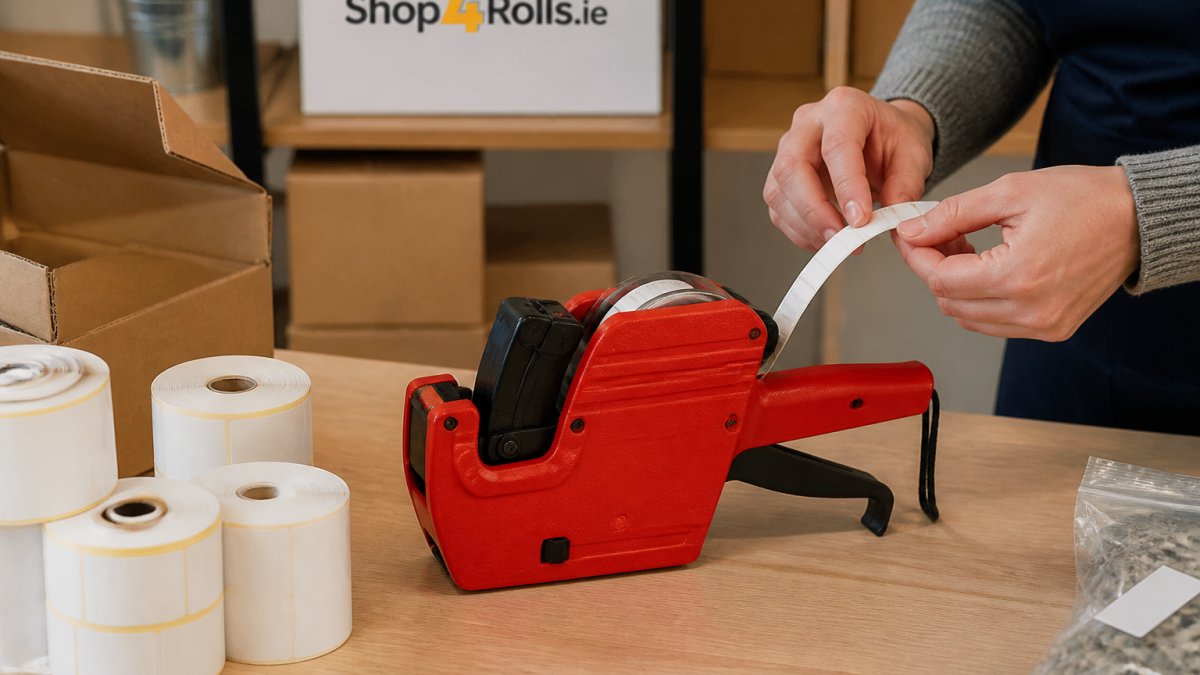
A price label gun is a handheld labeller that prints and applies adhesive price tags to stock in one motion, replacing handwritten tickets and reducing till errors. This guide from Shop4Rolls.ie covers how to choose one, load it properly, and keep it running. Most buying advice stops at the model number; the harder part is matching the gun to your label rolls, your shelving, and the volume your staff actually price each week.
Single Line vs Double Line Pricing Guns
Single line pricing guns print one row of information. Double line models print two, which lets you show price and a unit price, a date code, or a product code on the same label.
When One Line Is Enough
A single line gun suits shops where the price is the only thing that changes. Convenience stores, market stalls, and small cafés get everything they need from one row: the guns are lighter, the label rolls cheaper, and staff learn the mechanism in minutes.
When You Need Two Lines
Two lines earn their keep when the price alone is not enough. If you sell by weight, a double line gun prints price and unit pricing on the same tag. Pharmacies and hardware shops often use the second line for a batch or date code so stock can be traced later.
| Feature | Single Line | Double Line |
|---|---|---|
| Rows printed | One | Two |
| Best for | Price only | Price plus unit or date code |
| Label rolls | Smaller, cheaper | Larger, higher cost per roll |
| Typical users | Cafés, stalls, small shops | Grocers, pharmacies, hardware |
Choosing the Right Pricing Gun Labels
Pricing gun labels are sold as rolls sized to a specific gun model, and the roll you buy must match the gun's label feed and print head, a roll a fraction too wide will not sit in the channel correctly.
Permanent vs Removable Adhesive
Permanent adhesive bonds to card, plastic, and glass and will not lift in normal shop conditions. Use it on stock that is being sold once. Removable labels peel away cleanly, which suits anything that gets re-priced, returned, or moved between seasons. Clothing retailers often run removable labels for this reason.
How to Load a Price Gun Without Wasting a Roll
Loading a price label gun takes about two minutes once you know the sequence. Follow these steps to avoid the tangled first roll that catches most new users.
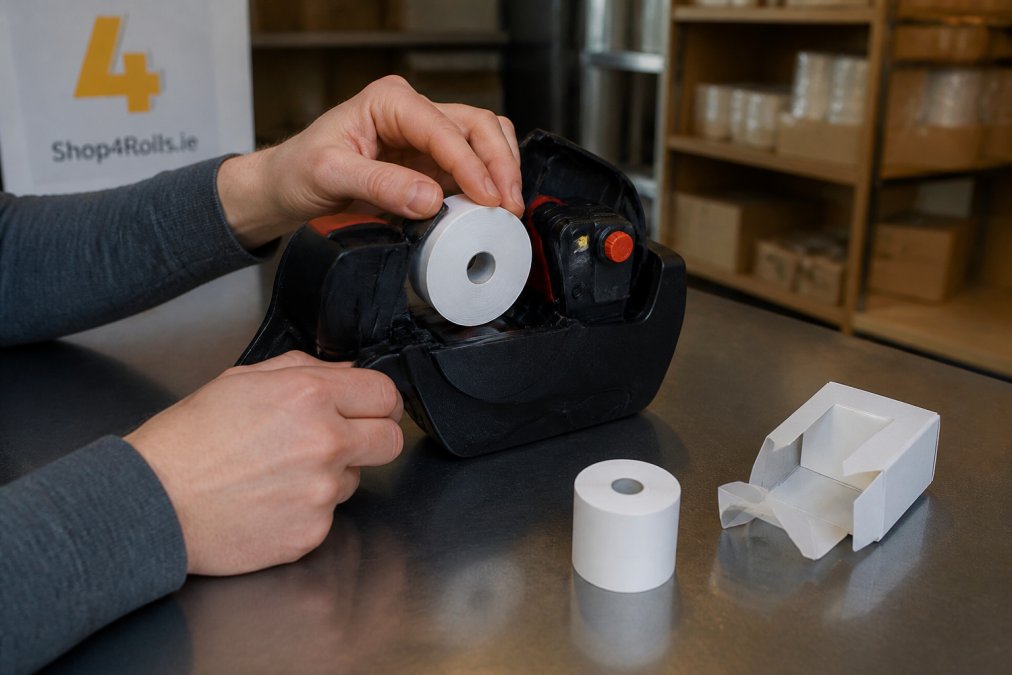
- Open the gun by releasing the latch at the back of the body.
- Lift the old roll and the take-up spool out of the chamber.
- Thread the new label roll so the labels face the print head, with the backing paper running toward the take-up spool.
- Feed the first 10-15 cm of backing through the label feed slot until it catches.
- Close the latch until it clicks, then squeeze the trigger twice to test the advance.
- Check the first printed label for alignment before pricing any stock.
Minimum Order Quantity and Bulk Buying Explained
Minimum order quantity (MOQ) is the smallest number of rolls a supplier will sell in a single order, and it varies by product and supplier: some sell single rolls, others only break a carton of ten or twenty. Before you commit to a bulk box, work out what your shop actually gets through, because label rolls are a consumable with a shelf life, not a stock item you can sit on indefinitely.
Work Out Your Real Monthly Usage
Start with a count, not a guess. Take one gun and one busy trading day, and count how many labels it applies: a small convenience store pricing a delivery might run 150 to 300 labels a day, while a grocer pricing a full weekly reset across several aisles can run into the thousands. Multiply the daily figure by your trading days per month, then by the number of guns in use.
The Storage Problem Nobody Mentions
Adhesive label stock is sensitive to heat, damp and direct sunlight. A bulk box stored in a warm back office, a south-facing stockroom or a damp cellar will degrade: the adhesive can migrate, the backing paper can cockle, and the roll can misfeed long before you reach the end of the box. Stock kept in a cool, dry, dark place and rotated oldest-first performs the same on the last roll as the first.
Bulk Buying by Trade
The right order size depends on what you sell and how often prices change:
- Off-licences and convenience stores: prices move with promotions and supplier cost changes, so you re-price often but in small batches. Medium cartons rotated regularly usually beat a year's supply.
- Pharmacies: labels often carry batch or date information as well as price, and dispensing stock is priced at the point of sale. Usage is steady rather than spiky, which suits a standing monthly order.
- Grocers and hardware shops: weekly resets and seasonal lines create peaks. Buying to cover the peak, then drawing down in quiet periods, avoids both stockouts and dead stock.
- Market stalls and pop-ups: low, irregular volume. Single rolls or small packs are almost always the better buy, even at a higher cost per label.
The Real Trade-Off
Bulk buying cuts the cost per label and reduces reordering, but it ties up cash, consumes storage and exposes you to degradation if stock is kept badly. The sweet spot for most shops is roughly one to three months of usage per order, enough to capture the price break, short enough that the last roll is still fresh.
Troubleshooting and Maintenance That Saves You Money
Most price label gun problems come down to a handful of causes, and almost all are fixable in under five minutes without a replacement part. Work through this diagnostic sequence in order, because the symptom you see is often caused by something upstream of where you are looking.
Diagnose Before You Dismantle
Start with the roll, not the gun. Nine times out of ten the fault is in the consumable or how it is seated, not the mechanism.
- Check the roll is seated flush. Open the gun and confirm the roll sits square in its channel with no side-to-side play. A roll that is a fraction too wide, or not pushed fully home, will feed crooked and tear.
- Check the label orientation. Labels must face the print head, with the backing paper running toward the take-up spool. If the gun is printing on the backing, the roll is in the wrong way round.
- Check the backing tension. If the backing is slack, the labels will bunch; if it is too tight, they will tear on advance. Reseat the take-up spool and squeeze the trigger twice to test.
- Check the print head. Adhesive build-up on the print head causes faint, patchy or smeared print. Wipe it with a dry, lint-free cloth, never a wet cloth, which can leave residue.
- Check the ink roller. If the print is uniformly faint after cleaning the head, the ink roller is dry or worn. This is the single cheapest maintenance item on the gun, and replacing it on schedule prevents the faint-print problem that makes staff re-price items by hand.
- Check the trigger mechanism. A sticking trigger usually means adhesive has worked into the linkage. Clean it out before assuming the gun is worn out.
Symptom-to-Cause Quick Reference
| Symptom | Most likely cause | First fix |
|---|---|---|
| Labels feed crooked | Roll not seated flush | Open the gun and reseat the roll |
| Print faint or patchy | Dry or worn ink roller, or dirty print head | Clean the head, then replace the roller |
| Trigger sticks | Adhesive build-up in the linkage | Clean the mechanism with a dry cloth |
| Labels tear on advance | Roll too tight or backing damp | Swap in a fresh roll from dry storage |
| Labels bunch at the spool | Backing tension wrong | Reseat the take-up spool and test |
| Gun prints on the backing | Roll loaded the wrong way round | Reload with labels facing the print head |
A Maintenance Routine That Prevents Most Faults
Prevention is cheaper than repair. A short weekly routine keeps a gun running for years:
- After each pricing session: close the gun so dust does not settle on the print head.
- Weekly: wipe the print head with a dry cloth and check the ink roller for wear.
- Monthly: inspect the label channel for adhesive residue and clear it out.
- When changing a roll: check the backing path for tears or debris before loading the new roll.
- When storing: keep guns and spare rolls in a cool, dry place away from heat and damp.
When to Repair and When to Replace
Most faults are consumable or seating issues and cost nothing to fix. If the gun still misfeeds after the sequence above, the likely culprits are a worn feed mechanism or a damaged print head. Compare the cost of a replacement part against a new gun, for a high-volume retail environment, a spare gun on the shelf is often cheaper than a day of hand-pricing.
Conclusion
The gap between a pricing gun that saves your staff time and one that sits in a drawer comes down to three decisions: the right label size, the right adhesive, and a loading routine your team actually follows. Get those right and the rest is consumables.
Frequently Asked Questions
Are price gun labels universal?
No. Label rolls vary by gun model, with differences in roll diameter, core size, and label dimensions. A roll that fits one brand of pricing gun may jam or feed incorrectly in another. Always check the model number printed on your gun and match it to the label specification. Buying compatible supplies from a supplier that lists gun compatibility clearly saves returns and downtime.
Where can you buy price gun labels?
Pricing gun labels are stocked by retail supply specialists, stationery wholesalers, and online shops that carry shop equipment. Look for a supplier that lists which gun models each roll fits, offers both permanent and removable adhesive options, and holds stock for quick delivery. Ordering labels alongside your other shop consumables keeps reordering simple and reduces the number of separate deliveries you need to manage.
What is the best price label gun for a small shop?
A single line handheld labeller suits most small shops pricing a few hundred items a week. It is lighter, cheaper to run, and faster to reload than double line models. If you also need to show unit pricing, batch codes, or dates, a double line gun earns its keep. Match the gun to your label size and the volume of stock you price each week rather than buying the largest model available.
How often should you replace the ink roller in a price gun?
Replace the ink roller when prints start looking faint or patchy, which for a busy shop can be every few weeks. Keeping spare ink rollers on hand avoids a mid-shift scramble. Store them sealed and away from heat, and wipe the print head with a dry cloth when you change the roller. Clean, consistent prints make prices easier for staff and customers to read at a glance.