 how-to
How to Implement Compostable Packaging in Food Retail
Table of Contents
- What You'll Need Before You Start
- Step 1: Audit Your Current Packaging and Waste Streams
- Step 2: Choose the Right Compostable Materials for Food Contact
- Step 3: Check Compostable Packaging Certification Standards
- Step 4: Understand Compostable Packaging Waste Disposal Regulations
- Step 5: Source Wholesale Eco-Friendly Packaging Suppliers
- Step 6: Train Staff and Educate Customers on Compostable Packaging
- Step 7: Run a Cost-Benefit Analysis for Your Store
- Frequently Asked Questions
Last Updated: October 2, 2026
What You'll Need Before You Start
Most guides skip that last part, telling you to buy "eco-friendly" cups that then land in general waste and break down nowhere.
Shop4Rolls.ie supplies packaging and operational stock, so we see which swaps work in a busy deli or café and which fall apart by week two.
Before you order anything, gather these basics:
- A list of every food-contact item you currently buy
- Your monthly spend on each item
- Your current waste collection contract and bin types
- A rough count of how many covers or transactions you handle daily
- One staff member who can own the project
The rest of this guide walks you through seven steps, from the first audit to the final cost check.
Step 1: Audit Your Current Packaging and Waste Streams
Start by emptying one bin. Not a metaphor, an actual bin.
Sort it into three piles: food waste, packaging, and everything else.
Next, list every packaging item you buy and what it's made from.
Then check your waste contract. Ask your collector three questions:
- Which bins do you accept, and what goes in each?
- Do you offer a food waste or organic bin?
- Where does the organic waste end up?
That last answer matters more than any logo on a cup.
Once you know what leaves your store and where it goes, you can choose packaging that fits that route.
Step 2: Choose the Right Compostable Materials for Food Contact
Compostable packaging is designed to break down into compost in a defined environment, within a set time, without harmful residue. That definition matters, because "biodegradable" alone means almost nothing.
Here's how the main materials compare:
| Material | Best For | Watch Out For |
|---|---|---|
| Bagasse | Takeaway containers, clamshells | Can soften with very wet foods |
| Kraft paper | Wraps, bags, tray liners | Grease resistance varies by grade |
| PLA | Cold cups, cutlery, lids | Needs industrial composting |
| Seaweed-based film | Sachets, wrappers | Still limited in supply |
Bagasse, Kraft Paper and Fibre-Based Alternatives
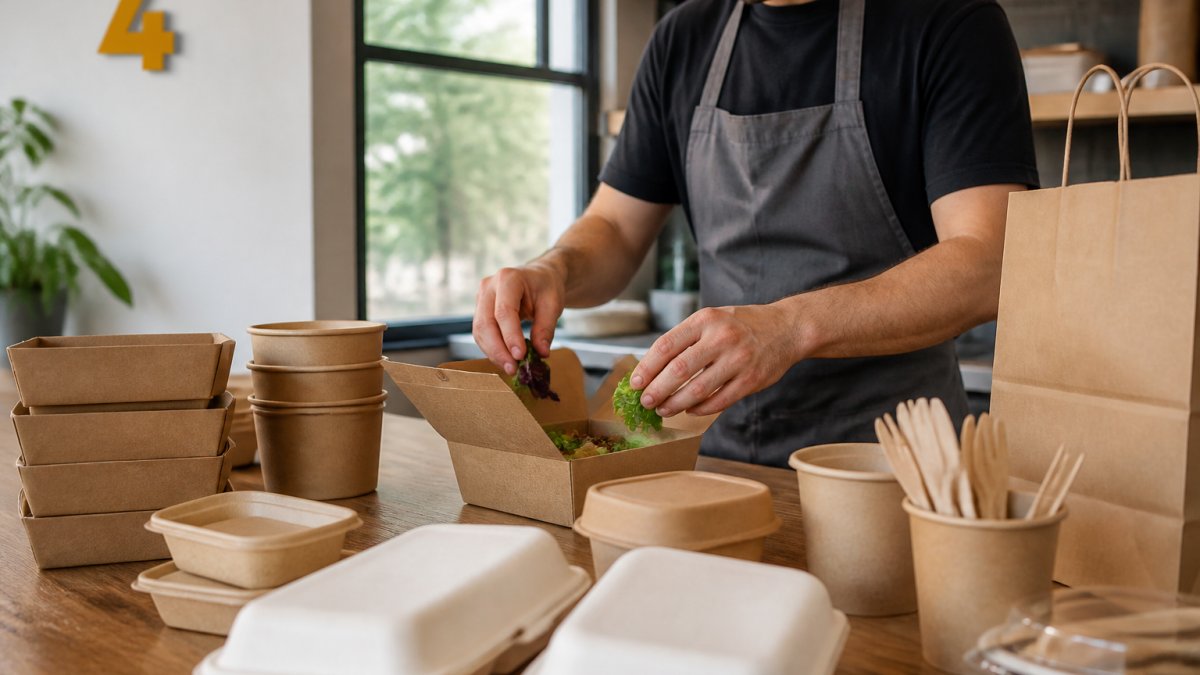
Bagasse is the pulp left after sugarcane is crushed, pressed into sturdy containers that handle hot food well. Kraft paper suits wraps, bags, and liners, though hot items need a grease-resistant grade. Fibre-based alternatives now cover trays, bowls, and lids.
These three are your safest starting point: widely available, suited to hot and cold food, and familiar to customers.
PLA Cups and Seaweed-Based Packaging
PLA is a plant-based polymer used for cold cups, cutlery, and clear lids. It looks and performs like plastic, which customers like, but most PLA needs industrial composting to break down. Seaweed-based packaging is promising but thin on supply, so treat it as a trial item, not a core line.
Step 3: Check Compostable Packaging Certification Standards
Certification is your proof. Without it, "compostable" is just a word printed on a box.
Look for recognised certification marks on the packaging or spec sheet, confirming the item was tested against a published standard for breakdown time, residue, and safety.
The European Committee for Standardization publishes the packaging standards that certification bodies test against. If a supplier can't name the standard their product meets, keep looking.
The Standards That Actually Matter
Two European standards do most of the work in food retail:
- EN 13432, the harmonised standard for packaging recoverable through composting and biodegradation. It sets the pass levels for disintegration, biodegradation, and ecotoxicity, and it is the standard most industrial-composting certifications reference.
- EN 14995, the parallel standard for plastics that are not packaging, which is why some cutlery and service items cite it instead.
A product certified to EN 13432 is designed for industrial composting conditions, not a garden heap. That distinction is the single most common source of confusion at the bin.
Who Issues the Certificates
Certification bodies test against the standard and issue a certificate with a unique reference number. The marks seen most often on food-contact items in Ireland are the seedling mark (industrial composting) and the home-composting equivalent, a separate, stricter claim tested at lower temperatures.
When a supplier sends a spec sheet, check that the certificate:
- Names the standard (EN 13432, EN 14995, or the home-composting equivalent)
- Lists the specific product or product family, not just a category
- Is current, with an expiry date that has not passed
- Covers food contact, not just the material's breakdown behaviour
Food Contact Is a Separate Question
Compostability and food-contact safety are tested under different regimes: a bin liner certified to EN 13432 may still be unsuitable for wrapping a sandwich. Ask for the food-contact declaration separately, and check the item suits your temperature range, hot liquids and fatty foods expose gaps fastest.
Check three things before you commit:
- The certification mark and the standard it references
- Whether it's certified for industrial or home composting
- Whether the certificate covers food contact
That third point is easy to miss, a compostable bin liner isn't a compostable sandwich box.
Step 4: Understand Compostable Packaging Waste Disposal Regulations
Compostable packaging only delivers a benefit if it reaches the right waste stream, your disposal route decides whether the switch is real or cosmetic.
Commercial waste in Ireland is governed by national waste legislation and local collection rules. The Environmental Protection Agency oversees waste licensing and sets out how waste must be handled and tracked.
The practical rules for a food retailer are simple:
- Keep compostable packaging out of general waste where possible
- Never mix compostable items into a plastics recycling bin
- Check whether your collector accepts compostable packaging in the organic bin
- Train staff on which bin each item belongs in
Get this wrong and you've paid more for packaging that ends up in landfill anyway.
Mapping Your Local Waste Infrastructure
Not every area has the same facilities, some regions have industrial composting capacity, others send organic waste elsewhere.
Call your collector and ask: do you accept certified compostable packaging in the organic bin, and where is it processed? If not, compost on site, find a collector who does, or choose materials that suit your existing bins.
Step 5: Source Wholesale Eco-Friendly Packaging Suppliers
Finding wholesale eco-friendly packaging suppliers is easy. Finding one that stocks everything, holds stock, and delivers when promised is harder.
Start with these checks:
- Do they list the certification standard for each compostable item?
- Can they supply your full range, or just part of it?
- What's their lead time, and what happens when an item is out of stock?
- Do they offer wholesale pricing at your order volume?
- Is there a minimum order?
A common mistake is splitting orders across three or four suppliers for the best price per line, you save a little per unit and lose it in admin time and missed deliveries. One supplier with reliable stock beats four with patchy availability.
Shop4Rolls.ie stocks over 3,000 packaging and operational products from a purpose-built warehouse, so you can add compostable lines to the same order as your till rolls and receipt paper. Pricing depends on quantity and delivery, and current rates are listed on the Shop4Rolls.ie site.
Step 6: Train Staff and Educate Customers on Compostable Packaging
Your switch fails at the bin if staff don't know the rules. A five-minute briefing won't cut it.
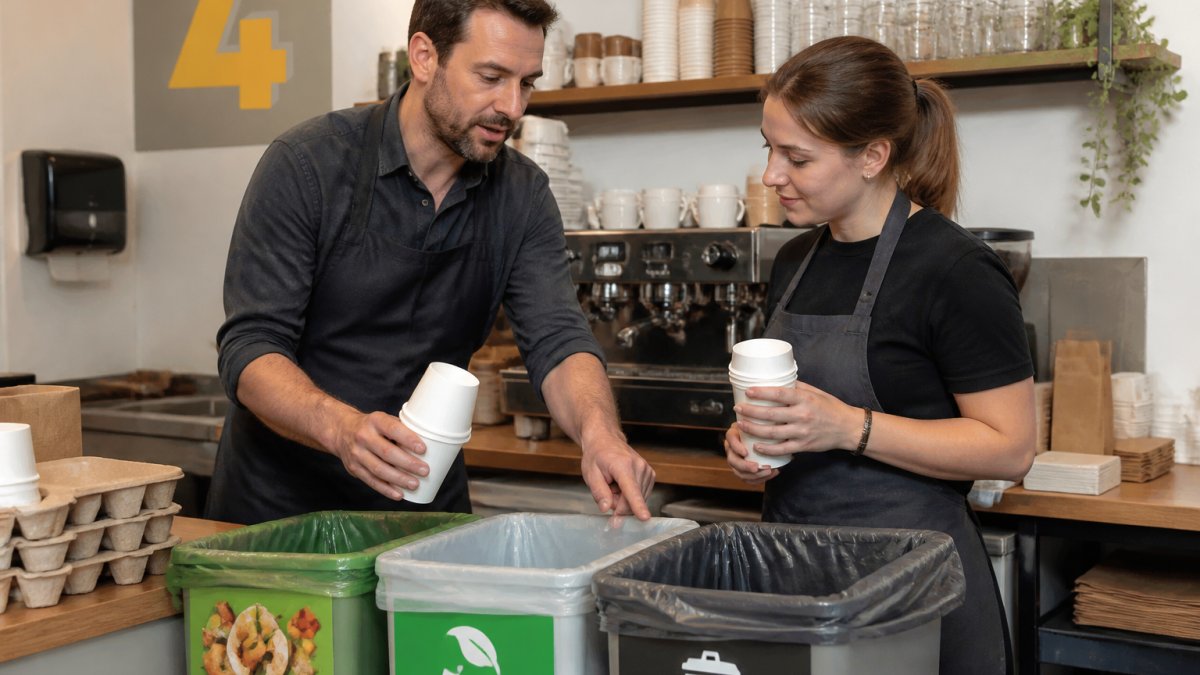
Run a short session covering what's changed, which bin each item goes in, and what to say if a customer asks.
For customers, signage does most of the work. Label bins clearly and say where the waste goes.
Here's a simple script staff can use:
"That cup is compostable, so it goes in the brown bin here. The lid goes in the same bin. Thanks for asking."
Short, clear, and it stops the item landing in general waste.
Step 7: Run a Cost-Benefit Analysis for Your Store
Compostable packaging usually costs more per unit than standard plastic, the question is whether the total picture works for your store.
This section gives you a framework you can actually run, plus the procurement checklist that decides whether the numbers hold up.
Build the Numbers Around Four Lines
- Extra cost per item, multiplied by monthly volume
- Savings from reduced general waste collections or lighter bins
- Any reduction in food waste charges if you compost more
- Value of customer perception and repeat business
For a small café, the premium on a few hundred cups a month is manageable. For a high-volume takeaway it's a real line item, test one category first rather than switching everything at once.
A Worked Framework You Can Copy
Take one product category, say, 12oz hot cups and lids. Work through it in this order:
- Baseline unit cost. Your current price per cup and per lid, from your last invoice.
- Compostable unit cost. The quoted price for the certified equivalent, at your actual order volume, not the headline rate.
- Monthly volume. Cups sold per month, from your EPOS or a manual count over one week multiplied out.
- Unit premium. Compostable cost minus baseline cost, per item.
- Monthly premium. Unit premium multiplied by monthly volume.
- Waste-side offset. Any reduction in general waste bin lifts, bin weight charges, or food waste collection fees once compostable items move to the organic stream.
- Net monthly position. Monthly premium minus waste-side offset.
That net figure is the number to defend. If it is small and stable, the switch is a straightforward decision. If it is large, test one category, measure for a quarter, and decide on evidence rather than enthusiasm.
The Procurement Checklist That Protects the Numbers
A cost model is only as good as the supply behind it. Before committing to a supplier, run this checklist:
- Certification evidence. Can they produce the certificate PDF, with a current reference number, for each compostable line?
- Range coverage. Can they supply your full packaging list, or will you be splitting orders across suppliers?
- Stock reliability. What is their lead time, and what happens when a line goes out of stock mid-quarter?
- Volume pricing. Do they publish wholesale tiers, and does your order volume actually reach them?
- Minimum order. Is there a minimum that forces you to over-order and tie up cash?
- Delivery terms. What are the delivery charges and cut-off times, and do they hold for your location?
- Substitution policy. If a line is unavailable, what do they send instead, and is it certified to the same standard?
Splitting orders across three or four suppliers to chase the best price per line saves a little per unit and loses it in admin time, missed deliveries, and inconsistent certification paperwork. One supplier with reliable stock and clear certificates usually beats four with patchy availability.
Track It for a Full Quarter
Compare packaging spend, waste collection costs, and customer feedback before and after. A quarter smooths out seasonal variation while still letting you course-correct, a defensible answer, and a baseline for extending the switch to the next category.
Frequently Asked Questions
What are the legal requirements for compostable packaging in food retail?
There is no single law that mandates compostable packaging across all food retail. Requirements depend on what you sell and where waste goes. If you offer compostable items, they must meet the relevant European standards (EN 13432 for industrial composting) to be legally described as compostable. You also need to comply with waste segregation rules and ensure packaging that touches food meets food-contact material regulations. Check with your waste collector and local authority about what can go into organic waste bins in your area.
How do I distinguish between biodegradable and certified compostable packaging?
Biodegradable means the material will eventually break down, but it gives no timeframe or conditions. Certified compostable means it meets a specific standard, such as EN 13432, proving it breaks down within a set time under defined conditions. Look for the certification logo and the standard number on the product or supplier documentation. If a supplier cannot provide a certificate, treat the claim as marketing rather than a verified compostable packaging certification standard.
How do I source reliable, certified compostable wholesale supplies?
Ask suppliers for certificates of conformity to EN 13432 or home-compostable standards before ordering. Request samples to test how the packaging performs with your actual food items. Confirm stock availability and lead times, especially if you run a busy counter. Wholesale eco-friendly packaging suppliers should provide clear documentation, consistent stock, and delivery you can rely on. If you already order other operational supplies from a trusted supplier, check whether they stock compostable ranges to reduce the number of accounts you manage.
How can I communicate the benefits of compostable packaging to my customers?
Use clear bin signage with simple language: what goes in, what stays out. Train staff to answer the two most common questions: is it really compostable, and which bin does it go in. Avoid vague claims like eco-friendly on its own. Instead, state the specific certification and disposal route. A short counter card or shelf talker explaining your packaging choice builds trust and reduces contamination in your bins.
Switching to compostable packaging is straightforward once you know your waste route, your materials, and your numbers. The hard part is doing it without disrupting daily operations. Shop4Rolls.ie makes that easier with next-day restocking, over 3,000 products in one place, and a lowest price guarantee. Order your compostable lines alongside your till rolls and receipt paper, and keep one supplier for the stock you burn through every week. Sign up now and get your first order moving.