 how-to
Wholesale POS Consumables: Easy Online Ordering
Table of Contents
- What Counts as Operational and Point-of-Sale Consumables
- Setting Up Online Wholesale Ordering for Retailers
- The Retail Procurement Process, Step by Step
- Comparing Wholesale Prices and Calculating Total Cost
- Multi-Store Inventory Management and Chain-Wide Controls
- Wholesale Till Rolls and Card Machine Receipt Rolls
- Supplier Selection, Service Levels and Risk
- Frequently Asked Questions
Last Updated: October 9, 2026
What Counts as Operational and Point-of-Sale Consumables
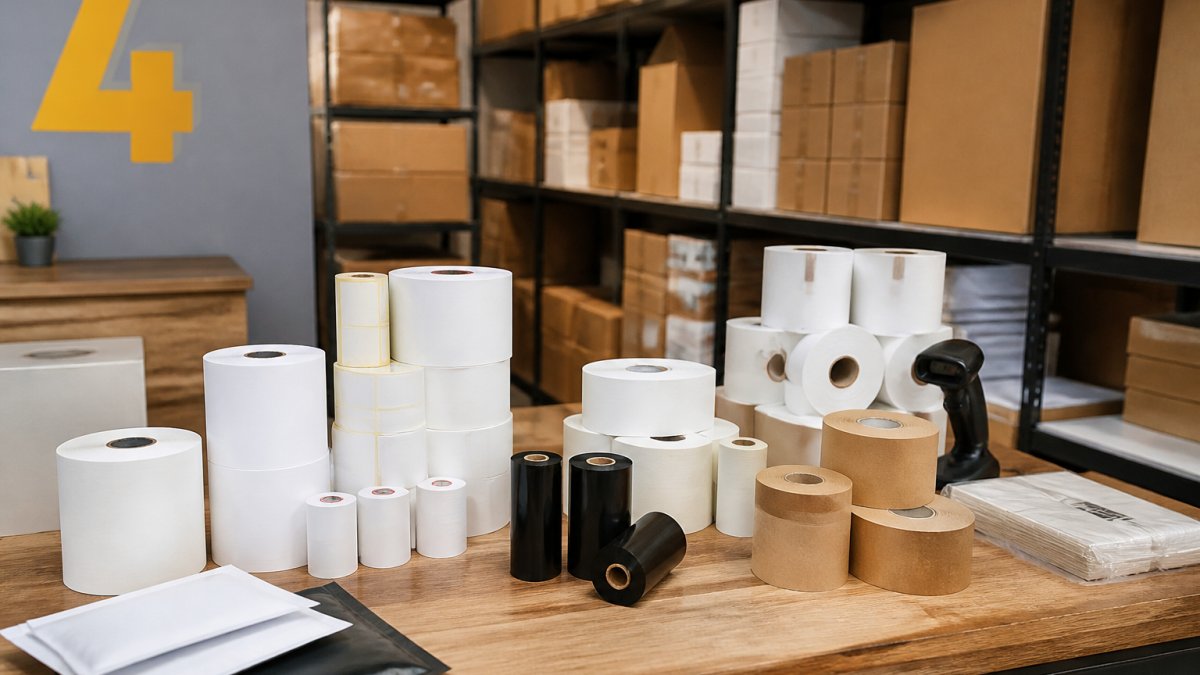
Wholesale POS consumables are the everyday items a retail business burns through to keep trading: till rolls, card machine receipt rolls, packaging, and checkout supplies. They are not stock you sell. They are stock you use, and running out of them stops a sale dead.
For procurement managers at retail chains, this category is awkward. The items are cheap individually but critical in aggregate. A till without a roll is a closed till. We group these consumables into three practical buckets:
- Point-of-sale consumables: thermal till rolls, card machine receipt rolls, and printer paper for POS systems
- Operational consumables: packaging, carrier bags, labels, and cleaning supplies for day-to-day operations
- Checkout supplies: bags, dividers, and the small items that keep a checkout moving
The distinction matters because each bucket has a different reorder rhythm. Till rolls run out fast and predictably. Packaging flexes with seasonal volume. Treating them the same is where stockouts start.
Shop4Rolls.ie stocks over 3,000 products across these categories, which is why many chains consolidate their consumables into one wholesale account rather than juggling several suppliers.
Setting Up Online Wholesale Ordering for Retailers
Setting up online wholesale ordering for retailers takes an afternoon, not a project. The goal is a single account where your team can reorder till rolls, receipt rolls, and packaging at wholesale prices without emailing quotes back and forth.
Here is the sequence we recommend to retail chains moving to an online wholesale store:
- Register your business account and confirm your delivery locations
- Build your product catalogue around the items you actually reorder
- Agree credit terms and account information with your supplier
- Set reorder points for high-turnover lines
- Train staff on the ordering system with a short reference sheet

Building Your Product Catalogue and Account Details
Your product catalogue should mirror how you buy, not how a supplier lists. Pull your last three months of purchase orders and tag every consumable line by location, size, and reorder frequency.
The common mistake is building a catalogue of everything available. Start with the twenty or thirty lines that cover most of your spend. Catalogue management gets easier once the core items are locked in.
Get the account details right at this stage: delivery addresses per store, a named contact for each location, and a single billing contact at head office.
Credit Terms and Account Information
Credit terms are where a good wholesale account earns its keep. A credit account lets stores order against the chain's account rather than paying per transaction, which simplifies reconciliation at month end.
Ask your supplier what credit terms they offer before you commit. Terms vary, and a supplier that fits your cash flow beats one that saves a cent per roll but demands payment upfront.
The Retail Procurement Process, Step by Step
The retail procurement process moves from a purchase requisition to order fulfilment in five stages. For consumables, the process should be short. If it takes more than a few clicks per store, it is too long.
| Stage | What Happens | Who Owns It |
|---|---|---|
| Purchase requisition | Store flags a low-stock item | Store manager |
| Approval | Spend checked against budget | Procurement |
| Purchase order | Order placed via the wholesale store | Procurement |
| Order fulfilment | Supplier picks, packs, dispatches | Supplier |
| Stock replenishment | Goods received and logged | Store manager |
From Purchase Requisition to Order Fulfilment
A purchase requisition is the internal request that starts a purchase; a purchase order is the formal order sent to the supplier. Keeping both steps light is the whole point of online ordering.
In practice, the fastest chains give store managers a reorder list and let them submit requisitions directly. Procurement approves anything above a set threshold and lets the rest flow through. Order management then becomes a matter of monitoring, not chasing.
Comparing Wholesale Prices and Calculating Total Cost
Comparing wholesale prices on unit cost alone will mislead you.
A practical way to compare two suppliers is to build a landed cost per line and then layer the risk cost on top. For a single high-turnover line such as a standard thermal till roll, the calculation looks like this:
| Cost element | Supplier A | Supplier B |
|---|---|---|
| Unit price at your volume | Lower headline rate | Slightly higher |
| Volume break threshold | You fall just short | You qualify at your normal order |
| Delivery charge | Per store, per order | Free above a minimum order value |
| Minimum order value | High, forces over-ordering | Matches your reorder rhythm |
| Payment terms | Payment upfront | 30-day credit account |
| Stockout risk | Occasional gaps on fast lines | Holds own stock |
Supplier A looks cheaper on the quote and often is not once delivery is charged per store and you over-order to hit a minimum.
The five levers to weigh together
- Unit price at your actual order volume, not the headline rate. A price that only applies above a volume you never reach is not your price.
- Volume pricing breaks. Ask where the thresholds sit and whether consolidating two stores' orders into one delivery gets you over the line.
- Delivery charges and how they are applied. Per order, per store, or free above a minimum order value, the structure matters more than the rate.
- Minimum order values. A high minimum pushes stores into over-ordering, which ties up cash and shelf space in stockrooms.
- Credit terms and contract length. A 30-day account improves cash flow; a long contract with no exit locks you into a supplier who may drift on service.
A simple landed-cost formula
Landed cost per unit = (unit price × quantity) + delivery + any surcharges, divided by quantity. Then add a risk allowance: estimate how often the line goes out of stock and what a stockout costs you in lost trading hours.
Contract terms to check before you sign
- Price review frequency and how increases are notified
- Whether volume breaks are locked for the contract term
- Return policy on wrongly sized rolls and damaged packaging
- Notice period and any minimum spend commitment
Run this comparison on your top ten consumable lines rather than the whole catalogue. Those lines carry most of your spend, and the differences between suppliers show up fastest there.
Multi-Store Inventory Management and Chain-Wide Controls
Multi-store inventory management is the hardest part of retail procurement, because each location runs its own stock while head office carries the cost. Online wholesale ordering solves this by giving every store the same catalogue and the same prices.
Chain-wide controls to put in place:
- A shared catalogue so every store orders the same approved lines
- Per-store reorder points based on that store's sales volume
- A single credit account with spend visibility by location
- Central reporting so procurement sees stock replenishment across the chain
The benefit is inventory control without micromanagement. Stores reorder what they need; head office sees the whole picture. For chains running multiple locations, this is the difference between inventory strategy and guesswork.
Enterprise Ireland's retail and supply chain supports are worth reviewing if you are scaling a chain and want guidance on supplier and operational planning.
Wholesale Till Rolls and Card Machine Receipt Rolls
Wholesale POS consumables such as till rolls and card machine receipt rolls are the single most common items a retail chain reorders, and the ones most likely to cause a stockout. They are also the easiest to get wrong on size.
Card machines take specific roll widths, and ordering the wrong size is a frequent and avoidable error. Before you order, note the make and model of each card machine and till printer, then match the roll width and diameter to the machine.
A few rules that save trouble:
- Standardise on one or two roll sizes across your chain where possible
- Keep a small buffer of receipt rolls at each store, not just at head office
- Order receipt rolls on a schedule rather than waiting for a store to run out
Supplier Selection, Service Levels and Risk
Supplier selection for consumables comes down to three things: stock availability, delivery reliability, and price. Get the first two wrong and price stops mattering.
A retail-consumables supplier scorecard makes the assessment measurable. Score each prospective or incumbent supplier against the criteria below, weighting stock availability and delivery reliability highest because a stockout on till rolls takes a checkout offline.
| Criterion | What to measure | Why it matters |
|---|---|---|
| Stock availability | Percentage of your lines in stock on the day you order | A gap on a fast line stops a sale |
| Delivery reliability | Percentage of orders arriving on the promised day | Late delivery forces emergency buying |
| Order accuracy | Percentage of orders with the correct roll size and quantity | Wrong sizes cause returns and downtime |
| Lead time | Standard and worst-case days from order to delivery | Sets your reorder point |
| Service responsiveness | Whether you reach a named contact by phone | Problems get resolved faster |
| Credit terms | Days of credit and invoicing structure | Affects cash flow across the chain |
| Returns handling | Turnaround on wrongly sized or damaged goods | Reduces admin burden on stores |
Questions to ask before you switch
- What are your service levels on next-day delivery, and how do you report against them?
- How do you handle a stockout on a critical line, do you substitute, part-ship, or notify in advance?
- Do you carry enough stock to cover a chain-wide order placed in one week?
- What are your credit terms, minimum order values and return policy?
- Who is our named account contact, and what are their hours?
Managing risk across the chain
Supply chain resilience matters more for consumables than for most categories, because the items are non-negotiable. A supplier that runs out of till rolls takes your checkouts down with them. Three practical controls reduce that exposure:
- Dual-source the critical lines. Keep a secondary supplier approved for till rolls and card machine receipt rolls, even if you order from them rarely. An approved backup is faster to activate than a new supplier.
- Hold a buffer at each store, not just at head office. A small reserve of receipt rolls at the till point absorbs a late delivery without a closed checkout.
- Review the scorecard quarterly. Service levels drift. A supplier that was reliable at contract start can slip once they win more of your volume.
Look for a supplier with its own stockholding and a customer care team you can actually reach by phone, because that combination is what shortens the gap between a problem and a fix.
Frequently Asked Questions
How can retail chains make wholesale reordering faster?
Set up a business account with agreed customer-specific pricing, save your regular product range as a template, and reorder from that list rather than browsing the full catalogue each time. Multi-location chains get the biggest gain by ordering for every store on one purchase order instead of raising separate requisitions. Keep a simple reorder point for each consumable, so a store triggers a top-up before the last box is opened rather than after.
What operational consumables should retail procurement teams keep in stock?
The essentials are till rolls and card machine receipt rolls for every POS terminal, plus packaging such as Jiffy bags and polythene bags for e-commerce and warehouse dispatch. Add checkout supplies, labels and general operational items your stores use daily. The rule of thumb is to hold enough cover for your busiest trading period, not your average week, because a card machine without a receipt roll stops the sale entirely.
How do procurement managers compare wholesale prices for till rolls and receipt rolls?
Compare the cost per roll rather than the pack price, and check the roll dimensions and core size against your printer model before ordering. Factor in delivery charges, minimum order thresholds and how quickly stock arrives, since a cheaper roll that takes four days to land costs more in lost sales than a slightly dearer next-day option. Ask for volume pricing bands so you know where the next discount tier starts.
How can a retail chain standardise consumable orders across multiple stores?
Agree one approved product range for all locations, so every store orders the same till roll and receipt roll specification. Centralise the account so purchasing runs through head office, then let individual stores request top-ups against that agreed catalogue. This keeps pricing consistent, simplifies multi-store inventory management, and stops branches buying incompatible rolls that sit unused in a stockroom.