 how-to
Ice Cream Cups: Sizes, Materials & Bulk Buying Guide
Table of Contents
- How to Choose the Right Ice Cream Cups for Your Business
- Paper Ice Cream Cups: Greaseproof, Freezer-Safe and Customisable
- 5oz Ice Cream Cups: Ideal for Kids' Portions and Tasting Menus
- 8oz Ice Cream Cups: The Standard for Sundaes and Frozen Yogurt
- Ice Cream Cups with Lids: Transport, Takeaway and Bulk Ordering
- Preventing Leaks, Sogginess and Condensation in Frozen Dessert Cups
- Frequently Asked Questions
Last Updated: October 6, 2026
How to Choose the Right Ice Cream Cups for Your Business
Choosing the right ice cream cups comes down to three things: the portion you serve, the material that suits your freezer and customers, and the lid if the dessert leaves the counter. Get those wrong and you either overpay for packaging or hand a customer a soggy mess. This guide from Shop4Rolls.ie covers cup sizes, paper versus plastic, lid fit, and the pack-quantity maths behind your real cost per serving.
The size should follow the scoop, not the other way around. A single standard scoop sits between a golf ball and a small fist, so a cup that holds one scoop plus a little headroom is the correct starting point. Anything larger means paying for packaging your customer never eats.
Match Cup Capacity to Your Actual Serving Size
Choose cup capacity from your standard scoop size, not from what looks generous on the counter. Measure one typical portion once, then buy the cup that holds it with a small margin for toppings.
A simple method we recommend:
- Scoop your normal single portion into a measuring jug and note the volume in millilitres
- Add roughly a fifth more for toppings, sauce, or a flake
- Convert to ounces if your supplier lists cups that way, since most ranges are sold in ounce sizes
- Round up to the nearest standard cup size rather than down
Do that once and you will never guess again. If you serve gelato, sorbet, and frozen yogurt from one counter, measure the largest and buy one size that covers all three.
Paper Ice Cream Cups: Greaseproof, Freezer-Safe and Customisable
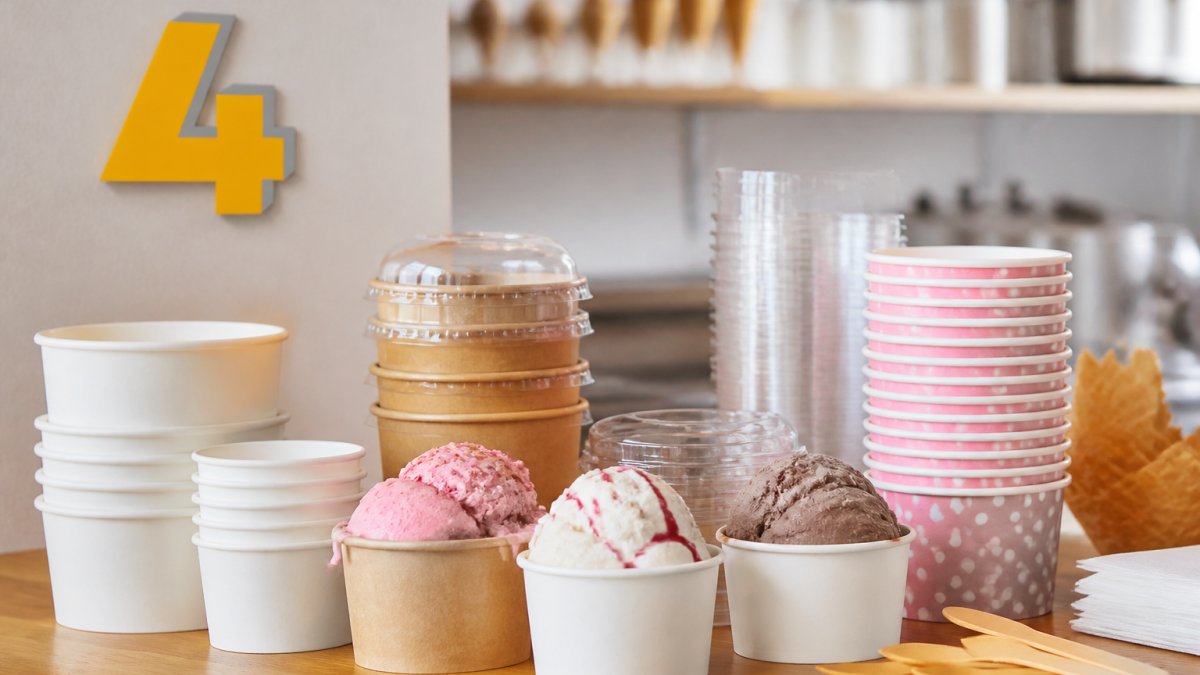
Paper ice cream cups are the default for most dessert counters: they handle cold, resist grease, and can be printed with your branding. They are lighter than plastic, stack tightly, and suit eat-in and takeaway alike.
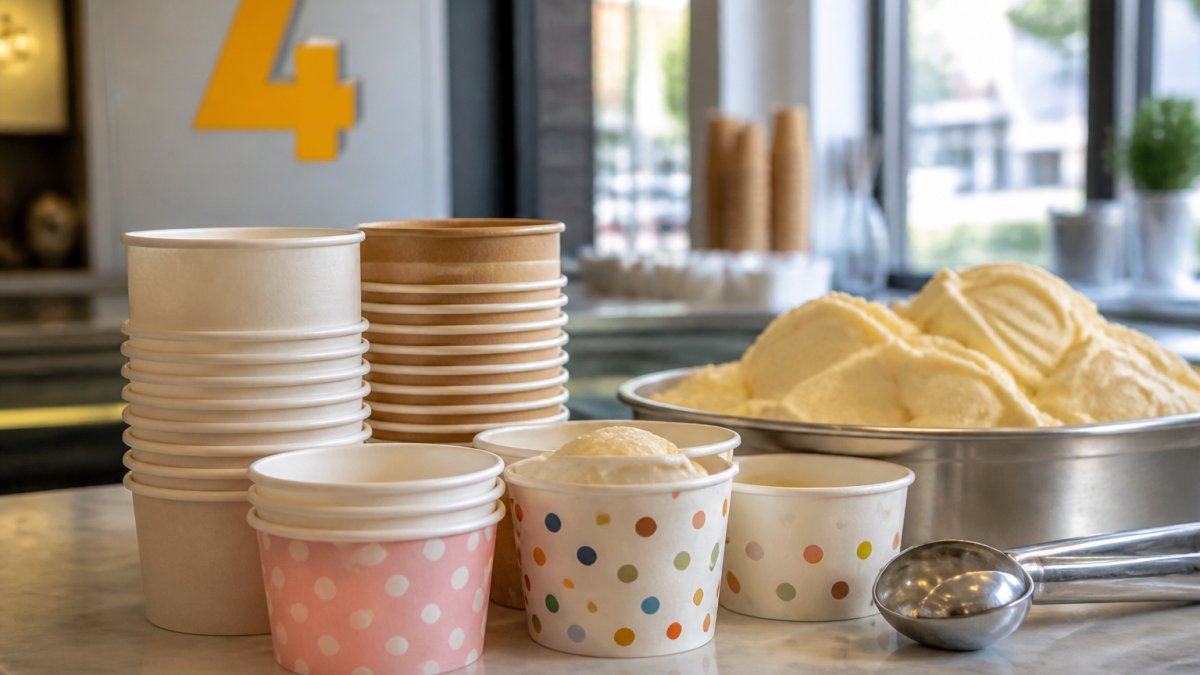
The coating matters more than the thickness. A cup can feel sturdy yet go soft within minutes if the board is not treated for a wet, cold dessert.
Waxed Paper, Cardboard and Coated Board Compared
Waxed paper, cardboard, and coated board all serve frozen desserts but behave differently once the cup meets a melting scoop. Waxed paper gives a moisture barrier for short serving windows. Plain cardboard is cheapest but softens fastest. Coated board, with a food-safe lining bonded to the board, holds up best for slower eaters and takeaway.
For food-contact safety, any cup or print you buy should use food-safe ink and be rated for food contact. If you are sourcing printed cups, ask your supplier to confirm both points in writing before you order in volume.
| Material | Best For | Watch Out For |
|---|---|---|
| Waxed paper | Quick-serve counters, tasting portions | Softens with slow eaters |
| Cardboard | Lowest-cost bulk buying | Weakest against moisture |
| Coated board | Takeaway, printed branding | Higher unit cost |
5oz Ice Cream Cups: Ideal for Kids' Portions and Tasting Menus
5oz ice cream cups suit children's portions, tasting flights, and small single-scoop serves. They keep the portion honest and let you price a smaller treat without looking stingy.
The size works because it sits just above a standard single scoop.
They earn their keep on tasting menus: a gelateria offering four flavours on a paddle can serve each cleanly in a 5oz cup, and a café can use the same size for a kids' scoop without a separate line.
How to Work Out Whether 5oz Is the Right Size for You
Before committing to a bulk pack, run this check against your actual serve:
- Scoop your normal single portion into a measuring jug and note the millilitres
- If it lands between 90ml and 120ml, a 5oz (148ml) cup gives you sensible headroom
- If it lands above 120ml, step up to 6oz or 8oz rather than compressing the scoop
- If you serve gelato, sorbet, and frozen yogurt from the same counter, measure the largest of the three and buy one size that covers all of them
For a tasting flight, the maths differs: four 5oz samples add up to roughly 600ml across the paddle, so price the flight against a single full serve rather than four separate cups. That keeps it profitable while still feeling like a treat.
What to Watch Out For
A 5oz cup is not a universal small size. It is too small for a sundae with sauce and toppings, and awkward for soft serve, which needs a wider rim to swirl cleanly. If your menu has both a kids' scoop and a sundae, buy the 5oz for the kids' line and keep the 8oz for everything else. Also check rim diameter before ordering lids: a 5oz cup from one range will not necessarily take another range's lid, even at matching capacity.
8oz Ice Cream Cups: The Standard for Sundaes and Frozen Yogurt
8oz ice cream cups are the workhorse size for sundaes, frozen yogurt, and two-scoop serves, holding a proper portion with room for sauce, nuts, or fruit without spilling over the rim.
This is the size most frozen yogurt counters standardise on, and the one we would pick if you stocked a single cup. It covers gelato, sorbet, soft serve, and frozen yogurt without being so large a single scoop looks lost.
Pair 8oz cups with a matching lid if any of those desserts leave the counter, and check the lid is sold for that exact cup rather than assumed to fit.
Ice Cream Cups with Lids: Transport, Takeaway and Bulk Ordering
Ice cream cups with lids turn a sit-down dessert into a takeaway product. The lid keeps contents in, condensation off the customer's hands, and lets you stack cups for transport without crushing the serve.
Lid fit is where most takeaway problems start. Lids are made for one cup diameter and rim profile, so a lid from a different cup line may sit loose or refuse to seal. Buy lids and cups as a matched pair from the same range, and test one filled cup before committing to bulk.
Choosing the Right Lid Type for Your Service
The right lid depends on how the dessert travels:
- Flat lids sit low on the rim and stack well. They suit cups that go into a carrier bag or a delivery box, because they add no height and are less likely to be knocked off.
- Domed lids give headroom for a swirl, a flake, or a tall soft-serve peak. They are the better choice for a dessert that is served immediately and eaten on the move, but they take up more space in a carrier.
- Vented lids allow a little steam or condensation to escape. They are worth considering if you are lidding a dessert that is still slightly warm at the surface, though for frozen desserts a standard flat lid is usually sufficient.
For transport, a flat-bottomed cup with a firm lid stacks better than a tapered one. If you are sending desserts out by delivery, that stability matters more than the cup's looks. A tapered cup that feels elegant on the counter can wobble in a box once the contents shift.
Cost Per Serving and Pack Quantity Maths
Cost per serving, not cost per pack, should drive your buying decision. A cheap pack that forces a larger scoop, or a premium cup used for one dessert, both distort the real cost.
Work it out like this:
- Take the pack price and divide it by the number of cups in the pack to get the unit price
- Divide that unit price by the number of servings you get from one cup, which is normally one
- Multiply by your expected weekly serves to see the true weekly packaging spend
- Add the lid cost per cup if the dessert is going out
Compare that weekly figure against your current supplier's, not the headline pack price. A dearer-looking pack can win once you account for cups no longer wasted on oversized portions.
For example, with a pack of 1,000 cups at a few cent each: if you serve 200 takeaway desserts a week, each using a cup and a lid, your weekly packaging spend is the cup unit price plus the lid unit price, multiplied by 200.
Ordering in Bulk Without Overcommitting
Bulk discounts are real, but so is storage. Cups and lids take shelf space, and a pallet of one size is a problem if your menu changes.
Check shelf life and storage conditions before buying deep. Keep paper and coated board cups dry and away from strong odours, since board picks up smells. Keep lids out of direct sunlight, as some plastics become brittle over time.
For current pricing on our cup and lid ranges, see the Shop4Rolls.ie website, where bulk discounts apply across larger quantities.
Preventing Leaks, Sogginess and Condensation in Frozen Dessert Cups
Leaks, sogginess, and condensation almost always come from one of three causes: an unmatched lid, a cup material never rated for a wet dessert, or a temperature gap between the frozen product and a warm room.
Here is how we would fix each:
- Leaks: check the lid is the matched lid for that cup, and that the rim is clean before the lid goes on
- Sogginess: move to a coated board cup if your current paper cup softens before the customer finishes
- Condensation: serve straight from the freezer into the cup, and keep stacked cups away from warm surfaces so moisture does not form on the outside before the lid goes on
Durability in freezing temperatures is also worth checking. Cups stored in a chest freezer and moved in and out all day take more punishment than cups kept at room temperature, so a board that feels fine on the shelf can crack at the rim after a week of cold cycling.
Frequently Asked Questions
What size ice cream cup should a business choose?
Start with your most common serving. A single scoop of gelato or sorbet fits a 5oz cup, while a sundae or double scoop needs an 8oz cup. If you offer both, stock both sizes. Measure your standard scoop before ordering and check the cup's stated capacity in millilitres. Getting this right reduces waste and stops customers feeling short-changed.
Are paper ice cream cups suitable for takeaway desserts?
Yes, provided they are waxed or coated and paired with a tight-fitting lid. Paper ice cream cups handle freezing temperatures well and resist grease from dairy and frozen yogurt. For takeaway, choose a cup with a compatible lid and avoid overfilling, which can cause leaks. Coated board cups hold up better than uncoated paper when condensation forms.
What should you look for when buying ice cream cups in bulk?
Check four things: food-contact safe materials, the correct capacity for your servings, lid compatibility, and pack quantity versus unit price. Confirm delivery times and returns policy before committing to a large pack.
Do ice cream cups with lids work for slush and milkshakes?
Lidded cups work for thicker frozen treats like soft serve and frozen yogurt, but thin slush and milkshakes need a leak-resistant cup with a secure lid. Check the lid fit and consider a domed lid for toppings. For transport, keep cups upright and avoid stacking heavy items on top, as pressure can force lids loose.
Running a dessert counter means juggling cup sizes, materials, lids, and pack quantities, and running out mid-service is the one problem no café can afford. Shop4Rolls.ie stocks a wide range of packaging and operational supplies with reliable stock availability, quick online ordering, and a lowest price guarantee, so restocking your ice cream cups does not turn into a weekly chore. Sign up now and keep your counter moving.