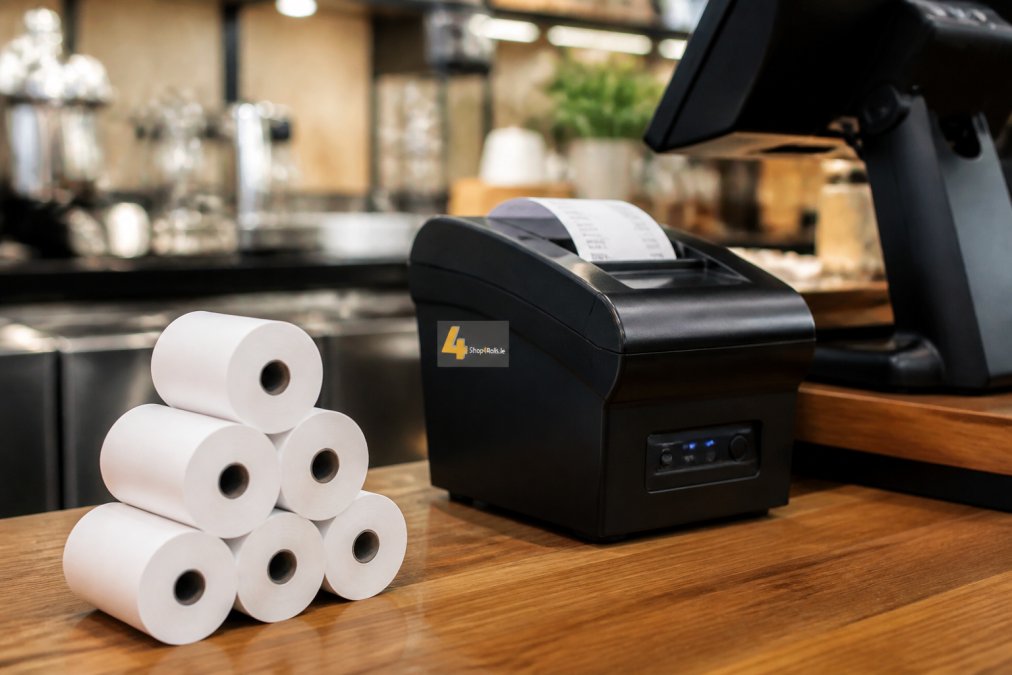
 how-to
Cheap Till Rolls for Restaurants: A Buying Guide
Table of Contents
- Understanding Till Roll Sizes and Compatibility with POS Systems
- How to Measure Till Roll Diameter Accurately
- Paper Quality, GSM Specifications, and Thermal Coating
- Bulk Buy Till Rolls Ireland: Maximising Savings
- How to Store Thermal Receipt Paper for Maximum Shelf Life
- Cost-Per-Receipt Analysis: Finding True Value
- Troubleshooting Common Printer Issues with Till Rolls
- Conclusion: Getting Cheap Till Rolls Without Compromising Quality
Last Updated: August 27, 2026
Understanding Till Roll Sizes and Compatibility with POS Systems
Till roll sizes vary significantly, and ordering the wrong dimensions wastes money and disrupts service. Most restaurants use one of three standard thermal paper widths: 80mm, 57mm, or 44mm (peer-reviewed research). The 80x70mm roll is most common for full-receipt printing in hospitality, whilst 57x55mm suits compact card machine terminals. Your POS system determines which size you need; compatibility matters far more than price.
Common POS Systems and Their Till Roll Requirements
Epos Now systems typically support 80mm and 57mm thermal rolls with 12mm cores. Square Register and Toast accommodate 80mm rolls as standard, though some compact models use 58mm. Lightspeed POS works with both 80mm and 57mm depending on your printer model. Tillpoint systems generally require 80x70mm rolls with either 12mm or 19mm cores. Card machine terminals from Worldpay, Ingenico, PAX, and Verifone typically print 57mm or 80mm receipts.
When sourcing cheap till rolls, compatibility is non-negotiable. Check your current supplier's product code or measure your existing roll's diameter and width. If uncertain, contact your POS provider directly, most have compatibility guides on their websites. Many restaurants waste money by switching suppliers without verifying dimensions first, only to discover mid-service that new rolls don't fit.
How to Verify Compatibility Before Ordering
Before placing a bulk order, confirm three specifications: paper width (44mm, 57mm, or 80mm), core diameter (12mm or 19mm), and outer roll diameter (typically 70mm or 80mm). Write these down and keep them with your supplier contact details. When requesting a quote, provide all three measurements to eliminate guesswork and prevent costly errors.
If upgrading your POS system or adding a new printer, the hardware's manual will specify compatible roll dimensions. Don't assume old rolls will work with new equipment. Ask your supplier to confirm their product matches your printer model before ordering.
How to Measure Till Roll Diameter Accurately
Measuring your till roll correctly takes two minutes and prevents ordering errors that can cost you service downtime.
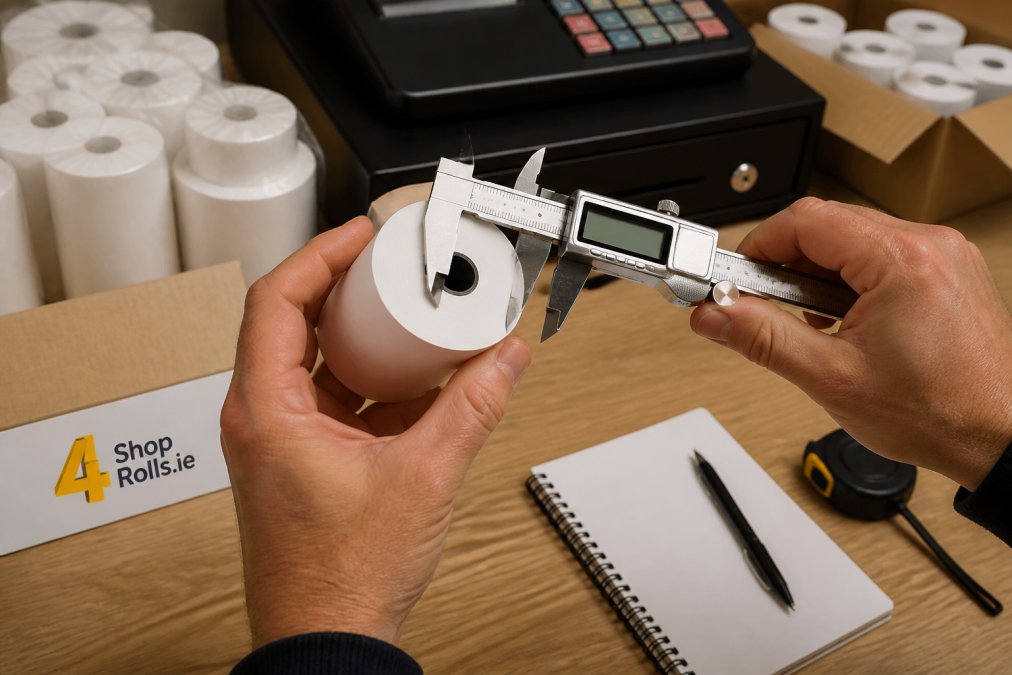
The core diameter is the hollow centre that your printer's spindle grips. Most restaurant tills use either 12mm or 19mm cores. Measure this distance across the hollow centre with a ruler or calliper. If you lack precise tools, compare your roll to a standard coin (a 1 euro coin is roughly 24mm, which helps estimate).
Outer diameter matters too, especially if your printer has height constraints. A standard roll is typically 70mm to 80mm in outer diameter. Rolls that are too large won't fit in the printer's housing; rolls that are too small will slip and misalign.
Paper width is the distance across the roll from edge to edge. Common widths are 44mm, 57mm, and 80mm. Once you have these three numbers, you can confidently order cheap till rolls without guessing. Write them down and keep them with your supplier contact details.
Paper Quality, GSM Specifications, and Thermal Coating
Not all cheap till rolls deliver the same quality. Paper density, measured in grams per square metre (GSM), directly affects durability and print longevity. Thermal paper relies on a heat-activated coating that darkens when exposed to the printer's heating element. Higher-quality thermal coating resists fading and moisture, which matters in busy restaurant environments.
Standard thermal receipt paper typically ranges from 48 GSM to 80 GSM (peer-reviewed research). For most restaurants, 60 GSM offers a practical balance: it's thick enough to handle frequent handling and survive accidental spills, yet doesn't inflate costs significantly.
BPA-free certification is increasingly important in hospitality. Bisphenol A is a chemical used in some thermal coatings that can leach into food contact surfaces. Many restaurants now require BPA-free receipt paper to meet health and safety expectations.
The thermal coating quality determines how long your receipt remains readable. Budget thermal paper may fade within weeks; premium coatings remain clear for months or years. If your restaurant needs receipts for dispute resolution or tax records, investing in better coating quality saves headaches later.
Bulk Buy Till Rolls: Maximising Savings
Ordering cheap till rolls in bulk is where real savings emerge, but only if you calculate the true cost per receipt rather than just comparing per-roll prices. Wholesale pricing typically kicks in at 20+ rolls per order, and the discount increases with volume.
Understanding Tiered Pricing and Volume Discounts
Most suppliers offer tiered pricing where per-roll cost decreases significantly as volume increases:
- 1-10 rolls: standard retail price
- 11-25 rolls: 10-12% discount
- 26-50 rolls: 15-20% discount
- 51-100 rolls: 20-25% discount
- 100+ rolls: 25-30% discount
Actual pricing depends on paper quality, coating type, and supplier. The key is that per-roll cost decreases significantly as volume increases.
Calculating Your Monthly and Quarterly Consumption
Before committing to a bulk order, establish your baseline consumption. A busy restaurant serving 200+ customers daily might use 10-15 rolls weekly. A mid-sized venue with 100-150 daily transactions uses 5-8 rolls weekly. A small café with 30-50 transactions uses 1-2 rolls weekly.
Track your actual usage over four weeks by counting the rolls you consume. Multiply that by 13 to estimate annual consumption. This prevents over-ordering (which ties up cash and risks paper degradation) or under-ordering (which forces you back to smaller, more expensive orders).
Example: A restaurant using 12 rolls weekly consumes 624 rolls annually. A bulk order of 60 rolls covers roughly five weeks of stock. Ordering every five weeks (roughly 10 orders per year) is more efficient than weekly orders, and the volume discount on 60-roll orders is typically 18-22%, compared to 8-10% on 10-roll orders.
Bulk Ordering Strategy: Balancing Cost and Storage
Bulk buying reduces ordering frequency, which saves time and shipping costs. Rather than placing weekly orders, you order once monthly and maintain steady inventory. This is especially valuable for restaurants that struggle with inconsistent supplier reliability.
However, don't over-order. Thermal paper has a shelf life of 12-18 months under proper storage conditions. Order enough to cover 8-12 weeks of consumption, not six months' worth. This balances the discount benefit against storage risk and cash flow.
Negotiate volume discounts directly with suppliers. Many offer loyalty discounts or special rates for customers who commit to consistent orders. If you're consolidating suppliers, mention this when requesting a quote.
Real-World Example: Cost Comparison
A restaurant using 60 rolls monthly faces two ordering strategies:
Strategy 1: Weekly orders of 15 rolls
- Per-roll cost: Refer to supplier for current pricing
- Monthly cost: Refer to supplier for current pricing
- Annual cost: Refer to supplier for current pricing
Strategy 2: Monthly orders of 60 rolls
- Per-roll cost: Refer to supplier for current pricing
- Monthly cost: Refer to supplier for current pricing
- Annual cost: Refer to supplier for current pricing
- Annual savings: Refer to supplier for current pricing
The bulk strategy can lead to savings annually on the same volume, plus reduces ordering time and shipping frequency.
How to Store Thermal Receipt Paper for Maximum Shelf Life
Thermal paper degrades faster than standard paper because the heat-activated coating is sensitive to temperature, humidity, and light exposure.
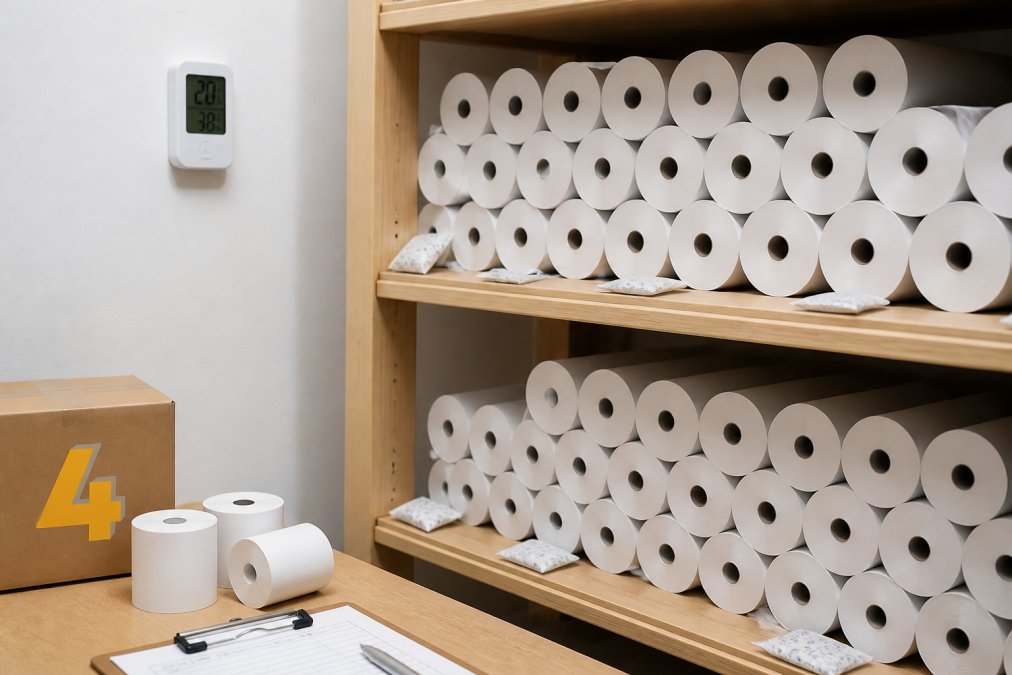
Store till rolls in a cool, dry environment, ideally between 15°C and 25°C with relative humidity between 45% and 65% (the CDC). Excessive heat accelerates coating degradation; excessive moisture causes the paper to curl and the coating to activate prematurely. Keep rolls away from direct sunlight, which fades the thermal coating. Store them in opaque boxes or closed cabinets rather than on open shelves.
Rotate stock using the FIFO method: first in, first out. Use older rolls before newer ones. Thermal paper has a shelf life of roughly 12-18 months under proper storage conditions, though this varies by coating quality.
Don't store rolls in the till itself or in the kitchen where heat from cooking equipment affects them. Store them separately in a designated supply area. Label boxes with the purchase date and product specifications so your team knows what's in stock and when it was ordered.
Cost-Per-Receipt Analysis: Finding True Value
Comparing till roll pricing requires looking beyond the per-roll cost. A cheaper roll might use thinner paper or lower-quality coating, meaning you need to replace it more frequently or deal with illegible receipts.
Calculate the cost per receipt by dividing the roll price by the number of receipts it prints. A standard 80x70mm roll prints roughly 500-600 receipts depending on print density and receipt length. A roll costing £1.50 that prints 500 receipts costs £0.003 per receipt; a cheaper roll at £1.00 that prints only 400 receipts costs £0.0025 per receipt, a minimal saving that disappears if the cheaper roll's coating fades and becomes unreadable.
Factor in waste. Rolls that tear, jam, or produce faded output waste your time and frustrate customers. Premium thermal paper has lower failure rates, reducing labour costs associated with printer troubleshooting and reprinting receipts.
Consider your restaurant's volume. A high-volume location with 500+ daily transactions justifies investing in premium coating quality because legible receipts prevent disputes and support accurate accounting. A small café with 50 daily transactions can afford to experiment with budget options because the absolute cost per location is low.
Track your actual consumption over three months to establish a baseline. This data informs smarter ordering decisions and helps you spot when a supplier's pricing has drifted.
Troubleshooting Common Printer Issues with Till Rolls
Many till roll problems aren't actually till roll problems; they're compatibility or handling issues.
Faded receipts usually mean either the thermal coating is degraded (storage issue) or the printer's heating element is failing. If new rolls from a different supplier still produce faint output, the printer needs servicing, not a different till roll.
Paper jams occur when the roll's outer diameter is too large for the printer's housing or when the core is damaged. Inspect the roll before inserting it. If the core is cracked or the roll is warped, it won't feed smoothly.
Misalignment, where the paper feeds crooked or off-centre, usually indicates the core diameter is wrong. A 19mm core in a printer designed for 12mm cores will sit loose and slip during printing.
Incomplete printing or missing characters suggests the printer's heating element needs cleaning. Dust and thermal coating residue accumulate on the print head, reducing contact with the paper. Clean the print head with isopropyl alcohol and a soft cloth.
Before blaming your supplier, rule out printer maintenance and compatibility issues first. Once you've confirmed the printer is working correctly, you can confidently evaluate whether the till rolls themselves are the issue.
Conclusion: Getting Cheap Till Rolls Without Compromising Quality
Finding cheap till rolls for restaurants means balancing cost with reliability. The lowest per-roll price isn't always the lowest total cost when you factor in waste, reprinting, and labour time spent troubleshooting poor-quality paper.
Shop4Rolls.ie offers competitive pricing on thermal paper, card machine receipt rolls, and all the packaging supplies your restaurant needs, all from one supplier with next-day delivery and a lowest price guarantee. Their team can confirm compatibility with your POS system before you order, eliminating the costly mistake of ordering the wrong size. With over 3,000 products in their purpose-built warehouse, you can consolidate your suppliers and simplify restocking.
Frequently Asked Questions
How do I know which size till roll my restaurant printer needs?
The most common sizes are 57mm and 80mm wide. Check your printer's manual or the current roll in your till to confirm. Measure the width and the core diameter (usually 12mm or 40mm). Write these down before ordering. If unsure, contact your printer manufacturer or the supplier's customer care team, ordering the wrong size wastes money and disrupts service.
Are there bulk-buying benefits for restaurant till rolls?
Yes. Buying in bulk reduces cost per roll significantly. Most suppliers offer tiered discounts, the more you order, the lower the unit price. Calculate your monthly usage first: count how many rolls you use weekly, multiply by 4, then order a 3-month or 6-month supply if storage allows. Bulk ordering also reduces delivery frequency, saving time and ensuring you never run short during busy periods.
How should I store thermal till rolls to prevent fading?
Store rolls in a cool, dry place away from direct sunlight, heat sources, and moisture. Ideal temperature is 15-25°C. Keep them in their original packaging or in sealed boxes to protect the thermal coating. Avoid stacking too many rolls on top of each other, which can compress the paper. Thermal paper fades over time if exposed to heat or light, so proper storage extends shelf life and ensures print clarity when you need receipts.
What's the difference between thermal and bond paper rolls?
Thermal rolls use heat-activated coating to print without ink, they're faster, cheaper per receipt, and require no maintenance. Bond paper (multi-ply) uses carbon or chemical layers and works with impact printers; it's slower and more expensive per receipt but produces multiple copies. Most modern restaurants use thermal for speed and cost efficiency. Choose thermal unless your POS system specifically requires bond paper or you need duplicate receipts.
Get started with Shop4Rolls.ie and streamline your till roll ordering with hassle-free bulk purchasing, reliable next-day delivery, and transparent pricing that eliminates supplier uncertainty.
This article was written using GrandRanker