 how-to
How to Calculate Packaging Needs for a New Online Store
Last Updated: October 29, 2026
Quick Summary
Packaging needs for a new online store depend on three inputs: expected orders per week, average items per order, and product mix. Measure every product, pick the smallest box that protects it, then multiply those numbers out per order to get monthly quantities.
- Use a conservative order forecast for your first month, not your best-case hope.
- Measure each product's length, width, height and packed weight before buying any boxes.
- Build a packaging bill of materials listing every component used in one order.
- Set your reorder point from your worst realistic lead time and busiest realistic day.
- Review your estimates after the first month and adjust orders against actual usage.
Table of Contents
- Start With Your Expected Order Volume and Product Mix
- Measure Your Products and Choose the Right Packaging Type
- Build a Packaging Bill of Materials per Order
- Work Out Quantities With Worked Examples for Different Store Sizes
- Set Safety Stock, Reorder Points and Supplier Lead Times
- How to Reduce Packaging Costs Without Risking Stockouts
- Review Your Estimates After Launch and Adjust Your Orders
- Frequently Asked Questions
Start With Your Expected Order Volume and Product Mix
Getting packaging right starts with a simple question: how many orders will you actually ship?
Packaging needs for new online stores depend on three things: expected orders, product mix, and how many items go in each parcel. Without those numbers, any packaging estimate is a guess.
Start with three inputs:
- Expected orders per week: Use a conservative figure for your first month, not your best-case hope.
- Average items per order: Count how many units a typical customer buys.
- Product mix: List your top products and the share of sales each one represents.
Early numbers will be rough. That is fine. Write them down anyway, because you will revise them after launch.
Measure Your Products and Choose the Right Packaging Type
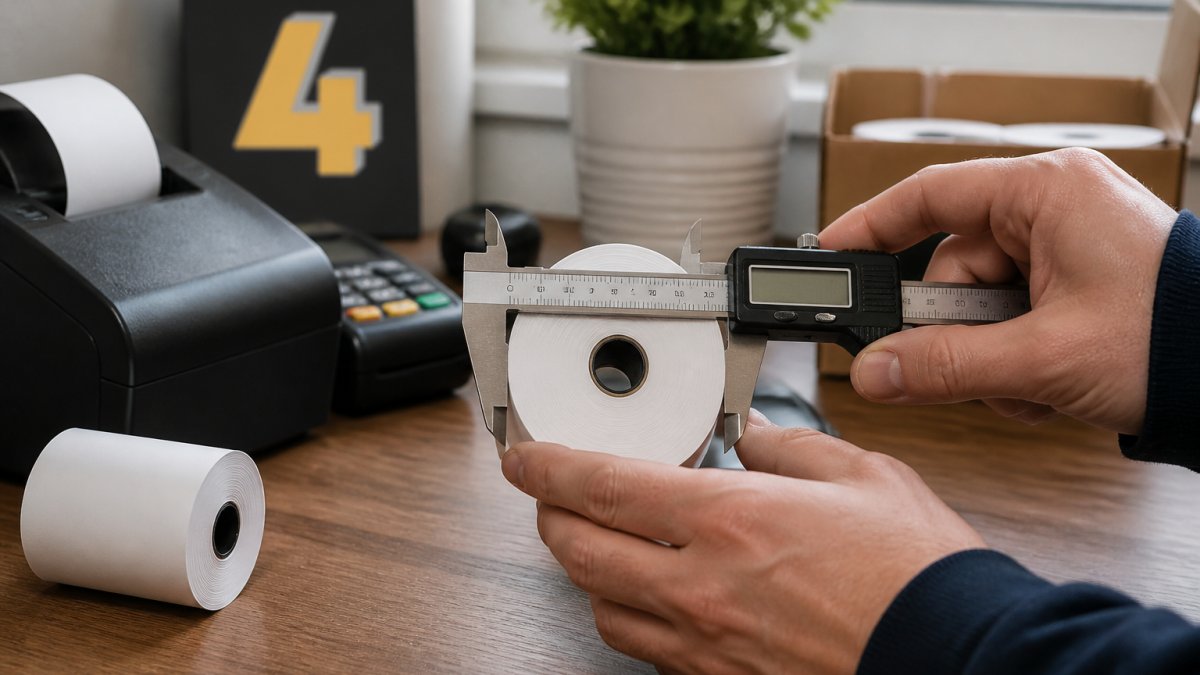
Measure every product before you buy a single box.
Packaging needs are shaped by these measurements. A 300mm bottle needs a different box to a folded jumper.
Common packaging types for online stores:
- Mailer bags: Light, flexible, suited to clothing and soft goods.
- Corrugated boxes: Sturdy, suited to fragile or heavy items.
- Padded envelopes: Suited to small, flat products.
Pick the smallest box that protects the product. Extra space adds void fill, extra cost and higher shipping charges.
Watch out: many new sellers choose one box size for everything. This wastes money on small items and risks damage on large ones.
Build a Packaging Bill of Materials per Order
A packaging bill of materials lists every component used in one order. Think of it as a shopping list for a single parcel.
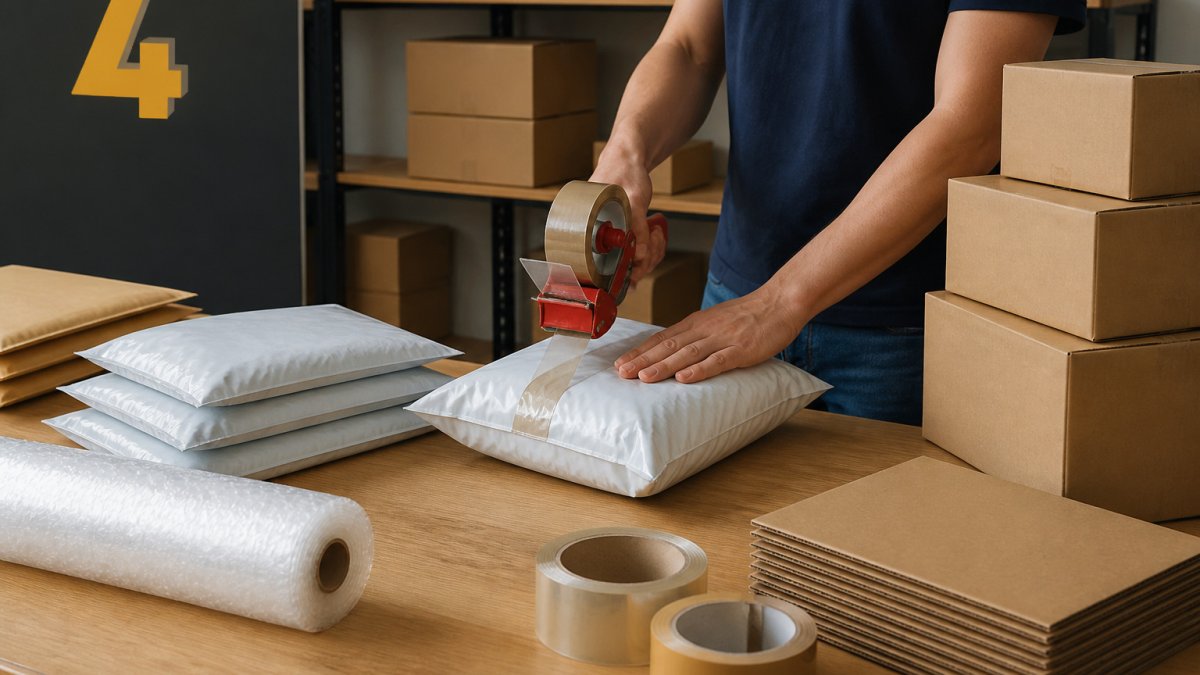
A typical list might include:
- One outer box or mailer bag
- Protective cushioning or void fill
- Packing tape
- A shipping label
- An insert or thank-you card
Multiply each item by your expected monthly orders. This gives you a realistic consumption figure for each component.
Here is a simple summary table to use as a template:
| Component | Per Order | Expected Monthly Orders | Monthly Total |
|---|---|---|---|
| Mailer bag | 1 | 200 | 200 |
| Void fill | 0.5 | 200 | 100 |
| Packing tape | 0.1 | 200 | 20 |
| Thank-you card | 1 | 200 | 200 |
Work Out Quantities With Worked Examples for Different Store Sizes
Most guides stop at 'estimate your orders'. The useful part is turning that estimate into a countable purchasing list. Below are three worked examples you can adapt. Each one starts from forecast orders, applies an order mix, and multiplies out a packaging bill of materials (BOM) per order profile.
The method is the same every time:
- Forecast monthly orders.
- Split those orders across order profiles (for example, soft-goods mailer, small boxed item, fragile item).
- Assign a BOM to each profile.
- Multiply profile orders by BOM quantities.
- Add a launch buffer (covered in the next section).
Example 1: Small launch, single product type (about 50 orders per month)
A store selling folded textiles only. Every order ships in a mailer bag with a thank-you card and a label.
| Component | Per order | Orders per month | Monthly total |
|---|---|---|---|
| Mailer bag | 1 | 50 | 50 |
| Thank-you card | 1 | 50 | 50 |
| Shipping label | 1 | 50 | 50 |
| Packing tape (per 100 orders) | 0.01 roll | 50 | 0.5 roll |
At 50 orders a month, a single case of 500 mailer bags covers roughly ten months. That is usually the right buy if storage is tight and cash is limited, provided the supplier's minimum order quantity (MOQ) is met.
Example 2: Mixed-SKU store (about 300 orders per month)
A store selling a mix of soft goods and small boxed items. Assume 60% of orders are soft goods (mailer) and 40% are boxed items (small corrugated box with void fill).
| Order profile | Share | Orders per month | BOM per order | Monthly component need |
|---|---|---|---|---|
| Soft goods | 60% | 180 | 1 mailer bag, 1 card, 1 label | 180 bags, 180 cards, 180 labels |
| Boxed item | 40% | 120 | 1 small box, 0.5 unit void fill, 1 label | 120 boxes, 60 void-fill units, 120 labels |
| Totals | 100% | 300 | , | 180 bags, 120 boxes, 60 void fill, 300 labels, 300 cards |
This is the step most new stores miss: the total is not '300 of everything'. It is 300 labels, but only 180 mailer bags and 120 boxes. Ordering 300 of each ties up cash in the wrong components.
Example 3: Fragile-product store (about 150 orders per month)
A store selling glassware. Every order needs a corrugated box, an inner wrap, void fill and a fragile label.
| Component | Per order | Orders per month | Monthly total |
|---|---|---|---|
| Corrugated box | 1 | 150 | 150 |
| Inner wrap (per item) | 1.2 (average items per order) | 150 | 180 |
| Void fill | 1 unit | 150 | 150 |
| Fragile label | 1 | 150 | 150 |
| Packing tape | 0.02 roll | 150 | 3 rolls |
Fragile stores should also budget for a damage allowance. A common pattern is to assume a small percentage of orders will need a replacement parcel, so add that to the monthly component need rather than discovering it after the first breakage.
Check MOQs and case sizes before you commit
Once you have monthly totals, compare them to what suppliers actually sell. If you need 50 mailer bags but the MOQ is a case of 500, your real decision is cash and storage versus unit price.
Pricing depends on quantity, dates and delivery, so check current prices on the Shop4Rolls.ie website or request a quote before you commit to a bulk order.
Set Safety Stock, Reorder Points and Supplier Lead Times
A reorder point is the stock level that triggers a new order. Get it wrong and you either run out mid-week or tie up cash in boxes you will not use for months. The formula is simple, but the inputs need to be honest.
The formula
Reorder point = (average daily usage × average lead time in days) + safety stock
Where:
- Average daily usage = monthly component need ÷ 30 (use 21 if you only ship on weekdays).
- Average lead time = days from placing the supplier order to stock being on your shelf, including any customs or courier delay you have actually seen.
- Safety stock = a buffer for demand spikes and late deliveries.
Setting safety stock
A common starting point is one to two weeks of usage, but the right number depends on two things: how variable your demand is, and how reliable your supplier is.
- Stable demand, reliable supplier: one week of usage is often enough.
- Seasonal or launch-period demand: two weeks or more.
- Long or unreliable lead times: size the buffer against the worst lead time you have seen, not the average.
A simple way to set it: safety stock = (maximum daily usage × maximum lead time) − (average daily usage × average lead time). This is the gap between a normal day and a bad day, and it is the amount you need on the shelf to cover the difference.
Worked example
A store uses 10 mailer bags a day on average, but on busy days it uses 15. The supplier's average lead time is 3 days, but has been as long as 5.
- Average usage × average lead time = 10 × 3 = 30 bags
- Maximum usage × maximum lead time = 15 × 5 = 75 bags
- Safety stock = 75 − 30 = 45 bags
- Reorder point = 30 + 45 = 75 bags
So the store reorders when stock hits 75 bags, not 30. The extra 45 is the buffer that covers a busy week combined with a slow delivery.
Reorder quantity
The reorder point tells you when to order; the reorder quantity tells you how much. A practical approach is to order enough to cover the lead time plus a review period, minus what is already on the shelf and on order:
Order quantity = (daily usage × (lead time + review period)) + safety stock − stock on hand − stock on order
If the store above reviews stock weekly (7 days), uses 10 bags a day, has a 3-day lead time, holds 75 bags and has 100 on order:
- (10 × (3 + 7)) + 45 − 75 − 100 = 100 + 45 − 175 = −30
A negative result means no order is needed yet, the stock on hand and on order already cover the next review period. Recalculate each week rather than ordering on a fixed schedule.
Supplier lead times to confirm before you rely on them
Ask each supplier for four numbers in writing: standard lead time, lead time during peak season, MOQ, and whether they hold stock or manufacture to order. To compare supply models, see bulk packaging solutions versus standard retail supply. A supplier who manufactures to order will have a longer and more variable lead time than one shipping from stock, and that difference should feed directly into your safety stock.
How to Reduce Packaging Costs Without Risking Stockouts
Lower packaging costs do not have to mean running short. Three practical steps help:
- Right-size your boxes: Smaller boxes cut void fill and dimensional weight charges.
- Buy in full cases when volume allows: Check that a bulk order does not tie up cash you need elsewhere.
- Review slow-moving lines: Drop products that sell rarely from your stock list.
A common mistake is cutting safety stock to save money. A single stockout can cost more in lost orders than the saving.
Review Your Estimates After Launch and Adjust Your Orders
Your first estimates will be wrong. That is expected. The goal is to correct them quickly.
After your first month, compare:
- Actual orders against your forecast
- Actual packaging used against your bill of materials
- Any damage claims or returns linked to packaging
Adjust your bill of materials and reorder points based on what you find. Most stores refine their numbers within three months.
Packaging planning is not a one-off task. Review it monthly, and your stock levels will steadily become more accurate.
Frequently Asked Questions
How do I determine the right size packaging for my products?
Measure each product's length, width and height, then add room for protective cushioning on every side. Choose the smallest box that fits the padded product, because a box that is too large adds void fill and raises your shipping cost through dimensional weight charges. Test a few sample products packed in your chosen box before ordering in bulk, and check that the item cannot move around once sealed.
What is the minimum order quantity for packaging?
Minimum order quantities vary by supplier, packaging type and whether the item is standard stock or custom printed. Standard mailers and boxes are often sold in smaller lots, while custom-branded packaging usually requires larger runs. Shop4Rolls.ie's website shows current product quantities and pricing, and pricing depends on quantity, dates and delivery. Confirm the minimum before you calculate your first order.
How can I reduce packaging costs for my small business?
Right-size your boxes so you pay less for materials and shipping, buy standard sizes you can use across several products, and order in quantities that match your forecast rather than over-stocking. Track how much void fill each order uses and cut back where possible. Review your numbers every few months, as order volumes change quickly for new stores.
How do I forecast packaging inventory to avoid stockouts?
Estimate expected orders per week using your sales forecast and product mix, then multiply by the packaging components each order needs. Add safety stock to cover demand spikes and supplier lead times, and set a reorder point at the stock level that will last until a new delivery arrives. Revise these figures after your first few months of trading.