 how-to
7 Steps to Choose Cost-Effective Shop Consumables
Last Updated: October 25, 2026
Quick Summary
Cost-effective shop consumables are chosen by identifying what your business needs, calculating total cost of ownership beyond unit price, and comparing bulk buying against your actual usage patterns and storage capacity. The cheapest per-unit price rarely delivers the lowest total cost when delivery, storage, waste, and reorder frequency are factored in.
- Total cost of ownership includes unit price, delivery costs, storage, waste allowance of 5-10%, and reorder frequency, not just shelf price.
- Bulk packs only save money when your weekly usage clears the pack within its realistic shelf life and you have dry, cool storage space.
- Supplier reliability on stock availability and lead-time consistency matters more than price alone, as stock-outs force emergency orders at premium prices.
- Set a reorder point based on weekly usage plus a 20% safety buffer and lead-time stock to avoid running out and prevent over-ordering.
- Test quality markers like paper thickness, print clarity, core construction, and protective packaging with a small trial pack before committing to bulk orders.
Table of Contents
- Step 1: Identify Your Essential Shop Consumables
- Step 2: Calculate Total Cost of Ownership for Consumables
- Step 3: Assess Till Rolls and Receipt Rolls Compatibility
- Step 4: Compare Bulk Buying Shop Supplies Against Your Usage
- Step 5: Evaluate Retail Packaging Supplies Quality and Durability
- Step 6: Review Supplier Reliability and Stock Availability
- Step 7: Set Up Reorder Points and Inventory Controls
- Making Your First Order with a Trusted Supplier
- Frequently Asked Questions
Step 1: Identify Your Essential Shop Consumables
Choosing cost-effective shop consumables starts with knowing exactly what your business needs.
Walk through your shop: what runs out first, and what slows your team when stock is low?
Common items include:
- Till rolls and thermal rolls
- Card machine receipt rolls
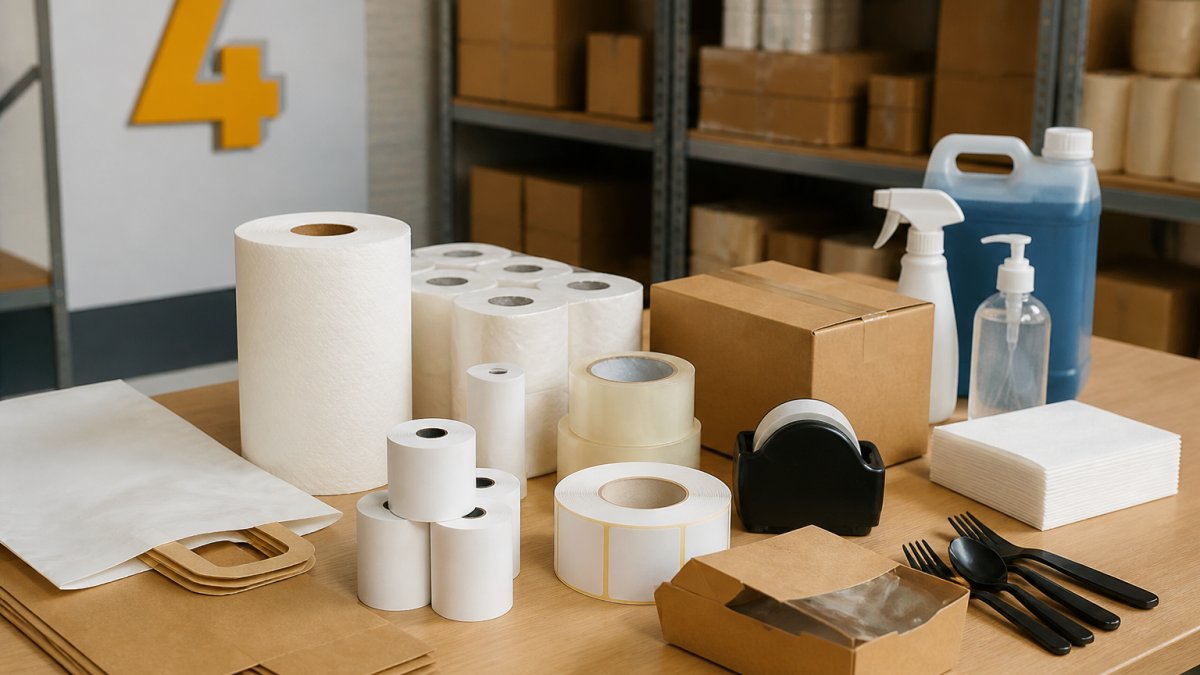
- Packaging supplies (Jiffy bags, polythene bags, tape)
The businesses that control costs best know what they need before they shop.
Document your usage patterns: how many till rolls and card machine receipt rolls do you use per week?
Step 2: Calculate Total Cost of Ownership for Consumables
Total cost of ownership (TCO) is the real price you pay: unit price plus delivery, storage, waste, and reorder frequency.
A cheaper till roll that arrives late costs more than a slightly pricier one delivered on time.
Calculate TCO this way: Learn strategies for optimizing supply chain costs to support this process.
- Find the unit price. Divide the pack price by the number of items. A box of 20 till rolls for €40 costs €2 per roll.
- Add delivery costs. If delivery is €15 and you order every month, that's €15 per order.
- Factor in storage. Bulk stock needs room, and shelf space you can't use for other things still has a cost.
- Account for waste. Some consumables expire or get damaged. Budget 5-10% waste into your calculation.
- Consider reorder frequency. Ordering weekly costs more in time and effort than ordering monthly.
guidance on calculating total cost of ownership shows that businesses often overlook hidden costs.
Your true cost per item tells you which option actually saves money.
Step 3: Assess Till Rolls and Receipt Rolls Compatibility
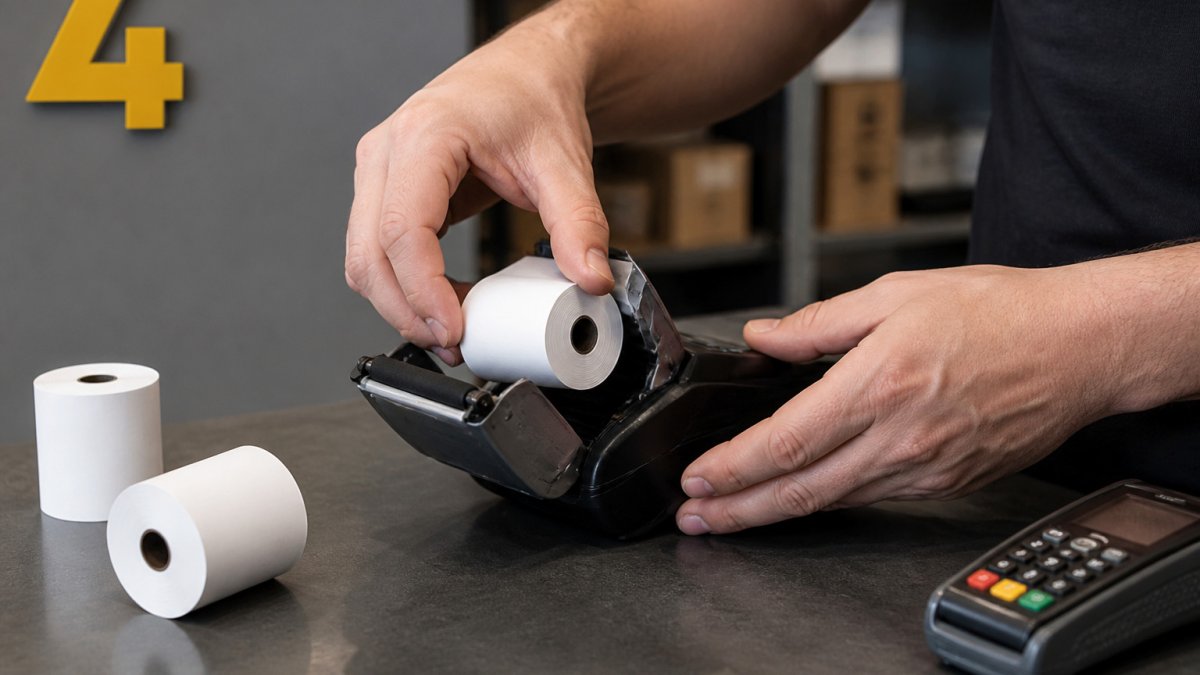
Choosing the wrong till roll or receipt roll is expensive: you order the wrong size, can't use it, or your card machine jams.
Check your equipment first. Look at the till or card machine. Find the model number. Write it down.
Then check the roll specifications:
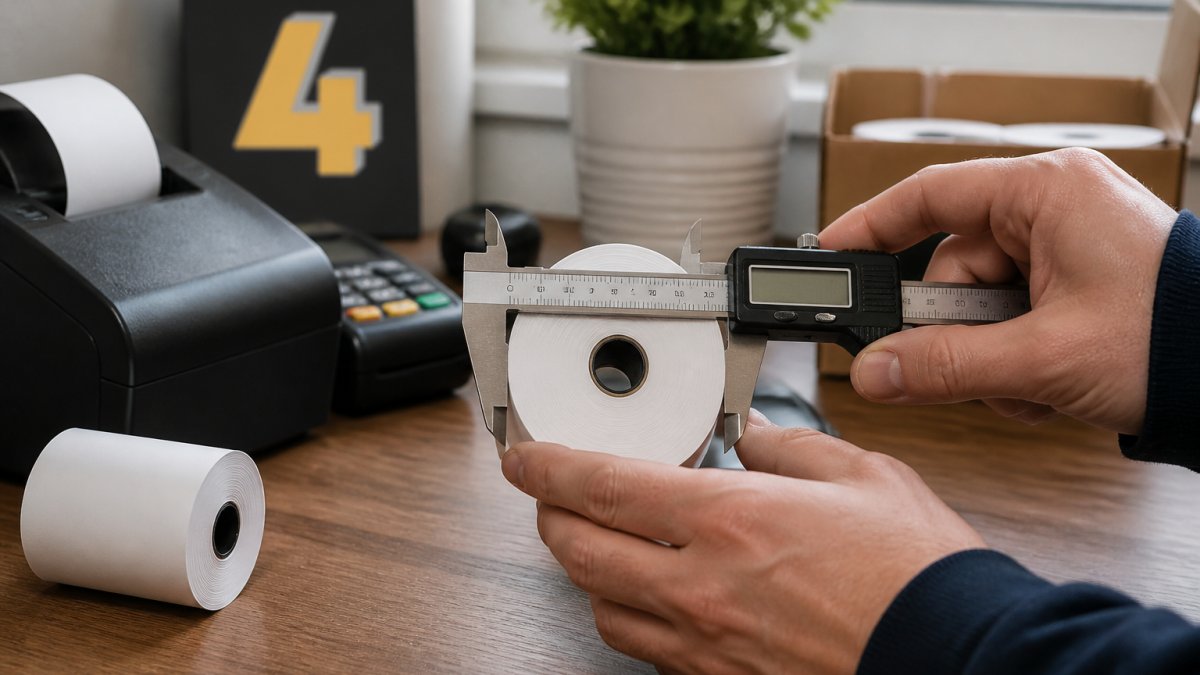
- Diameter: Most till rolls are 80mm or 57mm. Card machine rolls are typically 57mm.
- Width: Standard widths are 80mm or 58mm. Thermal rolls vary by machine.
- Core size: The cardboard tube inside the roll must fit your machine's spindle.
If you've ordered the wrong size before, you're not alone. Many retailers buy from multiple suppliers and end up with incompatible stock.
Step 4: Compare Bulk Buying Shop Supplies Against Your Usage
Bulk buying saves money per unit, but only when the discount beats the cost of holding extra stock. The useful question is when the bulk pack pays for itself once storage, tied-up cash, and waste are counted.

The break-even formula
Use this three-step calculation for any consumable where a larger pack is on offer:
- Saving per unit = (small-pack unit price) − (bulk-pack unit price).
- Extra units you must use = (extra cost of the bulk pack) ÷ (saving per unit). This is the number of additional units you must consume before the bulk pack is cheaper overall than buying the small pack twice.
- Weeks to clear the bulk pack = (bulk pack quantity) ÷ (your weekly usage). If that figure is longer than the consumable's realistic shelf life, the bulk pack is a false economy.
Worked example using illustrative prices:
| Pack size | Unit price | Pack cost | Saving vs 20-pack | Extra units to break even | Weeks to clear at 8 rolls/week |
|---|---|---|---|---|---|
| 20 rolls | €1.50 | €30.00 | , | , | 2.5 weeks |
| 50 rolls | €1.20 | €60.00 | €0.30/roll | 100 extra rolls | 6.3 weeks |
| 100 rolls | €1.00 | €100.00 | €0.50/roll | 140 extra rolls | 12.5 weeks |
At 8 rolls a week, the 50-pack only breaks even after roughly 100 extra rolls, about 12.5 weeks beyond the first 20-pack, and the 100-pack needs 140 extra rolls, or roughly 17.5 weeks. With thermal paper's 6-12 month shelf life, the 100-pack only makes sense for a higher-volume shop.
The costs the shelf price hides
- Storage cost. Bulk stock occupies space that could hold sellable product, a pallet taking 1 m² of a €200/m²/year back room consumes €200 a year.
- Cash tied up. Money spent on six months of till rolls isn't available for faster-turning stock. Compare the bulk discount against the return from deploying that cash elsewhere.
- Waste and damage. Thermal paper degrades with heat, light, and humidity, so rolls stored near a radiator or in sunlight can print faintly or jam. Budget a realistic 5-10% waste allowance into the bulk pack's effective cost.
When bulk buying wins
Bulk buying is the cheaper choice when all three of these are true:
- Your weekly usage clears the pack within its realistic shelf life.
- You have dry, cool storage space that is not displacing faster-moving stock.
- The size and specification are stable, you are not about to change equipment.
If any one fails, buy the smaller pack and put the saved cash and space to work elsewhere. The benefits of bulk buying retail consumables are real, but they are conditional on usage matching pack size, not on the discount alone.
Step 5: Evaluate Retail Packaging Supplies Quality and Durability
Cheap consumables often fail when you need them most: a till roll that tears mid-transaction costs time, and a receipt roll that doesn't feed properly can damage your card machine.
Check these quality markers:
- Paper thickness. Thermal paper should feel substantial, not flimsy. Thicker paper resists tearing.
- Print quality. Receipts should be dark and clear. Faded or patchy printing suggests poor thermal coating.
- Core construction. The cardboard tube should be rigid, not crushed or soft.
Ask your supplier for a sample, order a small pack, and use it for a week. If quality is poor, you haven't wasted money on bulk stock.
Retail packaging supplies from a reliable supplier last longer, reduce waste, prevent equipment jams, and keep checkout running smoothly.
Step 6: Review Supplier Reliability and Stock Availability
A cheap supplier who runs out of stock costs you more than a slightly pricier one who always has what you need. Reliability isn't a feeling, it's a set of measurable terms you can compare before you commit.
Score suppliers on the terms that actually cost you money
Build a simple scorecard. For each supplier, record the following and score each 1-5:
| Criterion | What to record | Why it matters |
|---|---|---|
| Stock availability | Whether your specific items are in stock today, and how often they have been out of stock in the last 90 days | Out-of-stock items force emergency orders at premium prices |
| Lead time | Quoted delivery days, and the actual days on your last three orders | Variability, not the average, causes stock-outs |
| Minimum order quantity (MOQ) | The smallest order they will accept, and whether it applies per line or per order | A high MOQ forces you to over-buy slow-moving lines |
| Price-break thresholds | The order value or quantity at which the unit price drops | You may be one pack short of a cheaper tier without realising |
| Delivery fees | Flat fee, free-delivery threshold, and surcharges for timed or weekend delivery | A €15 fee on a €40 order is a 37.5% uplift |
| Payment terms | Days to pay, and whether early-payment discounts are offered | Terms affect cash flow as much as price |
| Returns policy | Whether damaged or wrong-size stock is credited, and who pays return carriage | Wrong-size rolls are a common and avoidable loss |
| Communication | Whether they notify you proactively of delays or substitutions | Late notice turns a delay into a stock-out |
The lead-time variability trap
A supplier quoting "2-3 days" sounds fine until one in five deliveries arrives on day five. That variability forces you to hold safety stock, and safety stock is a cost. Ask for their actual on-time delivery rate over the last quarter, or track it over your first three orders: a consistent three-day lead time is cheaper to plan around than one averaging two days but occasionally taking six.
Price-break thresholds: the order you almost got right
Many suppliers price in tiers, a lower unit rate once your order passes a stated value or quantity. Before ordering, ask what the next price break is and how far your basket is from it: topping up with a fast-moving line you'll use anyway can drop the whole order into a cheaper tier. Equally, splitting an order across two months to stay under a free-delivery threshold can cost more in fees than the tier saving is worth.
Minimum order quantities and slow-moving lines
A high MOQ is not automatically bad, it is bad when it applies to a line you use slowly. Map your consumables into two groups:
- Fast movers (till rolls, carrier bags, tape): high MOQs are usually fine because you will clear them.
- Slow movers (specialist labels, seasonal packaging, uncommon receipt sizes): a high MOQ turns into dead stock. For these, favour suppliers with low or no MOQ, even at a slightly higher unit price.
Returns, damages, and wrong sizes
Before your first order, ask who pays carriage on a return and what the window is for reporting damage or wrong sizes. A supplier who credits damaged stock promptly and covers return carriage is worth a small premium, writing off a pallet of crushed rolls wipes out any unit-price saving. Get the terms in writing.
Putting the scorecard to work
Score your current supplier and one alternative across the eight criteria above. Where the alternative wins on two or more criteria that matter to your highest-volume lines, trial it on those lines only. Where your current supplier wins on lead-time consistency and returns, keep them for the lines where a stock-out is most expensive. The goal is not one perfect supplier, it is a short list where each is used for what they are genuinely best at.
Shop4Rolls.ie runs a purpose-built warehouse with over 3,000 products in stock, offers next-day delivery, and publishes clear terms on minimum order quantities and returns so you can score us against the framework above. Our one-stop packaging supplier model means ordering from one place instead of juggling three suppliers, but the scorecard still applies, and we expect to be measured by it.
Step 7: Set Up Reorder Points and Inventory Controls
The best way to avoid running out is to reorder before you're desperate. Set a reorder point, the stock level at which you automatically place a new order, like this:
- Find your weekly usage. Track how many till rolls you use per week. Let's say 10 rolls.
- Add a safety buffer. Add 20% extra for unexpected spikes. That's 12 rolls per week.
- Calculate lead time stock. If delivery takes 2 days, you need 4 rolls to cover that gap.
- Set your reorder point. When stock hits 16 rolls (4 days of usage plus buffer), place a new order.
Reorder points stop you running out and prevent over-ordering: you order regularly in amounts that match your usage instead of sitting on months of stock. Track inventory with a simple spreadsheet or your till system's built-in feature, check stock weekly, and order automatically when you hit the reorder point.
Making Your First Order with a Trusted Supplier
Once the analysis is done, choosing a supplier comes down to reliability, range, and price: one who stocks what you need, delivers on time, and offers fair pricing.
small business purchasing guidance recommends consolidating suppliers to reduce complexity and improve terms. When you buy all your consumables from one place, you build a relationship.
Shop4Rolls.ie is Ireland's leading one-stop supplier for till rolls, receipt rolls, and packaging supplies.
Place an order with us today. We'll help you find the exact consumables your business needs.
Frequently Asked Questions
What is the difference between cost per unit and total cost of ownership for consumables?
Cost per unit shows only the price of one item, but total cost of ownership includes the unit price, storage space required, waste or damage, replacement frequency, and supplier delivery costs. For example, cheaper till rolls that tear easily may cost more overall because you replace them more often and waste paper. Calculating total cost of ownership ensures you're comparing true value, not just the lowest sticker price.
Is it cheaper to buy shop supplies in bulk?
Bulk buying usually offers lower per-unit prices, but only if you use the stock before it expires or deteriorates. Small retailers with limited storage or low consumption may pay more in total cost because they waste excess stock or tie up cash in inventory. Calculate your monthly usage, storage capacity, and shelf life before committing to bulk orders. The savings depend on your specific business needs, not just the bulk discount.
How do I choose the right till rolls and receipt rolls for my equipment?
Check your point-of-sale system or card machine manual for the exact specifications: width in millimetres, core diameter, and paper type (thermal or bond). Ordering the wrong size wastes money and disrupts service. Reliable suppliers provide compatibility guides or customer support to confirm the correct roll before you order. Always verify specifications before placing your first order to avoid costly mistakes.
What should I check before choosing a consumables supplier?
Verify stock availability for your essential items, delivery speed and reliability, whether they offer a price guarantee, range of products (to consolidate suppliers), and how they handle out-of-stock situations. Ask about minimum order quantities, return policies, and whether they provide account support. A supplier with poor stock visibility or slow delivery can disrupt your business, so reliability matters as much as price.