 how-to
Choosing Right Polythene Bags for Shipping: 2026 Guide
Table of Contents
- Quick Comparison: Polythene Mailing Bag Types
- How to Choose the Right Polythene Bags for Shipping
- Mailing Bag Size Guide: Dimensions That Cover Common Items
- Recycled Mailing Bags: What to Check Before You Switch
- Weight, Labels and Storage: What Most Buyers Miss
- Sourcing the Best Wholesale Packaging Supplies for Your Business
- Common Mistakes When Buying Polythene Bags for Shipping
- Conclusion
- Frequently Asked Questions
Last Updated: September 10, 2026
Quick Comparison: Polythene Mailing Bag Types
Choosing right polythene bags for shipping starts with knowing which format suits your goods. A polythene mailing bag is a lightweight, flexible plastic shipping envelope, usually made from low-density polyethylene, designed to protect non-fragile items in transit while keeping postage costs down.
| Bag Type | Thickness | Best For | Key Trait |
|---|---|---|---|
| Standard poly mailer | 50-60 micron | Clothing, soft goods | Lightweight, cheap to post |
| Opaque mailer | 60 micron | Apparel, gifts | Hides contents |
| Grey mailing bag | 55-70 micron | General e-commerce | Recycled content, tear-resistant |
| Padded poly bag | 70-90 micron | Small electronics | Impact resistance |
| Biodegradable mailer | 50-60 micron | Eco-conscious brands | Compostable film |
The table covers the main categories; what follows explains how to pick between them without overpaying for protection you do not need.
How to Choose the Right Polythene Bags for Shipping
The right polythene bag is the lightest one that still survives the journey intact. Start with the item's dimensions, work backwards to thickness, then confirm the closure and finish match your labelling method.
Most buyers get this backwards: they pick a bag they like, then find it is too small, too thin, or too opaque to take a printed label cleanly.
Measure the Item, Then Add Clearance
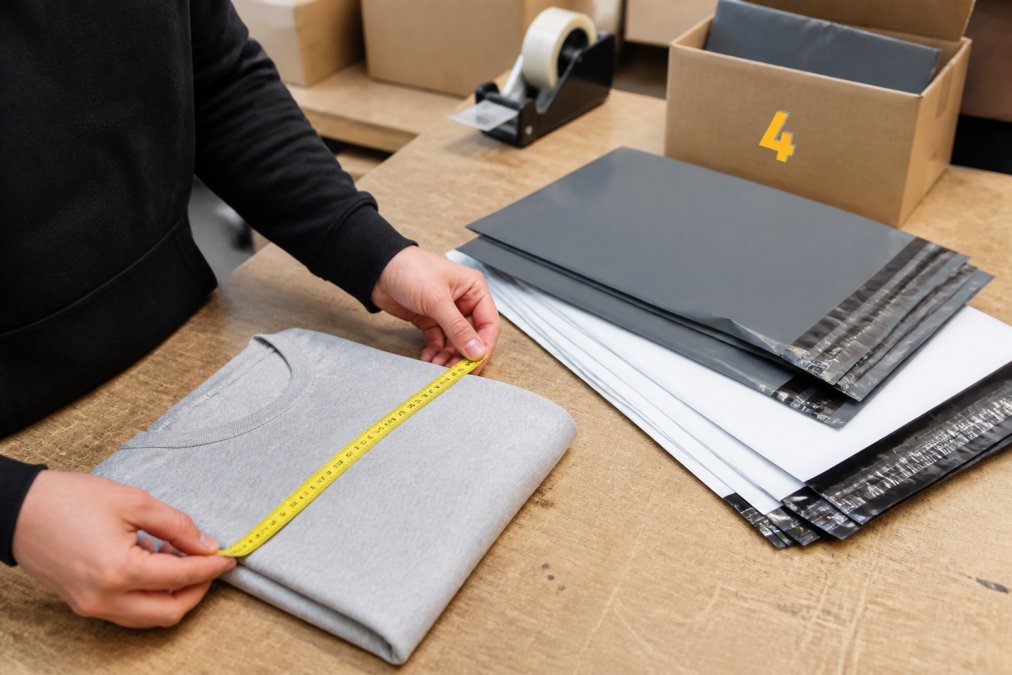
Measure the item at its widest and longest points, folded as it will ship, then add clearance. Measuring flat and ordering a bag that barely fits once folded is a common mistake.
- Fold the item the way it will actually travel
- Measure length and width at the widest points
- Add 2-4 cm clearance on each dimension
- Check the bag's usable internal size, not the external size
The gap between internal and external dimensions trips up first-time buyers: a bag listed at 30 x 40 cm may offer only around 28 x 38 cm of usable space once seams and lip are accounted for.
Match Thickness to What You Are Sending
Thickness, measured in micron or gauge, determines how much abuse a bag survives. Thin bags suit soft goods; anything with edges or weight needs more.
- Soft clothing and textiles: 50-60 micron
- General e-commerce parcels: 60-70 micron
- Items with sharp corners or moderate weight: 70-90 micron
Gauge and micron are not the same unit: micron is metric, gauge is an older imperial measure some suppliers still use. Convert to a single unit before comparing quotes, or you may compare a thin bag against a thick one without realising it.
Mailing Bag Size Guide: Dimensions That Cover Common Items
Sizing is where most returns and re-orders originate. A size guide only helps if it maps to real items, so here is how common products translate into bag dimensions.
| Item | Folded Size | Suggested Bag |
|---|---|---|
| T-shirt | 25 x 35 cm | 30 x 40 cm |
| Hoodie | 30 x 40 cm | 35 x 45 cm |
| Pair of jeans | 30 x 38 cm | 35 x 45 cm |
| Paperback book | 13 x 20 cm | 18 x 25 cm |
| Phone case | 10 x 18 cm | 15 x 22 cm |
| Small accessories | 15 x 20 cm | 20 x 25 cm |
Keep two or three sizes rather than one "universal" bag. Oversized bags cost more in dimensional weight and let contents shift; undersized bags force overfolding, which stresses seams.
Recycled Mailing Bags: What to Check Before You Switch
Recycled mailing bags are a straightforward swap for most e-commerce operations, provided you check the recycled content claim and confirm the film still meets your thickness needs. The catch is verification.
How to Verify a Recycled Content Claim
Terms like "eco-friendly" and "sustainable packaging" carry no fixed legal definition, so suppliers can use them loosely. To separate genuine recycled content from greenwashing, work through four checks:
- Ask for the percentage, in writing. "Made with recycled materials" is not a number. A credible supplier will state a figure such as 30%, 50% or 80% post-consumer recycled (PCR) content on the product specification sheet.
- Ask what type of recycled content. Post-consumer waste (material recovered from end users) is generally considered a stronger environmental claim than pre-consumer or post-industrial waste (scrap from the manufacturing process). Both are legitimate, but they are not equivalent.
- Request the certificate and its number. Where a certification is claimed, ask for the certificate number and the issuing body, then check that number directly with the body. A certificate you cannot independently verify is not evidence.
- Check the film still meets your thickness spec. Recycled film can behave slightly differently from virgin film. It may feel marginally stiffer or have a different surface finish, which matters if you rely on a smooth, static-free surface for label adhesion. Confirm the micron rating is unchanged before you switch a live product line.
Ireland's environmental regulator, the Environmental Protection Agency, publishes guidance on waste and packaging obligations that is worth reading before you make environmental claims on your own packaging. Consumer protection rules also apply to claims you print, so the wording on your mailer is a regulated statement, not marketing copy.
What Changes When You Switch to Recycled Film
Three practical differences show up most often:
- Surface finish. Recycled film can be slightly more matte or textured, which affects how cleanly a thermal label bonds.
- Colour consistency. Batch-to-batch colour variation is more common with recycled content, which matters if your packaging is part of your brand presentation.
- Stiffness. Some recycled films feel stiffer at the same micron rating, which can change how easily a bag folds around soft goods.
None are dealbreakers, but test each on a sample before a bulk order: run your normal packing routine for a week with the recycled version and compare tear rates, label adhesion and customer feedback against your current bag.
Weight, Labels and Storage: What Most Buyers Miss
Bag choice affects three costs most buyers ignore: shipping weight, label adhesion, and shelf life. Getting these right often saves more than shaving a cent off the unit price.
Cutting Cost by Shipping Weight, Not Just Bag Price
The cheapest bag per unit is not always the cheapest to ship. Carriers price by actual or dimensional weight, whichever is greater, so a bulky oversized bag can push a light item into a higher band.
Dimensional weight is calculated from the parcel's volume, not its mass, so a large, lightly filled poly mailer is charged for the space it occupies rather than the few hundred grams it weighs. That is why a 30 x 40 cm bag and a 35 x 45 cm bag can sit in different pricing tiers even when they hold similar items.
Buying one large bag size to "cover everything" adds volume, and volume is what dimensional weight charges you for. Matching bag size to item size keeps parcels in lower weight bands, and the per-parcel saving usually outweighs any difference in unit price.
A practical pattern most high-volume shippers follow:
- Keep two or three bag sizes that cover the bulk of your order profile, not one universal size.
- Measure a packed sample of each product and note the parcel dimensions, not just the item dimensions.
- Compare the volumetric weight of your packed parcel against the actual weight, and use whichever is higher to estimate the shipping band.
- Re-check the band whenever you change bag size or add padding, because a small volume increase can tip a parcel into the next tier.
Label Compatibility: Adhesive, Texture and Thermal Printing
Shipping labels adhere best to a smooth, dry, dust-free surface. Textured or heavily recycled films can reduce adhesion, so test a label on a sample bag before a bulk order. A label that peels in transit means a returned parcel.
Three variables determine whether a label stays put:
- Surface energy of the film. Polyethylene has a low surface energy, which is why some adhesives struggle to bond to it. Suppliers sometimes treat the film to improve adhesion, so ask whether the bag is surface-treated if you have had peeling issues.
- Adhesive type on the label. Standard permanent adhesives work well on smooth poly mailers. If you use a removable or freezer-grade adhesive, test it specifically, as these are formulated for different substrates.
- Application temperature and pressure. Labels bond best when applied at room temperature with firm, even pressure. Applying a label to a cold or damp bag, or in a cold dispatch area, reduces the initial tack and increases the chance of lifting.
Thermal shipping labels are the most common choice for e-commerce dispatch and generally perform well on standard poly mailers; the risk rises with recycled, matte or textured films. Simple test: apply a label to a sample bag, leave it 24 hours, then try to peel it. If it lifts cleanly at the edges, the combination is not reliable for transit.
Storage and Shelf Life: Protecting the Adhesive Strip
Storage matters too. Polythene bags keep well stored flat, out of direct sunlight and away from heat sources; sunlight and heat degrade the film over time, making it brittle and prone to tearing at the seams.
The self-seal adhesive strip is often the first component to fail, not the film. Adhesive can dry out, lose tack or become contaminated with dust if bags are stored open or in a dirty environment. To protect it:
- Keep bags in their original packaging until needed, and reseal the outer carton after each use.
- Store flat rather than compressed, so the adhesive strip is not under constant pressure.
- Keep stock away from radiators, windows and unheated damp areas, as both heat and moisture affect adhesive performance.
- Rotate stock so older bags get used first, and avoid holding more than a few months of supply unless you have dry, temperature-stable storage.
If you buy in bulk to hit a wholesale price break, factor in how long that stock will realistically sit. A slightly higher unit price on a smaller, more frequent order can be cheaper overall if it prevents a pallet of bags from ageing past its useful life.
Sourcing the Best Wholesale Packaging Supplies for Your Business
Sourcing well means buying the right specification at wholesale pricing, with stock you can rely on: consistent quality, dependable availability, and a price that holds up at volume.
Shop4Rolls.ie stocks polythene mailing bags alongside more than 3,000 other retail and operational products, so you can restock packaging and till rolls in a single order rather than juggling suppliers. Our lowest price guarantee and purpose-built warehouse mean the specification you order is the specification that arrives, and our customer care team ensures a professional, helpful, and efficient experience.
Common Mistakes When Buying Polythene Bags for Shipping
Most buying errors trace back to the same handful of habits. Fix these and your re-order rate drops sharply.
- Ordering by external dimensions. Usable internal space is smaller, so bags arrive "too small" for items that should fit.
- Buying one size for everything. Oversized bags raise dimensional weight and let contents shift.
- Ignoring micron when comparing quotes. A cheaper quote is often a thinner bag.
- Skipping the label test. Adhesion varies by surface finish, and a peeling label means a lost parcel.
- Storing bags in sunlight or near heat. Film degrades and tears at the seams.
- Trusting unverified eco claims. Ask for documentation before printing anything on your packaging.
Conclusion
Getting the specification right takes an afternoon of measuring and one test order, but it pays back on every parcel you ship. Businesses that struggle usually buy on unit price alone, then absorb the cost of returns, re-orders and rejected claims later.
Shop4Rolls.ie makes the sourcing side simple: over 3,000 products in one place, a lowest price guarantee, reliable stock from our own warehouse, and a dedicated customer care team. Sign up now and get your packaging and operational supplies restocked in a single order.
Frequently Asked Questions
How do I choose the right size polythene bag for my products?
Measure your item's length, width and depth, then add 2-4cm to each dimension so it slides in without stretching the film. For clothing, fold it flat first, since a folded jumper needs far less space than a loose one. Always check the internal dimensions of the bag rather than the external ones, because the self-adhesive strip and side seams reduce usable space. If your item sits between two sizes, go up rather than down.
What thickness of polythene is required for secure shipping?
Thickness is measured in microns, and most shipping bags sit between 40 and 70 microns. Light clothing and soft goods travel safely in 40-50 micron film. Heavier items, boxed goods or anything with sharp corners need 60-70 microns to resist punctures in transit. Below 40 microns, tear resistance drops noticeably and bags can split at the seam when stretched. If you ship mixed orders, standardising on 60 microns removes guesswork.
Are recycled mailing bags as strong as standard ones?
Good-quality recycled mailing bags perform close to standard ones for most shipping, because the strength comes from the film structure rather than virgin material alone. Ask for the recycled content percentage and check whether the supplier holds a recognised certification, so the claim is verifiable rather than a label on a box. Recycled film can vary slightly in colour and surface finish, which does not affect protection but may matter if you print branding on the bag.
Can I write or stick labels directly onto polythene bags?
Yes, but the surface matters. Most polythene mailing bags accept standard thermal labels and adhesive address labels well, provided the bag is clean and dry. On very smooth or glossy film, some labels lift at the edges, so press firmly and avoid stretching the bag after applying the label. Writing directly with a marker works on matte finishes but smudges on gloss. If you use a courier's own label, apply it flat and away from the seam.