 ultimate-guide
Credit Card Rolls: The 2026 Buying Guide
Table of Contents
- Why the Right Credit Card Rolls Matter for Your Business
- How to Measure Till Roll Diameter Accurately
- Thermal Paper Roll Sizes Guide: Finding Your Match
- Best Practices for Storing Thermal Paper
- Compatibility Checklist: Will These Rolls Fit Your Terminal?
- Bulk Buying Credit Card Rolls: What to Look For
- Troubleshooting Common Receipt Printer Issues
- Frequently Asked Questions
Last Updated: September 25, 2026
Why the Right Credit Card Rolls Matter for Your Business
The wrong credit card rolls cost you more than a few euro. They jam your terminal mid-transaction, produce faded receipts, and force staff to stop serving people while they reload paper.
Choosing the right credit card rolls is about matching three measurements to your specific machine: paper width, roll diameter, and core size. Get those right and the rest, from bulk pricing to storage, becomes straightforward.
Here's what most buying guides skip: a roll can look identical to another on the shelf and still fail in your PDQ machine. The difference is usually the core, the cardboard tube at the centre. A roll with the wrong core diameter will spin loosely or refuse to turn at all. Below, we'll cover measuring rolls accurately, matching them to common terminals, storing them properly, and buying in bulk without overpaying.
How to Measure Till Roll Diameter Accurately
Measuring till roll diameter accurately takes about two minutes and saves you the cost of a wrong order. You need the roll's outer diameter, width, and core inner diameter, write all three down before you shop.
Tools You Need for an Accurate Measurement
A ruler or measuring tape handles width and diameter fine. For the core, measure across the inside of the tube; digital callipers give a cleaner read, since core sizes come in tight increments and a millimetre of error means a poor fit.
Step-by-Step Measuring Process
- Take a part-used roll from your terminal, not a fresh one in its wrapper.
- Measure the paper width across the roll face in millimetres.
- Measure the outer diameter across the full roll.
- Measure the inner diameter of the cardboard core.
- Note the paper's finish, whether it's standard thermal or a heavier grade.
- Check the terminal model number, usually on a sticker underneath.
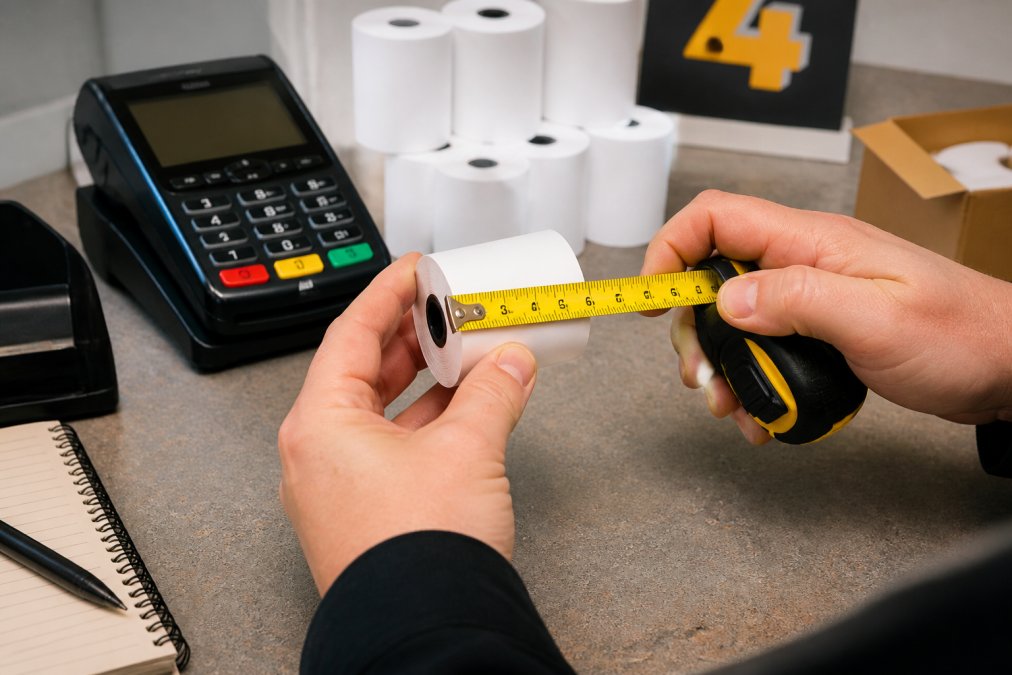
Width trips people up most often: it's the face of the roll, not the diameter across the top.
Thermal Paper Roll Sizes Guide: Finding Your Match
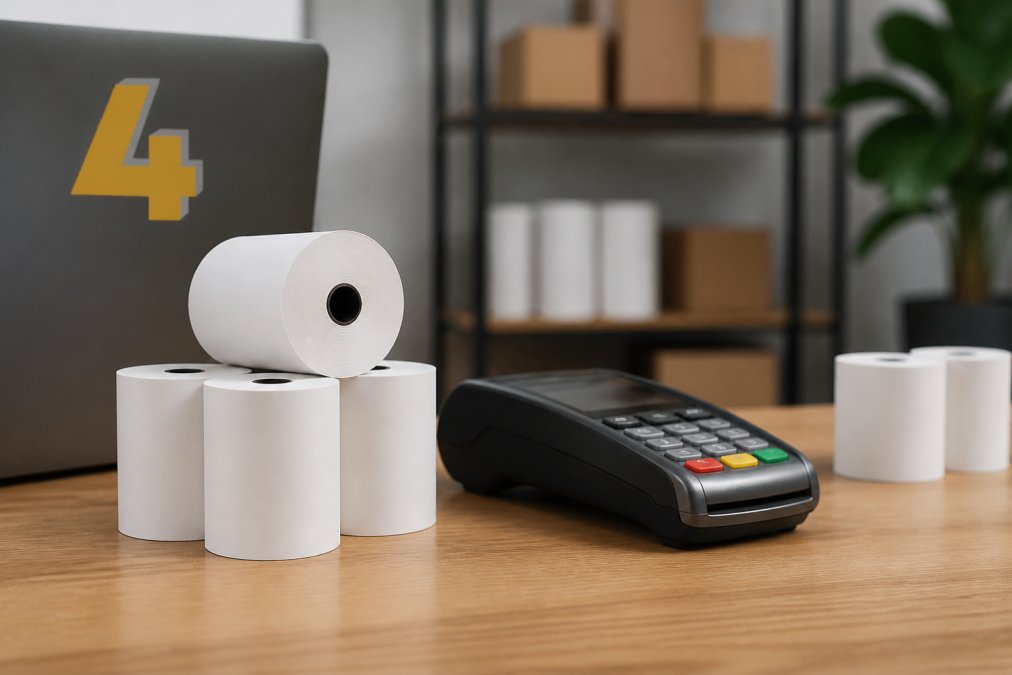
Matching your roll size comes down to width and core diameter. Handheld card machines and smaller PDQ units typically take 57mm rolls; countertop cash registers and larger receipt printers usually take 80mm. But width alone isn't enough, the core diameter and outer roll diameter must fit the spindle and compartment, and the paper grade must suit the print head.
Common Widths and Core Sizes for PDQ Machines
| Roll Type | Paper Width | Common Core Size | Typical Outer Diameter | Typical Use |
|---|---|---|---|---|
| Small handheld | 57mm | 12mm or 15mm | 40-50mm | Handheld PDQ machines, mobile card readers |
| Standard till | 57mm | 12mm or 15mm | 50-60mm | Compact cash registers, some card terminals |
| Large countertop | 80mm | 12mm or 18mm | 60-80mm | Full-size receipt printers, busy checkouts |
| Heavy-duty | 80mm | 25mm | 80-120mm | High-volume retail, warehouse despatch |
Core size is where compatibility genuinely breaks down. A 57mm roll with a 12mm core and one with a 15mm core look identical from the outside, but only one sits correctly on your spindle. If unsure, check the terminal's documentation or ask your supplier to cross-reference the model.
Terminal Model Cross-Reference
Use this table to identify the most common roll specification for popular terminal families. Always confirm against your specific model number, as manufacturers sometimes revise spindle designs within a product line.
| Terminal Family | Typical Roll Width | Typical Core | Notes |
|---|---|---|---|
| PAX S-series (e.g. S80, S90) | 57mm | 12mm | Compact handheld; check compartment depth for max diameter |
| PAX A-series (e.g. A920) | 57mm | 12mm | Android terminal; standard 57mm roll |
| Ingenico Move series | 57mm | 12mm | Handheld; some models accept 15mm core with adapter |
| Ingenico Desk series | 57mm or 80mm | 12mm or 18mm | Countertop; confirm width before ordering |
| Verifone VX series | 57mm | 12mm | Older handhelds; core tolerance is tight |
| Verifone P-series | 57mm | 12mm | Modern handheld; standard roll |
| Epson TM-T88 series | 80mm | 12mm or 18mm | Countertop receipt printer; high-volume |
| Star Micronics TSP series | 80mm | 12mm or 18mm | Countertop; check paper guide width |
Paper Grade and Weight
Thermal paper is graded by weight (gsm) and coating quality. Standard rolls are typically 48-55gsm; heavier grades run 60-70gsm and resist smudging and fading better, holding more paper per diameter so you reorder less often. If receipts must survive handling, sunlight, or heat, for warranty claims or VAT records, choose a higher-grade, fade-resistant roll. Cheaper, thinner paper saves a few cent per roll but costs more in jams, reprints, and complaints.
Best Practices for Storing Thermal Paper
Storing thermal paper correctly protects the coating that makes receipts print. That coating reacts to heat, light, and certain chemicals, so poor storage shows up later as faded or blank receipts, not visible damage on the roll.
- Keep rolls sealed in original wrappers until use
- Store below 25°C and out of direct sunlight
- Keep away from solvents, cleaning agents, and strong adhesives
- Rotate stock so older rolls get used first
- Avoid storing rolls in damp stockrooms or near kitchen heat
Compatibility Checklist: Will These Rolls Fit Your Terminal?
Checking compatibility takes more than matching a width number. Before you buy any credit card rolls, confirm the width, core diameter, outer roll diameter, paper grade, and unwind direction against your terminal's requirements. The checklist below covers the full set, followed by the mechanics behind each point.
- Paper width matches your terminal (57mm or 80mm)
- Core diameter matches your spindle (12mm, 15mm, 18mm, or 25mm)
- Outer roll diameter fits inside the terminal's paper compartment
- Paper grade suits your printing needs (standard or heavier weight)
- Roll direction matches the feed path (check which way the paper unwinds)
- Spindle tolerance is correct (roll turns freely but does not wobble)
- Paper thickness does not exceed the print head gap
Why Each Check Matters
Width. A roll 1mm too wide catches on the housing and jams; 1mm too narrow wanders and prints off-centre. 57mm and 80mm are standard, but some terminals use 44mm or 76mm, measure rather than assume.
When to Cross-Reference the Model Number
If you're ordering for a specific terminal model, a supplier with a broad range can cross-reference it for you. Shop4Rolls.ie stocks a vast selection of till rolls and card machine receipt rolls, so matching an unusual terminal is usually a matter of checking the model number rather than hunting across several suppliers. Provide the make, model, and any revision number from the label underneath the terminal, and ask for the recommended roll specification.
Bulk Buying Credit Card Rolls: What to Look For
For businesses running several terminals, standardising on a few roll types simplifies everything: fewer SKUs means less chance of staff grabbing the wrong roll and less storage space tied up in near-duplicate stock.
Troubleshooting Common Receipt Printer Issues
If problems persist after a fresh roll and a clean head, the fault is in the hardware rather than the paper, a technician is the sensible next step.
Frequently Asked Questions
How do I know which size credit card roll my machine needs?
Check the label on your current roll or the manual for your terminal. The two key measurements are paper width (commonly 57mm or 80mm) and core diameter. You can also measure the old roll with a ruler. If unsure, note your terminal model and ask your supplier. Ordering the wrong width is the most common mistake, so measure twice before buying.
What is the difference between thermal and standard paper rolls?
Thermal paper rolls have a special coating that darkens when heated by the print head, so they need no ink or ribbon. Standard paper rolls require a ribbon or ink cartridge to print. Most modern card machines and POS systems use thermal paper because it is faster, quieter, and produces clearer receipts. Thermal rolls are not interchangeable with standard rolls.
How should I store thermal credit card rolls to prevent fading?
Keep rolls in their original packaging until use. Store them in a cool, dry place away from direct sunlight, heat sources, and bright lights. Avoid storing near solvents, cleaning products, or plastics containing PVC, as fumes can degrade the thermal coating. Properly stored rolls last for several years and print clearly. Once a roll is loaded, use it within a reasonable time to avoid environmental exposure.
Why is my card machine printing blank receipts?
Blank receipts usually mean the roll is loaded upside down. The thermal coating only reacts on one side, so flip the roll and test again. If that does not fix it, check that the paper is not past its shelf life or was stored in a hot, damp place. A dirty print head can also cause blank or patchy output; clean it gently with an approved cleaning pen.