 ultimate-guide
How Much Do Receipt Rolls Cost? A 2026 Pricing Guide
Table of Contents
- What Actually Drives the Cost of Receipt Rolls
- How to Measure Till Roll Diameter Accurately
- Bulk Buy Till Rolls Ireland: When Volume Cuts Unit Cost
- Thermal Paper Storage Best Practices
- Printer Compatibility and POS System Checks
- Environmental Impact and BPA-Free Options
- Troubleshooting Printer Jams and Fading Receipts
- Conclusion
- Frequently Asked Questions
Last Updated: September 22, 2026
What Actually Drives the Cost of Receipt Rolls
Understanding what determines receipt rolls cost comes down to four variables: paper width, roll length, core size, and paper density. Change any one of these and the unit price shifts, sometimes by a significant margin. This guide from Shop4Rolls.ie breaks down each factor so you can compare quotes properly instead of guessing.

Paper Width and Roll Length
Thermal paper rolls are measured by width, length, and diameter. Standard till rolls for cash registers are usually 57mm wide by 57mm diameter, while card machine receipt rolls are typically 57mm by 40mm or 57mm by 50mm. The wider and longer the roll, the more paper you get, and the higher the unit cost.
Core Size and Paper Density
Core diameter is the hollow centre of the roll, usually 12mm or 25mm. A smaller core means more paper wound onto the same roll diameter, giving you more receipts per roll. Paper density, measured in GSM, affects both print quality and how long a roll lasts. Lower GSM paper is cheaper but produces fainter, faster-fading receipts.
How to Measure Till Roll Diameter Accurately
Measuring till roll diameter accurately takes under a minute with a ruler or tape measure. Place the roll flat on a surface and measure straight across the widest point of the wound paper, not including any loose tail. Record the width of the paper separately by measuring across the roll's face.
Follow these steps:
- Lay the roll flat on the counter
- Measure across the full diameter of the wound paper in millimetres
- Measure the paper width across the face of the roll
- Measure the core opening at the centre
- Check your printer manual or the existing roll's label to confirm the specification
Bulk Buy Till Rolls Ireland: When Volume Cuts Unit Cost
Buying in bulk lowers the unit cost of receipt rolls because suppliers spread fixed costs, packing, palletising, and delivery, across a larger order, and because the paper itself is bought in larger mill runs. Most suppliers, including Shop4Rolls.ie, publish box quantities and wholesale pricing tiers that step the per-roll price down as order volume rises.
Working Out Your Break-Even Volume
Before committing to a bulk order, run three numbers:
- Annual roll usage, count how many rolls your tills and card machines consume in a normal week, then multiply by 52.
- Storage capacity, measure the shelf or cupboard space you can dedicate to paper, in boxes. Thermal rolls are bulky; a six-month order for a busy counter can fill a small stockroom.
- Shelf life, thermal coating degrades over time, so stock held beyond roughly 12 to 18 months in poor conditions may print faintly before it is used.
If your annual usage is lower than the quantity needed to reach the next pricing tier, the tier is not a saving, it is dead stock. The break-even point is where the per-roll saving on the larger order exceeds the cost of the rolls you will not use before they degrade.
Calculating Your Cost Per Receipt
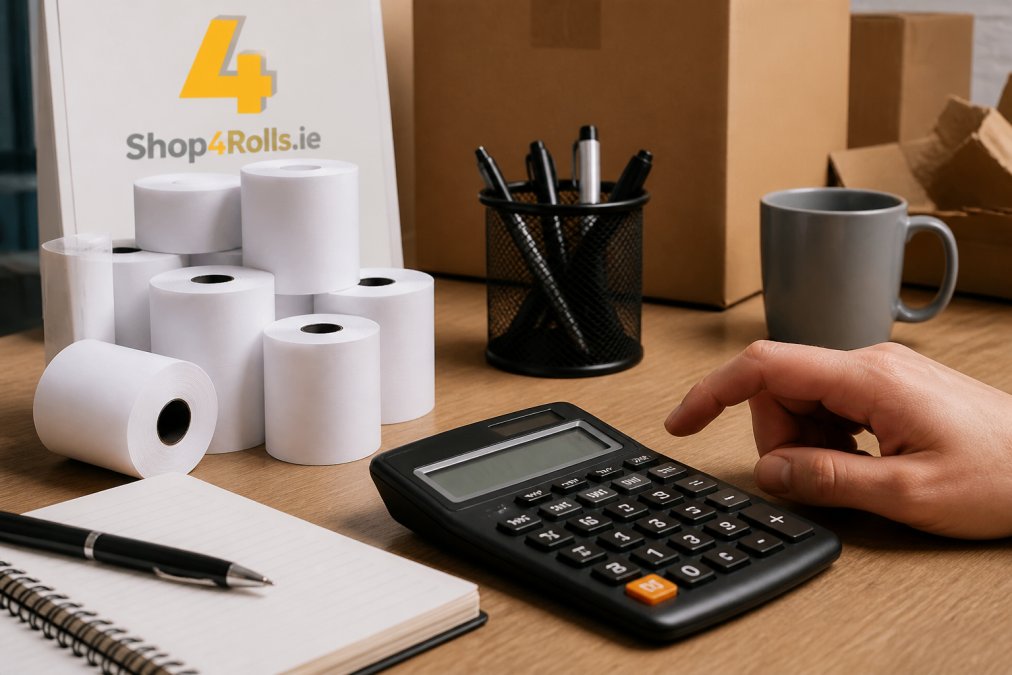
Cost per receipt is the only figure that matters for budgeting. Divide the price of a box by the number of receipts you can print from it.
| Variable | What to Record | Why It Matters |
|---|---|---|
| Box price | Total cost per box | Baseline for the calculation |
| Rolls per box | Count per pack | Determines total paper volume |
| Metres per roll | Length in metres | Affects how many receipts you get |
| Receipts per roll | Estimate from your till | Ties cost to real usage |
| Cost per receipt | Box price ÷ total receipts | The number to compare |
What to Ask a Supplier Before a Bulk Order
- The metre length and GSM of the roll, not just the diameter
- Whether the pricing tier is based on boxes, pallets, or spend
- Delivery lead time and whether freight is included at your order size
- Whether the same roll specification is held in stock year-round, so a reorder matches the first
Getting these answers in writing before you commit avoids the most common bulk-buying mistake: buying a large quantity of a roll that turns out to be a different length or grade from the one your printer was set up for.
Thermal Paper Storage Best Practices
Thermal paper storage best practices protect print quality and shelf life. Thermal coating reacts to heat, light, friction, and certain chemicals, so poor storage causes receipts to fade or print faintly. Keep stock in its original packaging, away from direct sunlight, and in a cool, dry area.
Printer Compatibility and POS System Checks
Printer compatibility checks prevent the most common ordering error. Before buying, confirm that your receipt printer or card machine accepts the roll width, diameter, and core size you intend to order. Epson, Star, and Ingenico terminals, for example, each specify particular roll dimensions.
Check three things:
- Paper width in millimetres
- Maximum roll diameter the printer housing allows
- Core diameter the spindle requires
Environmental Impact and BPA-Free Options
Most guides stop at "choose BPA-free." The more useful question is which paper specification actually fits your business, because the environmental options differ in cost, print behaviour, and shelf life, and the cheapest green-sounding choice is not always the lowest-impact one.
The Three Options Compared
Standard thermal paper uses a developer in the coating that reacts to heat to form the print. It is the cheapest per roll and the most widely stocked. The trade-off is that some developers have raised health and environmental concerns, and standard paper is not recyclable in most kerbside streams because the coating contaminates the pulp.
The Cost Trade-Off
Going BPA-free typically adds a small amount per roll. Going recycled or FSC certified can add more, depending on availability and the mill run. The right way to judge the premium is the same as any other paper decision: convert it to cost per receipt. A few pence per roll spread across thousands of receipts is a fraction of a penny per transaction, usually far less than the cost of a single printer service call.
The Bigger Lever: Waste
For most businesses, the largest environmental gain is not the paper specification at all. It is reducing waste:
- Match roll size to actual usage so you are not discarding part-used rolls
- Store paper correctly so fewer rolls fade and get thrown away
- Switch to digital receipts where customers prefer them, which removes the paper entirely for that transaction
- Recycle cores and packaging through the correct stream rather than general waste
A Practical Decision Path
- Confirm the roll dimensions your printer requires, this does not change with the paper grade
- Ask whether a BPA-free version is stocked in that size
- Request the GSM and metre length so you can compare cost per receipt, not cost per box
- Trial one box before ordering in bulk
- Review your storage and usage to cut waste alongside any specification change
Handled this way, the environmental choice becomes a straightforward specification decision rather than a vague commitment.
Troubleshooting Printer Jams and Fading Receipts
Most printer jams trace back to three causes: the wrong roll size, a loose paper tail, or a dirty print head. Fading receipts, by contrast, usually point to low-grade paper or heat exposure rather than a printer fault.
Try these fixes:
- Confirm the roll matches the printer's specified dimensions
- Trim the paper tail cleanly before loading
- Clean the print head with a soft cloth and approved cleaning wipe
- Check storage conditions if fading occurs across a whole box
- Test a roll from a different batch to isolate a paper fault
Conclusion
Working out what receipt rolls cost is really about matching the right specification to your actual usage, then comparing cost per receipt rather than cost per box. Get the width, diameter, core size, and paper grade right, store your stock properly, and the savings follow.
Frequently Asked Questions
How much does a standard thermal receipt roll cost?
The receipt rolls cost depends on several factors: paper width, roll length, core diameter, paper density (GSM), and order volume. A standard 57mm x 40mm roll bought in single packs costs more per unit than the same roll bought in boxes of 20 or more. BPA-free and FSC certified papers also carry a slightly higher unit price. For current pricing on specific sizes, check the Shop4Rolls.ie website directly.
Does buying receipt rolls in bulk save money?
Yes. When you bulk buy till rolls Ireland suppliers typically offer wholesale pricing that lowers the unit cost by a meaningful margin compared to single-pack purchases. The saving comes from reduced packaging, handling, and delivery costs per roll. For a busy retail or hospitality business going through several rolls a week, moving from single packs to box quantities is one of the simplest ways to cut your point-of-sale consumables spend.
How do I calculate the cost per receipt for my business?
Divide the total cost of a box of rolls by the number of receipts you can print from that box. First, work out how many receipts one roll produces (roll length in metres divided by average receipt length in metres). Multiply that by the number of rolls in the box, then divide the box price by that total. This gives you a cost-per-receipt figure that makes it easy to compare suppliers on real value, not just headline roll price.
What factors influence the price of thermal till rolls?
The main factors are paper width (57mm and 80mm are the most common), roll length, core diameter, paper thickness or GSM, and whether the paper is BPA-free or FSC certified. Order volume has the biggest impact on unit cost: wholesale pricing for box quantities is significantly lower than single-roll pricing. Delivery charges and packaging also affect the final price you pay per roll.