 comparison
Is Thermal Printer Paper Worth It for Retail in 2026?
Table of Contents
- The Real Cost of Thermal Printer Paper for Retail
- Thermal Paper vs Bond Paper Cost: A Direct Comparison
- Pros and Cons of Thermal Printing in High-Demand Environments
- How to Measure Till Roll Diameter Accurately
- How to Store Thermal Paper Rolls for Maximum Longevity
- Environmental Impact and Disposal of Thermal Paper
- Conclusion: Is Thermal Printer Paper Worth It for Your Retail Business?
- Frequently Asked Questions
Last Updated: September 17, 2026
The Real Cost of Thermal Printer Paper for Retail
Whether thermal printer paper is worth it for retail comes down to one question: does the money you save on ink and toner outweigh the cost of the paper itself? For most high-volume tills, the answer is yes. This guide from Shop4Rolls.ie breaks down the real numbers, the hidden costs, and the storage rules that decide whether thermal printer paper pays for itself.
Direct Thermal Technology Explained
Direct thermal printing is a method that creates text and barcodes by applying heat to a chemically treated paper, with no ink, toner, or ribbon involved. The thermal print head touches the paper's heat-sensitive coating, and the coating darkens where the heat lands. That is the entire mechanism: no cartridges to replace, no ribbons to thread, no ink to dry out between quiet trading days.
Thermal Paper vs Bond Paper Cost: A Direct Comparison
The upfront cost of a thermal roll is higher than a plain bond paper roll. That comparison is misleading on its own, because bond paper needs ink or toner to become a receipt, and thermal paper does not. The only comparison that answers 'is it worth it' is total cost of ownership (TCO) per 1,000 receipts, measured over a realistic trading period.
Building a TCO Figure for Your Till
TCO per 1,000 receipts is made up of four cost lines. Add them, divide by the number of receipts you actually print, and you have a figure you can compare against any alternative.
- Paper or media cost, the price of the roll divided by the number of receipts that roll produces. A standard 57 x 40 mm till roll typically yields a few hundred receipts depending on receipt length; a 80 x 80 mm roll yields fewer per roll but more per metre.
- Ink, toner, or ribbon cost, zero for direct thermal, ongoing for bond or impact printing. This is the line that usually decides the outcome.
- Maintenance and downtime, print head cleaning, jam clearance, and the labour cost of a till being out of action during trading hours.
- Wastage, part-used rolls discarded on roll-size changes, faded stock, and mis-ordered sizes that cannot be used.
Worked Comparison at Volume
A common pattern in high-volume retail is that the paper line looks expensive in isolation but the consumable line it replaces is larger. To test this for your own till, use your own figures in the structure below rather than relying on someone else's averages.
| Cost Factor | Thermal Paper | Bond Paper + Ink/Toner |
|---|---|---|
| Paper cost per roll | Higher | Lower |
| Ink or toner needed | None | Yes, ongoing |
| Ribbon needed | None | On impact printers |
| Print head cleaning | Periodic, lint-free paper helps | Regular |
| Paper jam risk | Lower with correct roll size | Higher on mismatched rolls |
| Cost per print at volume | Falls as volume rises | Stays tied to cartridge prices |
| Wastage risk | Roll-size mismatch, faded stock | Ink drying out, part-used cartridges |
The Break-Even Question
The break-even point is the receipt volume at which the extra paper cost per receipt is fully offset by the ink or toner cost you no longer pay. Below that volume, a low-use till may find bond or impact printing cheaper on paper alone. Above it, thermal almost always wins because the consumable line disappears entirely.
Three practical rules follow from this:
- High-volume tills (busy convenience, forecourt, quick-service) sit well above break-even and should default to thermal.
- Low-volume tills (occasional-use counters, back-office printing) may not, and should calculate before switching.
- Mixed estates should not assume one answer fits every till. Run the four-line TCO per machine, not per business.
Integration With Your Existing POS
Switching to thermal paper rarely requires a hardware overhaul. Most retail POS systems and card machines already use direct thermal print mechanisms, and the change is a consumable change, not a software one. The practical checks are:
- Confirm your POS or card machine specifies direct thermal, not impact or inkjet.
- Confirm the roll dimensions (width, outer diameter, core diameter) match the printer housing and spindle.
- Confirm the paper grade suits the print speed, very high-speed heads need a coating matched to the head temperature.
- Confirm your supplier can hold stock of that exact size, so a reorder does not force a reconfiguration.
Pros and Cons of Thermal Printing in High-Demand Environments
Thermal printing wins on speed and simplicity. It loses on longevity and heat sensitivity. Whether that trade is acceptable depends entirely on what the receipt is for.
Pros:
- No ink, toner, or ribbons to buy or replace
- Fast print speed, which keeps queues moving at checkout
- Fewer moving parts, so less maintenance downtime
- Clear, high-contrast output for barcode scanning
Cons:
- Prints fade over time, especially in heat or direct sunlight
- Not suitable for records you need to keep for years
- Paper costs more per roll than plain bond paper
- Requires correct roll sizing to avoid jams
How to Measure Till Roll Diameter Accurately
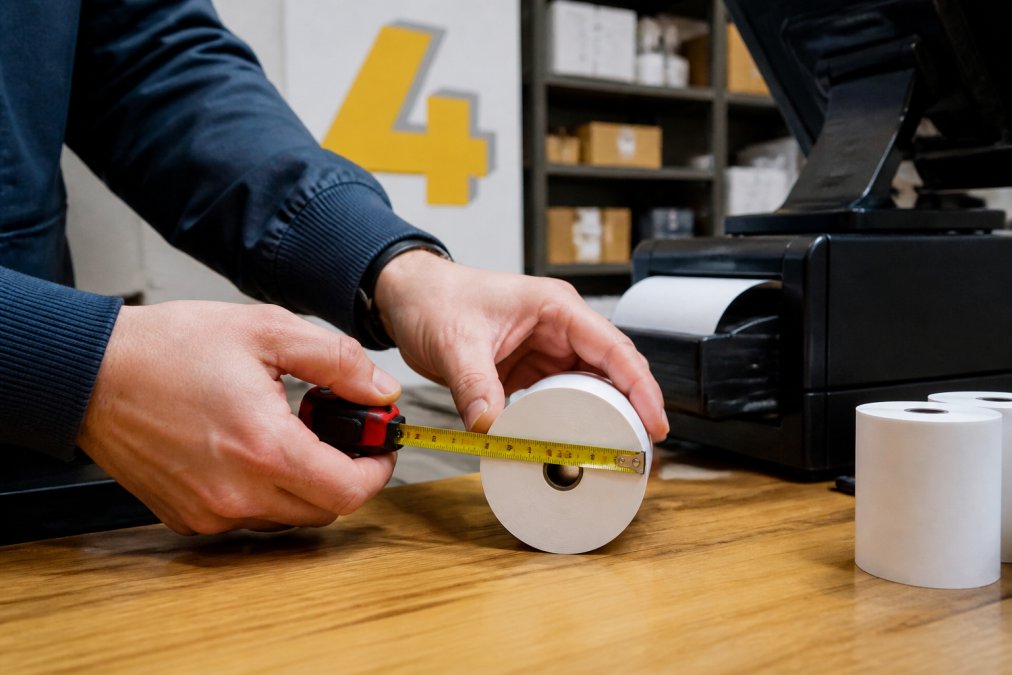
To measure a till roll accurately, lay the roll flat and measure across the full circle through its centre with a tape or ruler, then measure the core separately. The outer diameter decides whether the roll fits your printer housing; the core size decides whether it feeds onto the spindle.
- Measure the paper width across the roll face
- Measure the outer diameter through the centre
- Measure the core diameter across the inner tube
- Note the paper length if stated, as it affects how often you reorder
- Check all three against your printer's specification before ordering
How to Store Thermal Paper Rolls for Maximum Longevity
Store thermal paper rolls in a cool, dark, dry place, away from direct sunlight and heat sources. Print longevity depends more on storage than on the paper itself.
- Keep rolls in their original packaging until use
- Avoid storing near radiators, ovens, or south-facing windows
- Do not leave spare rolls in a hot car or delivery van
- Keep rolls away from plasticisers, which can react with the coating
- Use older stock first, as coating sensitivity declines over time
Environmental Impact and Disposal of Thermal Paper
Most articles stop at 'choose BPA-free'. That is only half the answer. The harder question for an eco-conscious retailer is what happens to the paper after the customer walks out, and the honest answer is that thermal paper is often not recyclable even when it is BPA-free.
Why Thermal Paper Is a Problem in Recycling Streams
The colour in a thermal receipt comes from a heat-sensitive coating, not from ink. That coating is what makes the paper behave differently from ordinary office paper in a recycling process. Two issues arise:
- Chemical content. Historically the coating used bisphenol A (BPA). Many suppliers now offer BPA-free alternatives, but 'BPA-free' does not mean 'coating-free', the paper still carries a reactive layer that mills must manage.
- Pulp yield and contamination. Coated and chemically treated papers can contaminate a pulp batch, and many mills and waste contractors therefore treat thermal receipts as a contaminant rather than a feedstock.
What This Means in Practice
Disposal rules vary by waste contractor and local authority, so the correct first step is to check with yours before adding thermal rolls or used receipts to a recycling bin. In practice, most retail thermal paper is treated as general waste unless your contractor confirms otherwise. Do not assume that a BPA-free label makes the paper recyclable, those are two separate claims.
A workable decision path:
- Ask your waste contractor whether they accept thermal receipts and used thermal rolls, and in which stream.
- Ask your paper supplier whether the specific roll is BPA-free, and whether the supplier publishes a coating or material statement.
- Separate where required. If your contractor treats thermal paper as general waste, brief staff so receipts do not end up in the mixed recycling bin.
- Reduce at source. The most reliable environmental lever is buying only what you need, in the right size, so faded or mis-sized stock is not wasted.
The Two Decisions That Actually Reduce Impact
For most retailers, the environmental impact of thermal paper comes down to two decisions that are fully within their control:
- Choose BPA-free stock where a supplier offers it, and ask for confirmation in writing rather than relying on a product title.
- Buy to actual usage. Over-ordering leads to faded stock, part-used rolls, and disposal of paper that was never printed. Right-sizing the order is a bigger environmental win than any single paper grade.
A Note on Digital Receipts
Where a customer accepts a digital receipt, the paper question disappears entirely for that transaction. Offering a digital option alongside thermal printing is the only route that removes the disposal issue rather than managing it. For retailers who must print, for regulatory, warranty, or customer-preference reasons, the practical position is BPA-free stock, correct sizing, and disposal through the stream your contractor confirms.
Conclusion: Is Thermal Printer Paper Worth It for Your Retail Business?
For most retail tills, thermal printer paper is worth it. The savings on ink and toner, the faster print speed, and the lower maintenance burden outweigh the higher paper cost in any high-demand environment. Where it falls short is longevity, so keep thermal receipts away from heat and sunlight if the record matters.
Frequently Asked Questions
What are the downsides of thermal paper?
The main downsides are fading and sensitivity. Thermal printer paper can fade if exposed to heat, direct sunlight, or friction. It also requires careful storage to maintain print longevity. Additionally, some thermal paper contains BPA or BPS, though BPA-free options are widely available. For retail, the trade-off is worth it because you avoid ink and toner costs entirely.
How long does thermal receipt paper last before fading?
Print longevity depends on storage conditions and paper quality. Standard thermal receipts can last 5 to 7 years if stored in a cool, dark place. High-quality thermal paper with a protective coating can last longer. Exposure to heat, sunlight, or plasticisers in folders accelerates fading. For records you need to keep, scan them or use archival-quality paper.
Does thermal paper require expensive ink or toner cartridges?
No. Thermal printing is an inkless process. The paper has a heat-sensitive coating that reacts to the thermal print head. This means you never buy ink, toner, or ribbons. The only consumable is the paper itself. For retail checkout, this removes a major recurring cost and eliminates the downtime associated with replacing cartridges.
How do I choose the right size of till roll for my printer?
Check your printer model's manual for the required roll width and diameter. Common widths are 57mm and 80mm. Measure the empty roll holder or the old roll's core diameter. Also note the roll's outer diameter to ensure it fits inside the printer compartment. Ordering the wrong size causes paper jams. If unsure, measure accurately or ask your supplier.
Switching paper suppliers feels risky when your till depends on it, but the wrong roll size or a late delivery costs you more than the change ever will. Shop4Rolls.ie removes that risk with Ireland's largest range of till rolls and card machine receipt rolls, a lowest price guarantee, and a customer care team that answers the phone. Sign up now and get your till rolls restocked without the guesswork.