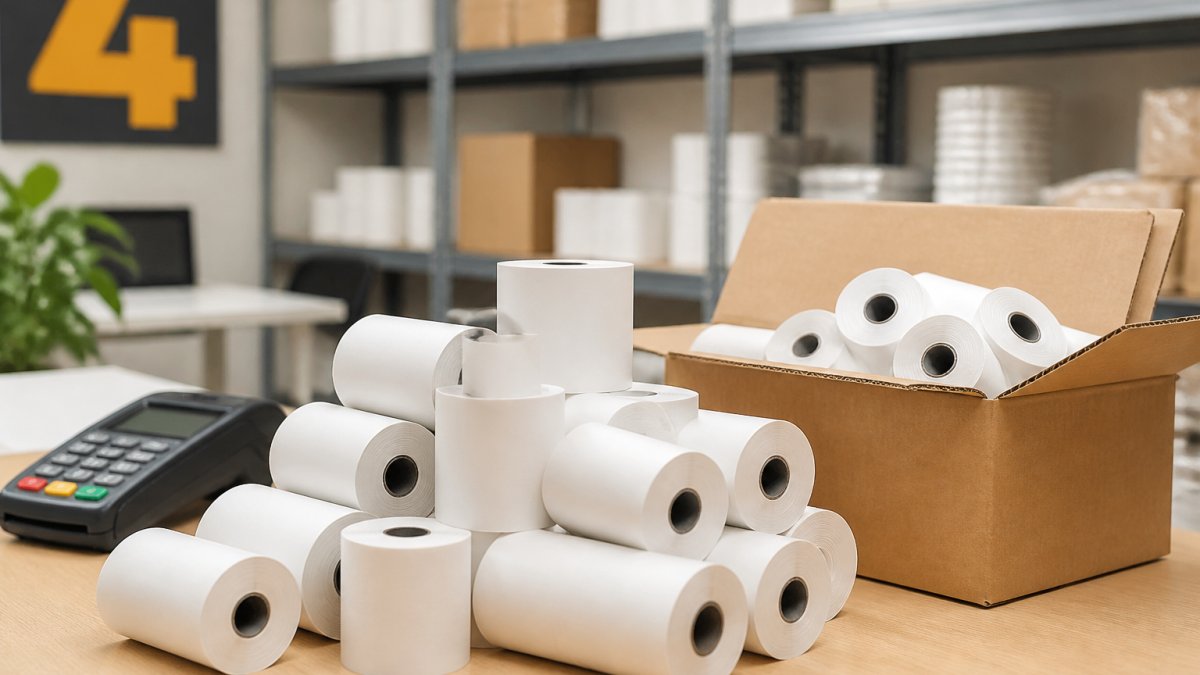
 comparison
Paper2Paper Alternative for Card Machine Rolls
Table of Contents
- Why Retailers Seek a Paper2Paper Alternative for Card Machine Rolls
- Card Machine Roll Sizes: Getting the Fit Right First Time
- How to Measure a Till Roll Before You Order
- Thermal Till Rolls vs Other Paper Types: What Your Printer Needs
- Thermal Paper Roll Suppliers: What Separates a Reliable One
- Total Cost Comparison: Price Per Roll vs Cost of Disruption
- Making the Switch Without Disrupting Your Ordering Process
- Frequently Asked Questions
Last Updated: October 13, 2026
Why Retailers Seek a Paper2Paper Alternative for Card Machine Rolls
A card machine roll is the small thermal paper roll that sits inside a payment terminal and prints each transaction receipt as it happens. At Shop4Rolls.ie, we supply card machine rolls as part of a vast selection of over 3,000 essential packaging and operational supplies, including the country's largest range of till rolls and card machine receipt rolls, which means a switch does not have to mean juggling a second supplier for everything else.
The real reason retailers move is rarely price alone. It is the cost of a gap: a card machine with no paper is a lost sale, and no discount makes up for that.
What Actually Matters When You Switch Suppliers
Most buyers assume the deciding factor is the cheapest roll. It isn't.
What matters is whether the replacement rolls physically fit your terminal, whether stock is genuinely held rather than promised, and whether a reorder takes two minutes or two phone calls. A supplier that lists every size and holds real stock removes the two most common failure points: wrong fit and late delivery.
Card Machine Roll Sizes: Getting the Fit Right First Time
Card machine roll sizes are defined by three measurements, and all three must match or the roll will jam, spin loose, or fail to feed. Get them right once and reordering becomes routine.
The common thermal roll widths for payment terminals sit around 57mm, with smaller handheld units often taking narrower rolls. Diameter decides how much paper fits on the roll, and core size decides whether it seats properly on the spindle.
Core Size, Roll Width and Diameter Explained
- Roll width: the paper's measured width, which must match the printer slot.
- Roll diameter: the full outside measurement, which sets how many receipts you get per roll.
- Core size: the inner tube diameter, which must match the terminal's spindle.
A roll that is the right width but the wrong core will not sit straight. A roll that is the right core but too wide simply will not fit.
How to Measure a Till Roll Before You Order
To measure a till roll, use a ruler or tape and record three figures: the paper width across the roll, the full outside diameter, and the inner core diameter.
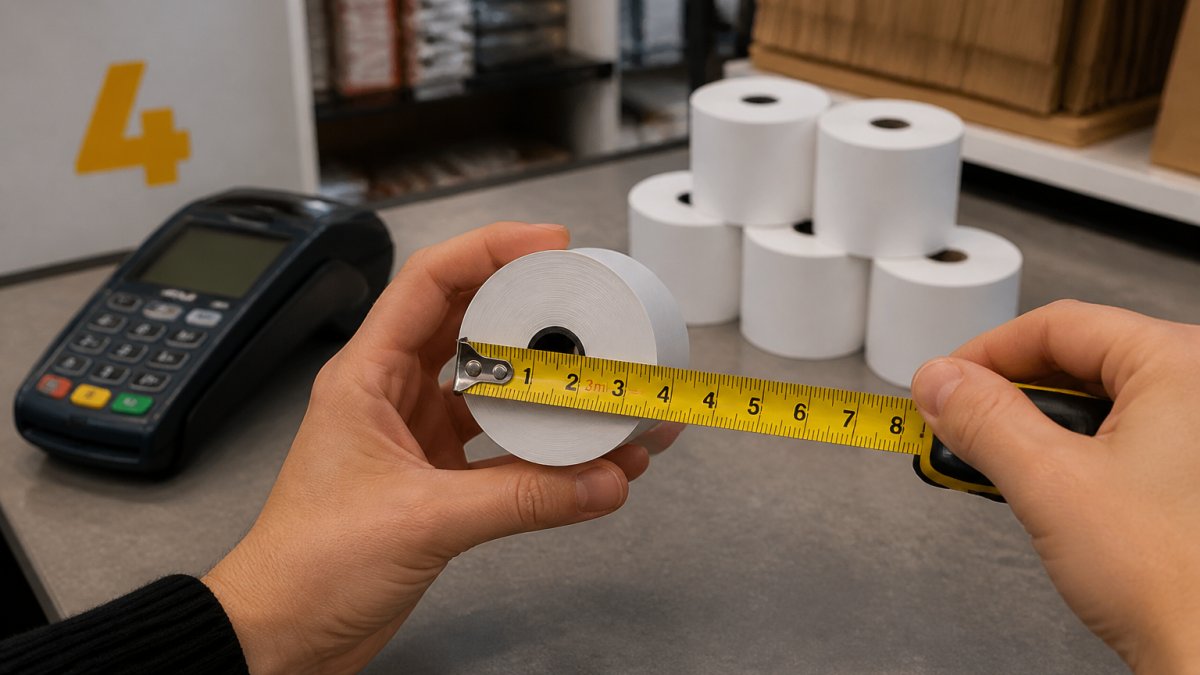
Measure the width across the flat face of the roll, not the length of paper. Measure diameter straight across the middle of the roll face.
A practical tip: measure a roll you know fits, not the empty spindle. Spindles vary slightly, and a used roll gives you the exact figures your terminal accepts.
Thermal Till Rolls vs Other Paper Types: What Your Printer Needs
Thermal till rolls are the standard choice for card machines because they print without ink or ribbons, using heat from the printer head to darken the coated paper. That is why thermal rolls are the only correct paper type for a payment terminal: a standard bond roll will feed through but print nothing.
Paper selection comes down to a few practical options:
| Paper Type | How It Prints | Best For |
|---|---|---|
| One-ply thermal | Heat-activated, no ink | Card machines, standard receipt printers |
| BPA-free thermal | Heat-activated, no ink | Businesses preferring BPA-free receipt paper |
| Two-ply carbonless | Handwriting or impact print | Manual dockets needing a copy |
| Three-ply carbonless | Handwriting or impact print | Multi-copy paperwork |
If your terminal is thermal, only thermal paper will work. Bond and carbonless rolls belong to impact printers, adding machines and manual systems.
Thermal Paper Roll Suppliers: What Separates a Reliable One
Most supplier pages tell you what they sell. Very few tell you how to tell them apart.
A reliable thermal paper roll supplier holds real stock, publishes clear measurements for every roll, and answers the phone when something goes wrong. Those three things separate a supplier you can build a routine around from one you tolerate until the next problem.
The Six Things to Test Before You Switch
- Stock visibility at the point of order. Availability should be shown on the product page or at checkout, not confirmed by email after you have paid. If a listed roll can sell out silently, you cannot plan around it.
- Published dimensions for every SKU. Width, diameter, core size and ply should be on the listing, not buried in a PDF or a phone call. If you have to ask, the supplier has not done the work.
- Delivery windows you can plan against. A stated cut-off time and a stated next-day or two-day window is what lets you reorder on a Thursday and know you are covered for the weekend. "Usually ships quickly" is not a window.
- Returns and wrong-size policy. Ask what happens if a roll does not fit. A supplier that treats a sizing error as your problem will cost you more than the roll is worth.
- Account setup speed. If placing a reorder means emailing a rep and waiting for a quote, the process is too slow for a business that runs out of paper on a Saturday. Online account creation and saved reorder history should take minutes.
- Emergency replenishment. Ask directly: if you run out mid-week, what is the fastest route to a replacement? A supplier with a genuine answer here is worth more than one with a lower headline price.
Stock Visibility, Delivery Windows and Account Setup
Look for a supplier that shows availability before you order, not after. A listed product that is out of stock should be flagged at checkout, not discovered when your delivery is late.
Account setup should take minutes, not days. If placing a reorder means emailing a rep and waiting for a quote, the process is too slow for a business that runs out of paper on a Saturday.
A useful test is to place one small order from a new supplier before you move your regular reorder across.
How to Compare Two Suppliers Side by Side
Write the same six questions down the left of a page and put your current supplier and the alternative across the top. Score each honestly. The supplier that wins on stock visibility, published dimensions and emergency replenishment is almost always the one that costs you less over a year, even if the unit price is a cent or two higher.
Competition and Consumer Protection Commission guidance on business-to-business buying
Total Cost Comparison: Price Per Roll vs Cost of Disruption
The cheapest roll per unit is not the cheapest roll overall. Once you add the cost of a failed delivery, a wrong size, or a mid-service stockout, the true cost of a card machine roll is the price plus the risk attached to it. That claim is easy to make and hard to act on, so here is how to actually work it out for your business.
The Four Cost Lines That Matter
Every card machine roll decision comes down to four numbers. Add them up and the "cheaper" supplier often stops being cheaper.
- Unit price per roll. The headline figure. Useful, but only one of four.
- Delivery cost and minimum order value. A low unit price with a delivery charge or a high minimum order can wipe out the saving on a small reorder. Work out the delivered cost per roll, not the listed cost.
- Cost of a wrong-size order. A roll that does not fit is not free, it is the roll price plus the time to return it, plus the delay before the correct roll arrives. If you have no spare stock, that delay is a stockout.
- Cost of a stockout. This is the one most buyers ignore. A card machine with no paper cannot take a card payment. Even a short outage during a busy period is a lost sale, and a lost sale is worth far more than the difference in roll price.
A Simple Break-Even You Can Run Yourself
You do not need a spreadsheet. Take the price difference between your current supplier and the alternative, multiply it by the number of rolls you use in a year, and compare that figure to the value of a single lost transaction.
If the annual saving from switching is smaller than the value of one lost sale, the switch only pays off if the new supplier is at least as reliable as the old one.
Discount-Only vs Reliable Stock: What Each Actually Costs
| Cost Factor | Discount-Only Supplier | Reliable Stock Supplier |
|---|---|---|
| Price per roll | Lower headline price | Competitive wholesale pricing |
| Delivered cost | Can rise with delivery fees or minimums | Predictable at checkout |
| Wrong-size returns | Time and postage to resolve | Clear sizing reduces errors |
| Stockout risk | Higher when stock is thin | Stock held and visible |
| Reorder effort | Often manual | Quick online ordering |
| Emergency cover | Rarely offered | Part of the service |
| Total cost | Price plus disruption | Price plus predictability |
A discount that saves a few cent per roll is wiped out by a single lost transaction or an emergency run to a local shop.
Where the Real Saving Usually Sits
The largest saving is rarely on the roll itself. It is on the time and risk around it: fewer wrong orders, fewer emergency runs, fewer phone calls to chase a delivery. A supplier that gets the fit right first time and holds stock removes those costs entirely, which is why the delivered cost per roll, not the listed price, is the number to compare.
Making the Switch Without Disrupting Your Ordering Process
Switching suppliers does not have to disrupt anything if you do it in the right order. Measure your rolls, confirm your terminal model, place one test order, and only then move your regular reorder across.
A simple sequence:
- Record width, diameter and core size for every terminal you run.
- Note the equipment model for each card machine and till.
- Place a single order to confirm fit and delivery.
- Once confirmed, set up your regular reorder and consolidate other supplies.
Shop4Rolls.ie stocks till rolls and card machine receipt rolls alongside packaging and operational supplies, so a switch can replace more than one supplier in a single account.
Commission for Communications Regulation on electronic payment terminals
Frequently Asked Questions
What can I use instead of Paper2Paper for card machine rolls?
You can switch to any supplier that stocks thermal card machine rolls in the sizes your terminal uses. Shop4Rolls.ie carries a large range of card machine rolls alongside over 3,000 other retail supplies, so you can consolidate orders. The key is matching roll width, diameter and core size to your printer, then checking stock availability and delivery times before committing to a new account.
How do I find the right size card machine roll?
Check the label inside your terminal's paper compartment or the printer manual. You need three measurements: roll width (common sizes include 57mm and 80mm), roll diameter, and core size. If the label is missing, measure the old roll with a ruler before ordering. Ordering the wrong width is the most common mistake, so confirm the width in millimetres first.
Are card machine rolls compatible with all card machines?
No. Card machine rolls vary in width, diameter and core size, and not every roll fits every terminal. Popular terminals from Ingenico, Verifone and PAX each take specific roll dimensions. Always check your terminal model against the roll specification before buying. If you are unsure, measure your current roll or ask the supplier to confirm compatibility for your exact model.
What should I compare when choosing a card machine roll supplier?
Compare four things: stock reliability (will they have your size when you need it), delivery speed (next-day versus multi-day), total cost including delivery charges, and whether they stock other supplies you buy regularly. A supplier that carries till rolls, receipt paper and packaging in one place saves you managing multiple accounts and reduces the risk of running out mid-week.
What is the difference between thermal till rolls and card machine rolls?
Both are thermal paper rolls, but they differ in size. Card machine rolls are smaller, typically 57mm wide with a narrow core, designed for compact payment terminals. Thermal till rolls for cash registers are usually 80mm wide with a larger diameter. The printing method is the same: heat activates the coating on the paper. Always match the roll to the device it feeds.
Running out of card machine rolls mid-service is a problem you can design out entirely. Shop4Rolls.ie supplies till rolls and card machine receipt rolls as part of a one-stop range of over 3,000 retail products, backed by a lowest price guarantee, quick online ordering and stock held in a purpose-built warehouse. Get started with Shop4Rolls.ie and keep your tills printing without the guesswork.