 comparison
E-commerce Packaging Materials: Ireland Comparison
Table of Contents
- E-commerce Packaging Materials Comparison: What Actually Matters
- Corrugated Cardboard Boxes and Postal Solutions
- Protective Infill and Cushioning Materials
- Best Wholesale Packaging Supplies Ireland: What to Look For
- Sustainable Packaging Regulations Ireland: Compliance Without the Headache
- Cost-Effective E-commerce Packaging Solutions: TCO Breakdown
- Unboxing Experience and Return Logistics
- Frequently Asked Questions
Last Updated: September 30, 2026
E-commerce Packaging Materials Comparison: What Actually Matters
Choosing packaging materials is a decision most e-commerce operators make once and then stop thinking about. That is a mistake: packaging materials are a recurring cost, a compliance obligation and a customer touchpoint at once, and getting the balance wrong shows up in your margins first. At Shop4Rolls.ie, we supply packaging and operational consumables to retail and e-commerce businesses nationwide.
The Real Cost of Getting It Wrong
Under-specify your packaging and you pay twice: once for the damaged item, once for the replacement. Over-specify it and you pay on every order in material cost, dimensional weight charges and disposal fees.
How to Use This Comparison
Work through the materials in pack-station order: outer box, then infill, then carrier bag or postal solution. For each, ask three questions.
- Does it protect the product through your actual carrier network?
- Does it meet your obligations under waste and packaging rules?
- What does it cost per shipped order, not per unit?
Corrugated Cardboard Boxes and Postal Solutions
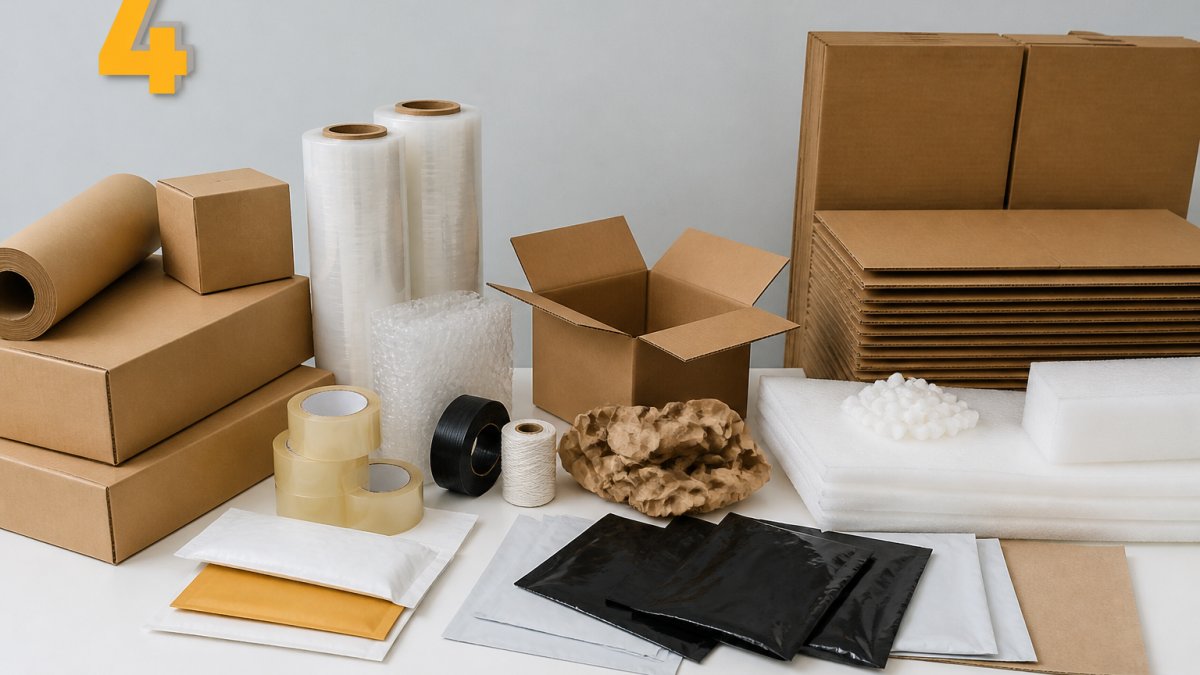
Corrugated cardboard is the default outer packaging for e-commerce: low weight, stacking strength and full kerbside recyclability. The two variables that matter are flute grade and box dimensions.
Single Wall vs Double Wall: When Each Works
Single wall board handles most non-fragile goods under a few kilograms. Double wall is worth the extra cost for anything fragile, over roughly 5 kg, or stacked in a van for hours.
| Box Type | Best For | Trade-off |
|---|---|---|
| Single wall | Lightweight, non-fragile goods | Crushes under heavy stacking |
| Double wall | Fragile or heavy items | Higher unit cost, more storage space |
| Rigid mailer | Flat items, documents, apparel | Limited size range |
Dimensional Weight and Shipping Costs
Carriers bill on dimensional weight, parcel volume converted into chargeable weight. A box 2 cm too tall on every side can push an order into the next weight band, so ordering a range of box sizes rather than two or three "close enough" sizes usually pays for itself within months.
Protective Infill and Cushioning Materials
Protective infill fills empty space inside a parcel and absorbs shock. The right choice depends on product fragility, parcel weight and whether the customer will compost or recycle it.
Void Fill Options: Paper, Air, and Starch
Paper void fill is kerbside recyclable and gives a clean unboxing look. Air pillows are light and cheap per parcel but plastic-based unless you choose a biodegradable film. Starch loose fill is compostable and suits heavier items, though it costs more per cubic metre.
- Kraft paper: recyclable, professional appearance, heavier
- Air pillows: light, fast to pack, plastic unless specified otherwise
- Starch loose fill: compostable, good shock absorption, higher cost
- Bubble wrap: best protection per gram, plastic-based
Stretch Film and Pallet Wrapping
For pallets going to wholesalers or fulfilment centres, stretch film secures loads in transit. Match micron thickness to pallet weight: too thin and it tears, too thick and you pay for material you do not need.
Best Wholesale Packaging Supplies Ireland: What to Look For
The best wholesale packaging supplies in Ireland come from a supplier who stocks the full range in one place, prices transparently and delivers next day without availability gaps. Splitting across three or four suppliers to save a few cent per unit rarely works out.
- Range depth. Can they cover boxes, infill, mailers, tape and labels in one order?
- Stock reliability. Do they hold stock in their own warehouse, or drop-ship from overseas?
- Price transparency. Is the wholesale price visible, or do you have to request a quote for everything?
- Delivery terms. What actually happens on a Friday afternoon order?
- Support. Can you reach a person when a delivery goes wrong?
Sustainable Packaging Regulations Ireland: Compliance Without the Headache
Sustainable packaging regulations in Ireland run through two mechanisms: the extended producer responsibility (EPR) system for packaging waste, and the waste levy on certain single-use items. Both fall on businesses that place packaging on the market, not just manufacturers or importers, and most e-commerce operators are producers without realising it.
Producer Responsibility Obligations (PRO) Explained
If your business places packaging on the market, you are a producer under Irish waste rules. In practice that means three things:
- Register with the relevant producer responsibility scheme for the packaging you handle.
- Report the tonnage and material type of packaging you place on the market, usually on an annual cycle.
- Pay a fee that funds the collection, recovery and recycling of that packaging.
The Waste Levy on Single-Use Items
Separately from EPR, a waste levy applies to certain single-use packaging items placed on the market, pushing businesses toward reusable or widely recyclable formats. For e-commerce, exposure is in carrier bags, certain plastic mailers and any single-use plastic item handed to a customer.
Labelling Requirements for Packaging Waste
Packaging placed on the market must be marked so consumers know how to dispose of it correctly. Material identification and disposal instructions must be accurate, incorrect labelling is an easy compliance failure to avoid and a visible one to customers.
Two practical rules of thumb:
- Match the label to what actually happens in kerbside collection, not to what you wish happened.
- Keep artwork versions under control. A material change without a label change is a compliance gap.
How to Calculate Your Own Exposure
You do not need a consultant for a first estimate. Build a spreadsheet with one row per packaging component and these columns:
| Column | What goes in it |
|---|---|
| Component | Box, void fill, tape, mailer, label, insert |
| Material | Corrugated, paper, LDPE, starch, other |
| Weight per unit (g) | Weighed, not estimated |
| Units per order | Usually 1, sometimes more |
| Annual orders | From your order system |
| Total tonnes per year | Weight x units x orders / 1,000,000 |
| Levy or EPR rate | From the current published rate |
| Annual cost | Tonnes x rate |
Cost-Effective E-commerce Packaging Solutions: TCO Breakdown
Cost-effective e-commerce packaging is measured per shipped order, not per unit. Total cost of ownership captures material, packing labour, shipping band, levy or EPR cost, and returns and replacements when protection fails. Most comparisons stop at the first line, which is why the cheapest box so often proves the most expensive decision.
Total Cost of Ownership Comparison
The table below shows how the same order carries very different real costs depending on the packaging choice. Treat the structure as a template and plug in your own figures.
| Cost Component | Budget Option | Mid-Range Option | Premium Option |
|---|---|---|---|
| Material per order | Lowest | Moderate | Highest |
| Packing time | Longer | Moderate | Fastest |
| Dimensional weight risk | High | Moderate | Low |
| Damage and returns | Higher | Lower | Lowest |
| Levy and EPR cost | Highest | Moderate | Lowest |
| Disposal and customer friction | Highest | Moderate | Lowest |
A Worked Example
Take a hypothetical 1.5 kg non-fragile item shipped domestically. The figures below are illustrative, not quoted rates, but the structure is what matters.
| Line | Budget option | Mid-range option |
|---|---|---|
| Box | Undersized single wall | Correctly sized single wall |
| Void fill | Heavy paper, overfilled | Light paper, minimal |
| Material cost | Lower | Slightly higher |
| Packing time | 90 seconds | 60 seconds |
| Chargeable weight | Pushed into next band by oversize | Within band |
| Damage rate | Higher | Lower |
| Levy and EPR | Higher (more material) | Lower |
| Cost per shipped order | Often higher | Often lower |
How to Build Your Own TCO Model
You do not need software. A spreadsheet with one row per packaging option and these columns will do:
- Material cost per order
- Seconds of packing labour per order, multiplied by your loaded hourly rate
- Chargeable weight per order, and the carrier band it falls into
- Expected damage rate, multiplied by replacement and return cost
- Levy and EPR cost per order, from your compliance spreadsheet
- Customer friction cost, however you choose to value it
Automation vs Manual Packing
Manual packing suits low volumes and varied order profiles. Automation pays off when you ship consistent parcel sizes at volume, cutting material waste and packing time per order. The crossover point depends on your order mix, not a fixed number.
Unboxing Experience and Return Logistics
The unboxing experience is where packaging stops being a cost line and starts being marketing. A parcel that arrives clean, well-protected and easy to open beats one that arrives crushed under three layers of tape.
Frequently Asked Questions
What is the best packaging for e-commerce?
The best packaging depends on your product. Corrugated cardboard boxes suit most items, with double-wall grades for fragile goods. Add protective infill such as paper void fill or starch-based cushioning. For soft items, polythene mailing bags work well. Consider dimensional weight to avoid paying for empty space. Test a few combinations to find what protects your products without overspending.
What are the current packaging regulations in Ireland?
Packaging producers must comply with the Producer Responsibility Obligations (PRO) regulations. This means registering with a compliance scheme, paying levies based on the weight and type of packaging placed on the market, and meeting recycling targets. Labelling requirements also apply. Check with your compliance scheme for the exact obligations that apply to your business size and material types.
What is the most eco-friendly packaging material?
Biodegradable and compostable materials offer strong environmental credentials. Plant-based options and recycled corrugated cardboard reduce virgin material use. Paper void fill replaces plastic bubble wrap. The most eco-friendly choice depends on your supply chain: a material that protects well and gets recycled locally often beats a compostable option that ends up in general waste. Check recyclability and local waste management regulations.
What are the most cost-effective packaging materials for small businesses?
For small businesses, cost-effective options include single-wall corrugated boxes for lightweight items, paper void fill instead of plastic air pillows, and polythene mailing bags for non-fragile goods. Buying in bulk from a wholesale supplier reduces per-unit costs. Compare total cost of ownership, including labour and shipping, not just the sticker price. Dimensional weight pricing makes right-sized packaging a money-saver.
How do I reduce my packaging waste to meet environmental standards?
Start by right-sizing boxes to cut void fill and dimensional weight charges. Switch to recyclable or compostable materials where possible. Work with suppliers who take back packaging or offer return logistics. Train staff on efficient packing to reduce material use. Track your packaging weight and material types against your PRO obligations. Small changes in box sizing and infill choice add up quickly.