 ultimate-guide
Packaging Solutions for Food Businesses Ireland: 2026 Guide
Table of Contents
- What Food Businesses Actually Need From a Packaging Supplier
- Quick Comparison: Packaging Supply Options for Food Businesses
- Takeaway Containers, Cups and Catering Disposables: Matching Packaging to Your Menu
- Eco-Friendly Food Packaging Ireland: Compostable, Biodegradable and Plant-Based Options
- Food Packaging Regulations FSAI: What Your Business Must Comply With
- Packaging Waste, Recycling and the Circular Economy: Managing Your Environmental Impact
- Best Wholesale Packaging Supplies Ireland: How to Choose a Supplier
- Cost-Benefit Analysis: Sustainable Packaging vs Plastic
- Frequently Asked Questions
Last Updated: September 24, 2026
What Food Businesses Actually Need From a Packaging Supplier
Buying on unit price alone is the biggest mistake when sourcing packaging solutions for food businesses Ireland operators make. A supplier that saves a cent per container but delivers late or runs out mid-service costs far more than the saving.
Quick Comparison: Packaging Supply Options for Food Businesses
| Supply Route | Best For | Typical Lead Time | Order Flexibility | Price Transparency |
|---|---|---|---|---|
| Online supplier | Cafés, takeaways, small retail | Next-day to 48 hours | Low minimums | Listed online |
| Specialist takeaway supplier | Coffee shops, pizzerias | 2-5 days | Medium minimums | Often quote-only |
| Cash and carry | Same-day top-ups | Immediate | No minimum | In-store |
| Direct manufacturer | High-volume chains | Weeks | Large volumes | Contract pricing |
| B2B platform | Brands outsourcing production | Varies | Project-based | Fee-based |
How to Read the Comparison Table
Lead time matters more than most owners admit: if your lids run out on a Friday, a five-working-day supplier is useless regardless of price.
Takeaway Containers, Cups and Catering Disposables: Matching Packaging to Your Menu
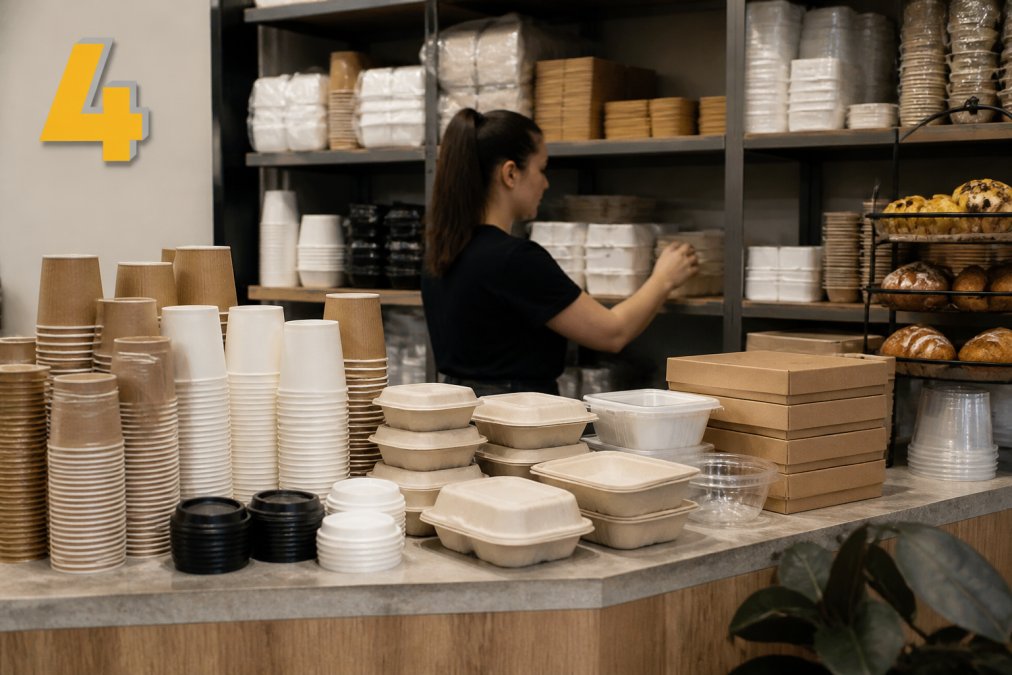
- Coffee and cold drinks: hot cups, cold cups, lids, sleeves, cup carriers
- Hot food to go: lidded containers, meal boxes, soup containers, carrier bags
- Cold and deli: sandwich wedges, salad bowls, lidding film
- Catering and events: platters, disposable cutlery, napkins, tableware
Hot Cups, Cold Cups and Lidding Systems
Hot cups need a lid that vents steam without leaking; cold cups need a tight seal for condensation. They are different products and shouldn't be substituted.
Flexible Packaging: Stand-Up Pouches, Gusseted Bags and Printed Shrink-Wrap
Flexible packaging covers stand-up pouches for retail-ready goods, gusseted bags for bulk and bakery items, and printed shrink-wrap for multipacks. Pouches suit retail shelf presence, gusseted bags suit anything sold by weight, and printed shrink-wrap is where custom branding pays off fastest.
Eco-Friendly Food Packaging Ireland: Compostable, Biodegradable and Plant-Based Options
Eco-friendly food packaging Ireland operators can source now spans compostable containers, biodegradable films, and plant-based wraps made from bagasse, PLA, and paperboard.
Food Packaging Regulations FSAI: What Your Business Must Comply With
Most suppliers stop at "make sure it's food-grade", useless when an environmental health officer asks for your declaration of compliance. Here's what the rules require and what documentation you need.
What "Food Contact Material" Actually Covers
A food contact material is anything intended to come into contact with food, including:
- Primary packaging (the container or wrap touching the food)
- Secondary packaging where migration is possible (outer bags, sleeves)
- Processing equipment surfaces, conveyor belting, and seals
- Printing inks, adhesives, and coatings applied to packaging
- Reusable crates, trays, and dispenser parts
The Three Core Legal Requirements
1. Safety and inertness. Under Regulation (EC) No 1935/2004, materials must not transfer constituents to food in quantities that could endanger health or change the food's composition, taste, smell, or texture.
The Declaration of Compliance (DoC)
For plastic food contact materials, Regulation (EU) No 10/2011 requires a written declaration of compliance at every supply-chain stage except retail sale to the consumer. A valid DoC identifies the supplier and material, confirms EU compliance, lists use restrictions (temperature, fat content, contact time), and notes supporting documentation on request.
Labelling Obligations That Touch Packaging
Under Regulation (EU) No 1169/2011, pre-packed food must display the food name, ingredients with allergens emphasised, net quantity, durability or use-by date, storage conditions where relevant, the operator's name and address, country of origin where required, and a nutrition declaration unless exempt. If you pack on-site for retail sale, you are the operator named on the label; if a third party packs for you, the label must name them.
Allergen Information for Non-Pre-Packed Food
For food sold loose or made to order, most takeaway and café trade, allergen information must still be available. Provide it in writing or direct customers to ask staff, provided a clear sign says so. It must cover the 14 named allergens and be accurate for every item.
What Enforcement Looks Like
FSAI works with HSE environmental health officers and local authority veterinary services. Inspections can be routine or complaint-triggered, and outcomes include compliance notices, improvement or prohibition notices, closure orders published on the FSAI website, and District Court prosecution. Published closure orders outlast the fine reputationally. Businesses that pass cleanly keep a simple folder, physical or digital, of DoCs, supplier details, and order records for every food contact material on site.
A Practical Compliance Checklist
- Keep a DoC for every food contact material currently in use
- Record supplier name, product code, and date of each delivery
- Store materials per the supplier's instructions (temperature, humidity, away from strong odours)
- Do not reuse single-use packaging beyond its intended purpose
- Review labels whenever a recipe, supplier, or pack size changes
- Train staff on allergen information and where to find it
- Check the FSAI guidance on food contact materials before introducing any new material, especially imported or novel packaging
Packaging Waste, Recycling and the Circular Economy: Managing Your Environmental Impact
Packaging waste in Ireland is a regulated cost with reporting obligations. Understanding the scheme is the difference between a predictable overhead and an unwelcome invoice.
Extended Producer Responsibility in Practice
Ireland operates extended producer responsibility (EPR) for packaging under the EU (Packaging) Regulations, administered by the EPA. If you place packaging on the Irish market, you contribute to the cost of collecting and treating it as waste.
What Counts as Packaging You Place on the Market
You are likely placing packaging on the market whenever you sell food in a container, bag, box, or wrap the customer takes away; sell pre-packed food for retail; use carrier bags, even charged ones; or supply packaging as part of a delivery or catering service. Packaging that never leaves your premises generally falls outside the definition.
The Circular Economy Act and What It Changes
The Circular Economy and Miscellaneous Provisions Act 2022 drives the shift away from single-use packaging. Its practical effects include a levy on single-use disposable cups at point of sale, restrictions on certain single-use plastics, a move toward deposit return and reuse, and stronger EPA waste enforcement powers.
What Your Waste Contractor Will and Won't Take
Recycling acceptance varies by contractor and facility. Rigid plastics (PET, HDPE, PP) are widely accepted if clean and dry. Paper and card are accepted, but grease-contaminated board (pizza boxes, chip cartons) is not recyclable. Compostable packaging is usually not accepted in brown bins unless your contractor confirms it, since many items need industrial composting Irish facilities may not provide.
Practical Steps That Cut Both Waste and Cost
- Right-size packaging. Oversized boxes waste material, add EPR weight, and cost more per unit.
- Standardise SKUs. Fewer sizes means less dead stock and better bulk pricing.
- Switch to mono-materials. Easier to recycle and often lighter.
- Reduce weight without losing performance. Lighter film or board cuts EPR fees measurably.
- Track monthly usage. Stops panic ordering at premium prices.
- Train staff on portioning. Overfilled containers leak, get refunded, and waste packaging.
Reuse and Refill: Where the Real Savings Sit
Reusable packaging costs more upfront but less per use once it clears break-even. A café keep-cup scheme can pay back within weeks if a small share of customers switch; for takeaways, reusable containers work best where you control the return loop, such as a local delivery radius with a deposit scheme.
Best Wholesale Packaging Supplies Ireland: How to Choose a Supplier
Best wholesale packaging supplies Ireland buyers should prioritise stock reliability, range depth, and delivery speed over headline unit price. What separates a good supplier:
- Stock availability you can trust. Out-of-stock on a critical line costs a trading day.
- Range depth. One supplier covering packaging, till rolls, and receipt paper saves admin and delivery costs.
- Delivery you can plan around. Next-day matters when restocking mid-week.
- A phone number that gets answered. Problems get solved faster by voice than by ticket.
- Transparent pricing. See what you're paying before you commit.
Cost-Benefit Analysis: Sustainable Packaging vs Plastic
Sustainable packaging costs more per unit today, but the gap narrows once you account for waste charges, brand positioning, and customer expectations.
| Factor | Conventional Plastic | Compostable / Plant-Based |
|---|---|---|
| Unit cost | Lower | Higher |
| Waste charges | Higher under EPR rules | Often lower |
| Customer perception | Neutral to negative | Positive |
| Heat and grease performance | Reliable | Improved, varies by product |
| Supply availability | Broad | Growing |
| Best use case | High-volume, low-margin | Visible, brand-led items |
Frequently Asked Questions
What are the current food packaging regulations in Ireland?
Food packaging in Ireland must comply with FSAI requirements under EU Regulation 1935/2004 on food contact materials. This means packaging must not transfer harmful substances to food, must be traceable, and must carry accurate labelling. The FSAI enforces these rules and provides guidance on approved materials. Businesses should keep documentation from suppliers confirming food-grade compliance. For takeaway and catering operations, this includes containers, cups, wraps, and cutlery that touch food directly.
How do I choose eco-friendly packaging for my food business?
Start by identifying which items your customers handle most, such as takeaway containers, cups, and cutlery. Compostable and biodegradable options work well for these high-visibility items. Check that eco-friendly food packaging Ireland suppliers provide certification for compostability standards. Plant-based wraps and fibre-based containers suit hot and cold food alike. Consider your waste disposal setup too, because compostable packaging needs commercial composting to break down properly. Bulk ordering reduces cost per unit and cuts delivery emissions.
What are the benefits of using wholesale packaging suppliers?
Wholesale suppliers offer lower unit prices, consistent stock availability, and access to a wider product range than retail channels. For food businesses, this means you can order takeaway containers, cups, flexible packaging, and catering disposables in one delivery. Wholesale accounts often include dedicated support and bulk pricing tiers. Reliable nationwide delivery matters when you cannot afford to run out of critical packaging mid-service. A single supplier for multiple product lines also simplifies ordering and reduces admin time.
Are there specific labelling requirements for food packaging in Ireland?
Yes. Food packaging must display allergen information, ingredient lists where applicable, and country of origin for certain products. The FSAI enforces EU Regulation 1169/2011 on food information to consumers. Pre-packed foods need nutritional declarations, while loose or made-to-order items require allergen signage nearby. Custom branded packaging must still carry mandatory legal information. If you use printed shrink-wrap or stand-up pouches for retail, check that your label includes all required fields before going to print.
How can I reduce packaging costs for my catering business?
Buying in bulk is the fastest way to cut per-unit costs. Consolidate your orders so you qualify for wholesale pricing on takeaway containers, cups, and cutlery. Review your packaging sizes and remove any items that are larger than needed. Switch to standard sizes rather than custom shapes where branding is not essential. Negotiate a supply agreement that locks in pricing for six to twelve months. Track usage per week so you order accurately and avoid both emergency purchases and overstock.
What should I look for in a wholesale packaging supplier?
Look for a supplier that stocks food-grade items, offers nationwide delivery, and has reliable stock levels. Check whether they carry the specific sizes your menu requires, from hot cups and cold cups to tray sealing and lidding. A good supplier provides product documentation for FSAI compliance and can advise on eco-friendly alternatives. Pricing transparency matters too. Request samples before committing to a large order so you can test durability and fit with your existing equipment.
Can packaging design help extend shelf life?
Yes. Barrier properties in flexible packaging, such as form-fill-seal films and vacuum-sealed pouches, slow down oxidation and moisture transfer. This can extend shelf life for chilled and ambient products. Tray sealing with modified atmosphere packaging works well for fresh prepared meals. For dry goods, gusseted bags with inner liners protect against humidity. Choosing the right material for your specific product reduces waste from spoilage and improves food safety. Discuss barrier requirements with your supplier before selecting packaging.
The challenge for most food businesses isn't choosing packaging, it's keeping the right stock on the shelf without overordering or overpaying. Shop4Rolls.ie handles that side of the operation with over 3,000 products, next-day delivery, a lowest price guarantee, and a customer care team that answers the phone when something needs sorting. Sign up now and get your packaging, till rolls, and receipt paper from one supplier instead of three.