 ultimate-guide
Plastic Cups With Lids: Wholesale Buying Guide 2026
Table of Contents
- Why the Right Plastic Cups With Lids Cut Daily Costs
- Cup Sizes, Dimensions and Lid Compatibility Explained
- PET Plastic, Clear Cups and Recyclable Options Compared
- Takeaway Coffee Cup Regulations Every Operator Should Know
- Disposable Smoothie Cups With Lids for Cafes and Juice Bars
- Best Wholesale Packaging Supplies Ireland: How to Choose a Supplier
- Storing, Stacking and Organising Bulk Cup Stock
- Frequently Asked Questions
Last Updated: September 26, 2026
Why the Right Plastic Cups With Lids Cut Daily Costs
Getting your plastic cups with lids wrong is one of the quietest ways a hospitality business loses money. The wrong lid means leaks, remakes, and complaints. The wrong cup size means you over-pour or under-serve every drink you sell. And the wrong supplier means you run out mid-service on a Saturday.
This guide from Shop4Rolls.ie walks through cup sizing, lid compatibility, material choices, takeaway rules, and how to buy in bulk without overcommitting cash to stock you cannot shift.
Here is the core argument: cups and lids are not a commodity purchase. They are a system. A 12oz cup from one supplier is not guaranteed to fit a 12oz lid from another, and that mismatch is where most operators lose money without realising it.
Cup Sizes, Dimensions and Lid Compatibility Explained
Cup size is measured by volume, but lids are matched by rim diameter. That distinction is the single most common source of ordering errors in food service.
A cup's stated capacity (8oz, 12oz, 16oz) tells you how much liquid it holds. The rim diameter tells you which lid fits. Two cups can both be labelled 16oz and still have different rim measurements depending on the manufacturer's tooling. This is why a lid that clicks perfectly onto one brand's cup can sit loose on another.
Standard rim diameters you will encounter across most disposable drinkware:
| Cup Capacity | Typical Rim Diameter | Common Lid Type |
|---|---|---|
| 8oz | 80mm | Flat lid |
| 12oz | 90mm | Flat or dome lid |
| 16oz | 90mm | Flat or dome lid |
| 20oz | 90mm | Dome lid |
| 24oz | 90mm | Dome lid |
The practical takeaway: if you are switching suppliers, check the rim diameter on the spec sheet before you order a pallet of lids. Ordering the wrong size once is annoying. Ordering 2,000 of them is a storage problem you will be looking at for months.
Flat Lids, Dome Lids and Straw Slots
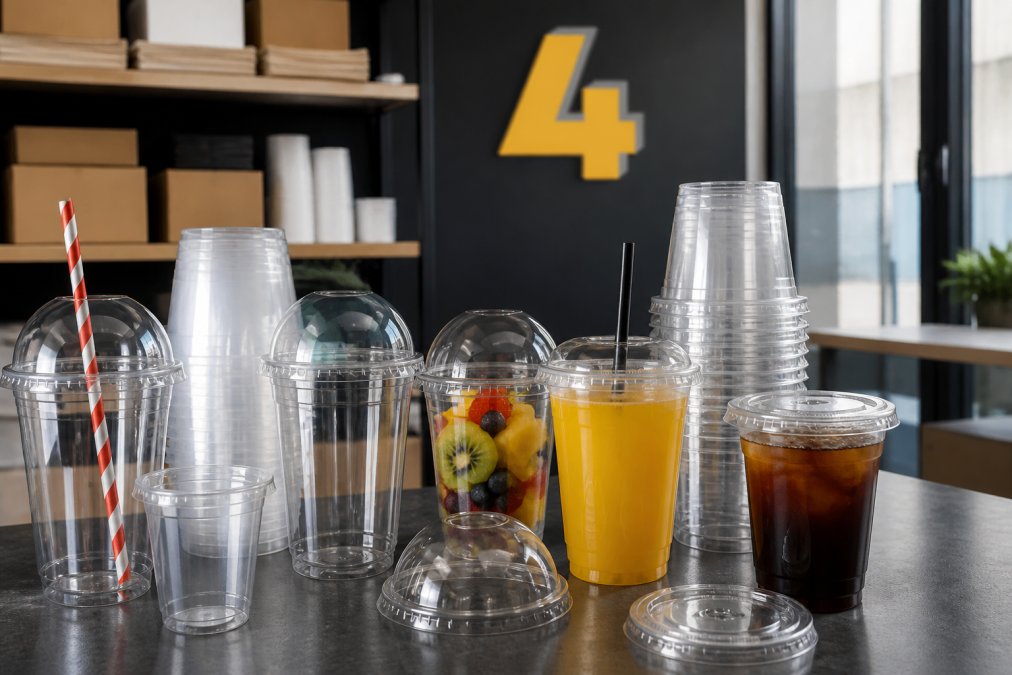
Flat lids sit close to the drink surface. They stack tightly, take up less storage space, and suit hot drinks and short cold drinks where you are not adding toppings.
Dome lids give headroom. They suit iced coffee with cream, smoothies with fruit, and anything with whipped topping or a straw. Most dome lids include a straw slot, though some are designed for sipping directly.
Straw slots matter more than people think. A dome lid with a narrow slot will not take a wide smoothie straw, and a flat lid with no slot forces staff to remove the lid to add a straw. Check the slot diameter against the straws you actually buy.
PET Plastic, Clear Cups and Recyclable Options Compared
Material choice is not a values statement. It is an engineering decision driven by three variables: the temperature of the drink, the format you serve it in, and where the cup ends up after the customer leaves. Get those three right and the material picks itself.
Three materials dominate disposable drinkware, and each has a clear best-fit use case.
PET (polyethylene terephthalate) is the clear, rigid plastic behind most iced coffee cups, smoothie containers, and cold drink cups. It is transparent, food-grade, and shows the drink clearly, which matters for layered iced coffees and colourful smoothies. PET softens as temperatures climb, so it is a cold-drink material. It is also the most widely collected plastic in household and commercial recycling streams.
PP (polypropylene) is slightly less transparent but handles heat. It is the material to specify for hot drinks, and it is also the more forgiving choice for cups that will be stacked, transported, or handled roughly. PP is recyclable, though collection is less universal than for PET.
PLA and other compostable materials are plant-based and break down in industrial composting. They carry a higher unit cost and, critically, require the customer to have access to the right waste stream. In practice, most compostable cups placed in general waste behave exactly like conventional plastic in landfill, the material only delivers its benefit if the collection infrastructure exists.
A simple selection framework:
| Drink type | Recommended material | Why |
|---|---|---|
| Iced coffee, cold brew | PET | Clarity, rigidity, cold-safe |
| Smoothies, juices | PET | Shows colour, takes dome lids |
| Hot coffee, tea | PP | Heat resistance |
| Hot and cold mixed menu | PP | One material, fewer SKUs |
| Compostable-only venue | PLA | Only if collection is verified |
The honest trade-off: PET gives the best clarity at the lowest cost and is recyclable where collection exists. Compostable sounds better on a menu but often ends up in general waste because the infrastructure is not there. If you cannot verify where your waste goes, recyclable PET is the more defensible choice, and you can say so to a customer without overclaiming.
One practical rule: do not mix materials across a single drink format. A PET cup with a PP lid is fine mechanically, but it complicates your recycling message and your staff training. Standardise per drink line.
For guidance on what can actually be recycled and how, check the MyWaste Ireland recycling guide.
Takeaway Coffee Cup Regulations Every Operator Should Know
Takeaway coffee cup regulations in Ireland have shifted in recent years, and operators need to know where they stand before ordering stock.
The Government of Ireland guidance on single-use plastics sets out the direction of travel for disposable food service items.
What this means when you are buying:
- Check whether your cups and lids are recyclable in your local collection
- Keep records of what material you are buying and from whom
- Be ready to explain your packaging choice if a customer asks
- Watch for changes, since packaging rules continue to tighten
Disposable Smoothie Cups With Lids for Cafes and Juice Bars
Three things to get right:
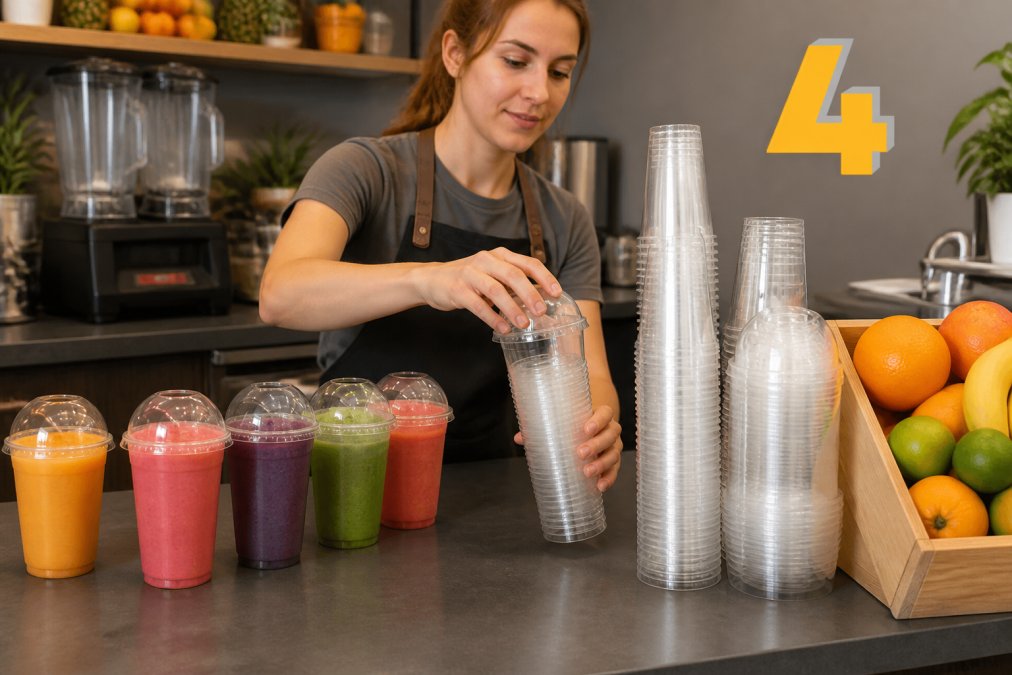
Capacity. A 16oz cup looks generous on a menu but fills fast once you add fruit, yoghurt, and ice. Many juice bars standardise on 20oz or 24oz for smoothies and reserve 12oz and 16oz for juices and iced coffee.
Best Wholesale Packaging Supplies Ireland: How to Choose a Supplier
Most supplier guides tell you to look for range, reliability, delivery, and price. That is true but useless, because every supplier claims all four. What separates a good supplier from a costly one is whether they can answer specific, verifiable questions about the products they sell, and whether their answers hold up when you test them.
Use this as an evaluation method, not a checklist.
A quick evaluation checklist:
- Can they quote rim diameter in millimetres for every cup?
- Do they state a restock policy for out-of-stock items?
- Will they send a sample pack before a bulk order?
- Is the repeat-order price the same as the first-order price?
- Can the person on the phone answer material and sizing questions?
Storing, Stacking and Organising Bulk Cup Stock
Bulk stock saves money per unit but creates a storage problem if you do not plan for it.
Frequently Asked Questions
Where can I buy plastic cups with lids in bulk?
Business suppliers stock them in sleeves and full cases rather than single packs. Ordering by the case lowers the unit cost and keeps a buffer of stock behind the counter. Check that the cups and lids are sold as a matched pair, since a 12oz cup from one range will not seal on a 16oz lid from another. A wholesale supplier with a purpose-built warehouse can usually deliver next day, which matters when you are close to running out mid-service.
What are the drawbacks of using plastic cups with lids?
The main ones are storage space, waste and lid fit. Full cases take up shelf room, so plan where they will live before ordering. Single-use items add to general waste unless you separate them for recycling, and mixed-material cups with sleeves or stickers are harder to recycle. Lid fit is the practical headache: buy cups and lids from the same range and check the seal on a sample before committing to a full case.
Are there eco-friendly alternatives to standard plastic cups with lids?
Yes. PET cups are widely recycled in household and commercial recycling streams, and compostable or plant-based options are available for operators who want to reduce single-use plastic. Compostable cups need the right waste stream to break down properly, so check what your collection service accepts before switching. Many businesses run both: standard PET for everyday service and a compostable line for events or customers who ask.
How do I choose the right size plastic cup for my takeaway menu?
Match the cup to the drink, not the other way around. Iced coffee usually sits between 12oz and 16oz, smoothies and milkshakes between 16oz and 20oz, and water or soft drinks between 7oz and 12oz. Measure your standard pour first, then pick the nearest capacity with a little headroom for ice and foam. Buying two or three sizes covers most menus without tying up cash in a size you rarely use.