 comparison
Thermal Receipt Paper vs Standard Paper: 2026 Guide
Table of Contents
- Thermal Receipt Paper vs Standard Paper: Key Differences
- What Is Thermal Receipt Paper?
- What Is Standard Paper for Receipts?
- How Thermal Printing Works vs Ink-Based Printing
- Thermal Printer Paper Compatibility: Choosing the Right Media
- How to Identify Thermal Receipt Paper
- Thermal Receipt Paper Storage and Fading: What You Need to Know
- Thermal Paper Roll Sizes and Specifications
- Thermal Receipt Paper vs Standard Paper: Which Should You Choose?
- Making the Right Choice for Your Business
- Frequently Asked Questions
Last Updated: October 21, 2026
Thermal Receipt Paper vs Standard Paper: Key Differences
When you're running a retail business, the choice between thermal receipt paper and standard paper affects more than just your receipts. It shapes your printing costs, equipment requirements, and how long your records remain legible. At Shop4Rolls.ie, we work with retailers who face this decision regularly, and the answer isn't one-size-fits-all.
Thermal receipt paper is coated with a heat-sensitive chemical layer that darkens when exposed to heat from a printer's thermal head. Standard paper requires ink or toner to produce an image, much like a traditional office printer. The difference matters because it determines your ongoing consumable costs, the durability of your receipts, and which printer technology you'll need.
This guide breaks down exactly how each works, where each excels, and how to choose the right one for your business. We'll cover printing mechanics, storage considerations, compatibility, and the real costs involved, so you can make an informed decision.
What Is Thermal Receipt Paper?
Thermal receipt paper is a specially coated substrate designed to produce printed images when heated. The paper itself contains no ink. Instead, a chemical coating, typically a dye and developer combination, reacts to heat, creating a dark mark on the paper surface.
The coating consists of three layers: a base paper, a reactive chemical layer, and often a protective topcoat. When a thermal printer's printhead heats specific areas of the paper, those chemicals darken instantly.
Thermal paper comes in rolls of various widths and lengths. Common sizes range from 57mm to 80mm wide, with roll lengths typically between 18 and 40 metres. Retailers use thermal receipt paper most commonly in point-of-sale systems, card payment terminals, and kitchen printers in hospitality venues.
The main advantage is simplicity: no consumables beyond the paper itself. The main limitation is that thermal prints fade over time, especially when exposed to heat, light, or friction. This is why many retailers keep digital records alongside physical receipts.
What Is Standard Paper for Receipts?
Standard receipt paper is regular bond paper, the same material used in office photocopiers, but typically in roll format rather than sheets. It requires ink or toner to produce an image, delivered by an inkjet or laser printer.
Standard paper has no chemical coating. The printer applies pigment or dye to the paper surface using either a liquid ink spray (inkjet) or fused toner powder (laser). This means the image is physically deposited onto the paper, not chemically activated within it.
For receipt printing, standard paper typically comes in rolls of substantial length, notably longer than thermal rolls of the same physical size. This is because the paper itself is thinner and more compact when wound.
Standard paper receipts are more durable than thermal receipts in many ways. The printed image doesn't fade as quickly because the ink or toner sits on the surface rather than relying on a chemical reaction.
How Thermal Printing Works vs Ink-Based Printing
Thermal printing uses direct heat to activate chemicals already present in the paper coating. The printer contains a thermal printhead, a row of tiny heating elements, that warms the paper to approximately 60-80°C as it passes underneath.
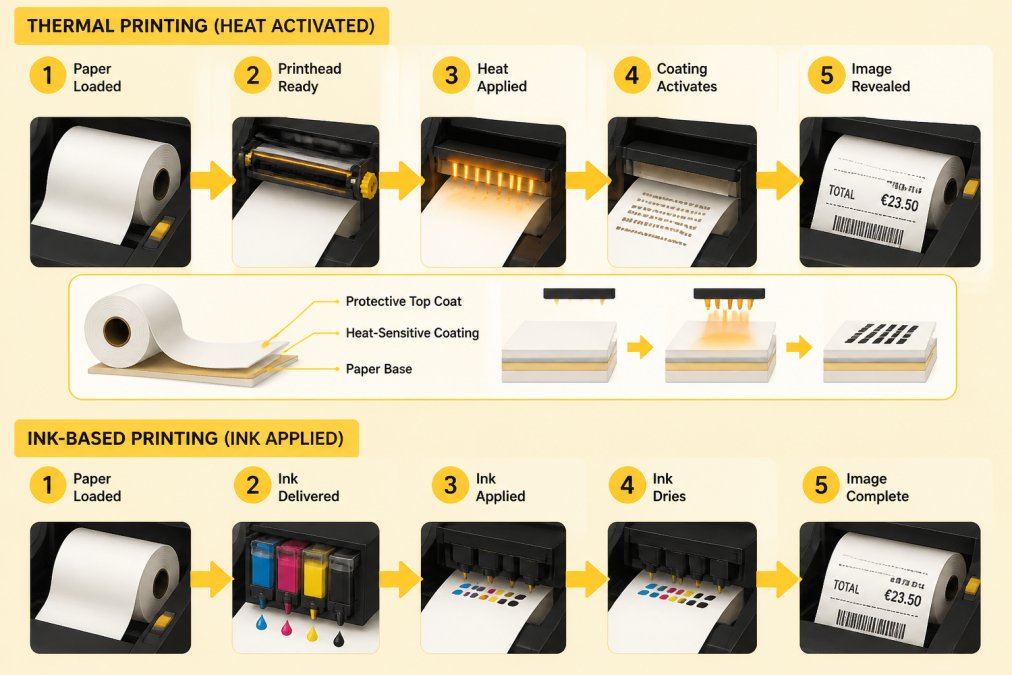
Thermal printers are mechanically simple: paper, a heated printhead, and a motor to advance the roll. No ink cartridges, no toner drums, no liquid reservoirs. This simplicity means fewer mechanical failures and lower maintenance.
Ink-based printing works differently. An inkjet printer sprays tiny droplets of liquid ink onto the paper surface.
The key operational difference: thermal printers are faster and quieter, but their output fades. Ink-based printers produce more permanent records, but cost more per receipt to operate and require more frequent maintenance.
Thermal Printer Paper Compatibility: Choosing the Right Media
Not all thermal papers work with all thermal printers. Compatibility depends on roll width, paper thickness, and coating type.
Roll width is the critical measurement. Common thermal receipt printer widths are 57mm, 58mm, 80mm, and 112mm. If you order a 57mm roll for an 80mm printer, it won't fit.
Paper thickness varies too. Standard thermal receipt paper is typically 60-80 gsm (grams per square metre). Thicker paper (80+ gsm) lasts longer in storage and resists tearing better, but feeds differently in some older printers.
Coating types matter for specific use cases. Standard thermal paper suits most retail receipts. Top-coated thermal paper has an additional protective layer that resists fading and scratching, useful for receipts stored longer or handled frequently.
When you're unsure about compatibility, contact your printer manufacturer or consult your equipment manual. Shop4Rolls.ie can help match your printer specifications to the correct paper roll; our customer care team can confirm the right size for your specific equipment.
How to Identify Thermal Receipt Paper
Thermal receipt paper has distinctive characteristics that make it easy to identify.
Visual test: Thermal paper has a smooth, glossy surface. Run your finger across it; thermal receipt paper feels slicker than standard office paper.
Heat test: Apply gentle heat from a lighter, match, or warm object near (not touching) the paper surface. Thermal paper will darken in the heated area, turning grey or black.
Scratch test: Scratch the surface of thermal paper with a fingernail or coin. You'll see a dark mark appear where you scratched; the heat from friction activates the coating. Standard paper shows no mark.
Smell test: Thermal paper has a faint chemical smell when new. Standard paper smells like regular paper. This is less reliable than other tests but noticeable to experienced users.
Colour and texture: Thermal receipt paper is typically bright white or slightly off-white with a uniform glossy finish. Standard receipt paper is often slightly cream-coloured or has a more textured, less reflective surface.
Thermal Receipt Paper Storage and Fading: What You Need to Know
Thermal receipt paper fades over time, and storage conditions determine how quickly this happens.
Heat exposure is the primary culprit. Thermal paper darkens when heated, but prolonged exposure to warm temperatures causes the chemical coating to deteriorate.
Light exposure also degrades thermal prints. UV light accelerates fading. Receipts stored in bright, sunlit areas fade noticeably within months. Dark storage is preferable.
Humidity and moisture affect thermal paper differently than standard paper. Excessive moisture can cause the coating to blur or smudge. However, moderate humidity (40-60%) is acceptable.
Friction and handling wear thermal prints away. Receipts rubbed repeatedly or folded many times will show fading at stress points.
For receipts you need to keep for extended periods, tax records, warranty documentation, or customer disputes, consider photographing or scanning them digitally.
Standard paper receipts don't face these fading issues. Ink and toner sit on the surface and remain stable for years, even in poor storage conditions.
Thermal Paper Roll Sizes and Specifications
Thermal receipt paper rolls come in standardised sizes, but knowing the measurements matters when ordering.
| Specification | Common Sizes | Notes |
|---|---|---|
| Roll Width | 57mm, 58mm, 80mm, 112mm | Must match your printer's slot width exactly |
| Roll Length | 18m-40m | Longer rolls mean fewer changeovers; check your printer's maximum roll capacity |
| Paper Thickness | 60-80 gsm | Standard 80 gsm is most common; thicker paper resists tearing |
| Core Diameter | 12mm, 25.4mm | Depends on your printer's spindle size |
| Coating Type | Standard, top-coated, water-resistant | Choose based on storage duration and environment |
Width is the most critical measurement. Thermal printers have fixed slot widths, and the paper must fit snugly. A 57mm roll won't work in an 80mm printer, and forcing it risks damaging the printhead.
Length determines how often you'll need to change rolls. A 20-metre roll might last a week in a busy retail environment or a month in a quiet café.
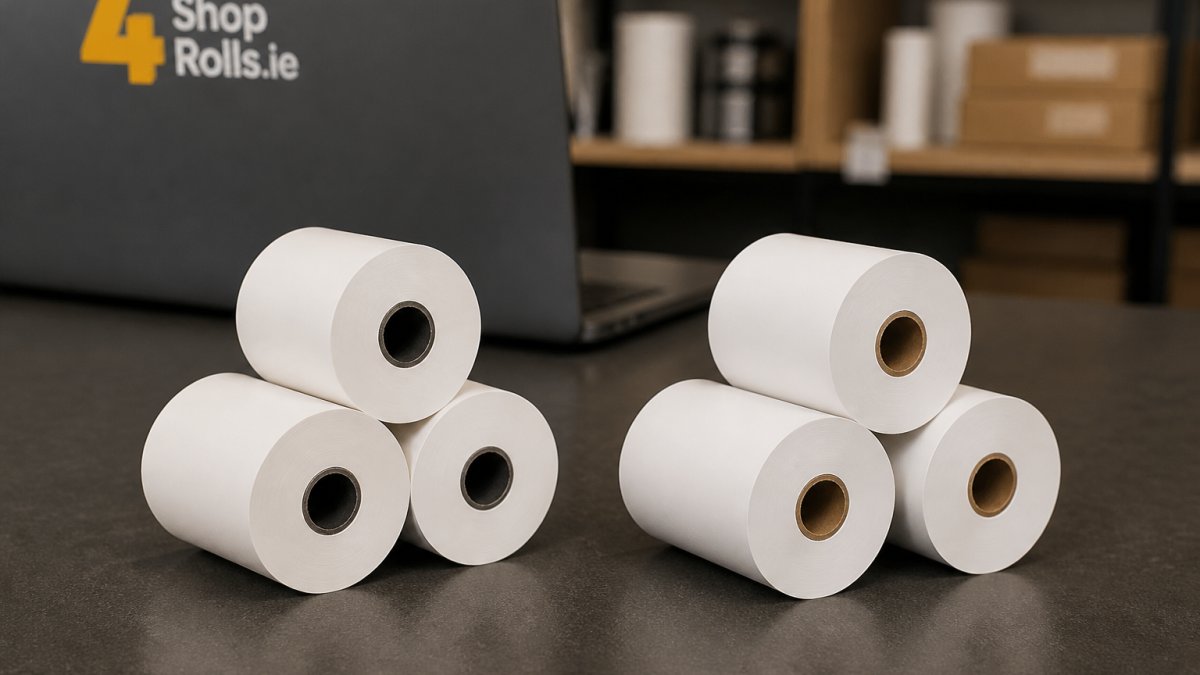
Core diameter is the size of the cardboard tube inside the roll. Most thermal printers use either 12mm or 25.4mm cores. Check your printer's specifications; using the wrong core size means the roll won't seat properly on the spindle.
When ordering thermal receipt paper, confirm all three measurements with your printer's manual or your current roll's packaging. Shop4Rolls.ie stocks thermal receipt paper in all standard sizes, and our team can verify the exact specifications your equipment needs before you order.
Thermal Receipt Paper vs Standard Paper: Which Should You Choose?
The choice depends on your business priorities: cost, durability, record retention, and printing volume.
Choose thermal receipt paper if:
- You print high volumes of receipts daily. Thermal printers are fast and silent, ideal for busy retail or hospitality environments.
- Operating costs matter more than record longevity. No ink or toner means lower consumable costs per receipt.
- You don't need receipts to remain legible for years. Most thermal receipts remain readable for a period in normal storage.
- You have digital backups. If you photograph or scan receipts, thermal paper is sufficient.
Choose standard paper if:
- You need receipts to remain legible indefinitely. Ink and toner don't fade like thermal coatings do.
- You print infrequently. The higher per-receipt cost is offset by lower overall volume.
- You need colour receipts or complex graphics. Thermal printers are monochrome and limited to simple line-based designs.
- Regulatory requirements demand permanent records. Some industries require receipts that won't fade, making standard paper the safer choice.
In practice, most retailers use thermal receipt paper because the speed, simplicity, and low consumable costs align with typical retail operations. However, hospitality businesses that retain receipts for extended periods, or businesses processing high-value transactions where receipt clarity is critical, often choose standard paper despite the higher cost.
Your printer choice locks you into one technology or the other, so decide based on your actual needs rather than switching between them repeatedly. Once you've selected thermal or standard, sourcing reliable rolls becomes straightforward, and that's where having a dependable supplier matters.
Making the Right Choice for Your Business
The decision between thermal receipt paper and standard paper ultimately comes down to your specific operational needs, storage practices, and regulatory environment.
If you run a busy retail store or café where speed matters and you're comfortable with digital record-keeping as backup, thermal receipt paper delivers simplicity and cost savings. If you need receipts that remain legible for years or operate in an industry with strict record-retention rules, standard paper is worth the extra expense.
Whichever you choose, ensure your supply chain is reliable. Running out of receipt paper mid-shift disrupts your business and frustrates customers. Shop4Rolls.ie stocks both thermal and standard receipt paper in all standard sizes, with next-day delivery and a lowest-price guarantee on the products you use every week.
POS Paper's guide to thermal roll options for business receipts POS Paper's guide
Digital Check's comparison of thermal and ink receipt printing costs Digital Check's comparison
MUNBYN's explanation of direct thermal printing versus regular-paper printing MUNBYN's explanation
Frequently Asked Questions
Is thermal paper the same as receipt paper?
Not all receipt paper is thermal. Thermal receipt paper uses a heat-sensitive coating that darkens when exposed to the printhead of a thermal printer. Standard receipt paper requires ink or toner to print. Both can be used for receipts, but thermal paper is more common in retail and hospitality because it requires no ink, making it faster and cheaper for high-volume printing.
Can a thermal printer print on standard paper?
No. Thermal printers rely on heat to activate the chemical layer on thermal paper. Standard paper has no heat-sensitive coating, so nothing will print. Attempting to use standard paper in a thermal printer will produce blank output. Always use thermal receipt paper or compatible media in thermal printers to ensure proper function.
How can you tell whether a receipt is printed on thermal paper?
Thermal receipts have a distinctive appearance: the print is usually black or dark brown on a white or light background, and the image quality is monochrome. Rub the back of a thermal receipt gently with your fingernail or a coin; thermal paper will darken where you apply pressure because heat activates the coating. Standard paper receipts printed with ink won't darken under pressure.
Does thermal receipt paper fade over time?
Yes, thermal receipt paper can fade, especially when exposed to heat, light, or humidity. Direct sunlight and high temperatures accelerate fading significantly. Standard printed receipts using ink or toner are more stable for long-term storage. If you need receipts to remain legible for years, store thermal receipts in a cool, dark place, or consider standard paper for archival purposes.
What are the main disadvantages of thermal paper?
Thermal paper fades over time when exposed to light and heat, making it unsuitable for long-term archival storage. It cannot produce colour prints. The paper is more expensive per unit than standard paper, though operating costs are lower because no ink is needed. Additionally, thermal paper is sensitive to friction and pressure; rough handling can cause unwanted marks on the surface.