 how-to
What Happens If You Run Out of Essential Shop Supplies?
Last Updated: October 31, 2026
Quick Summary
Running out of essential shop supplies can stall checkout, lose sales, and waste staff time, even if the item costs little. Stop any task that a missing item would make unsafe, check backup stock, then order a replacement and track delivery.
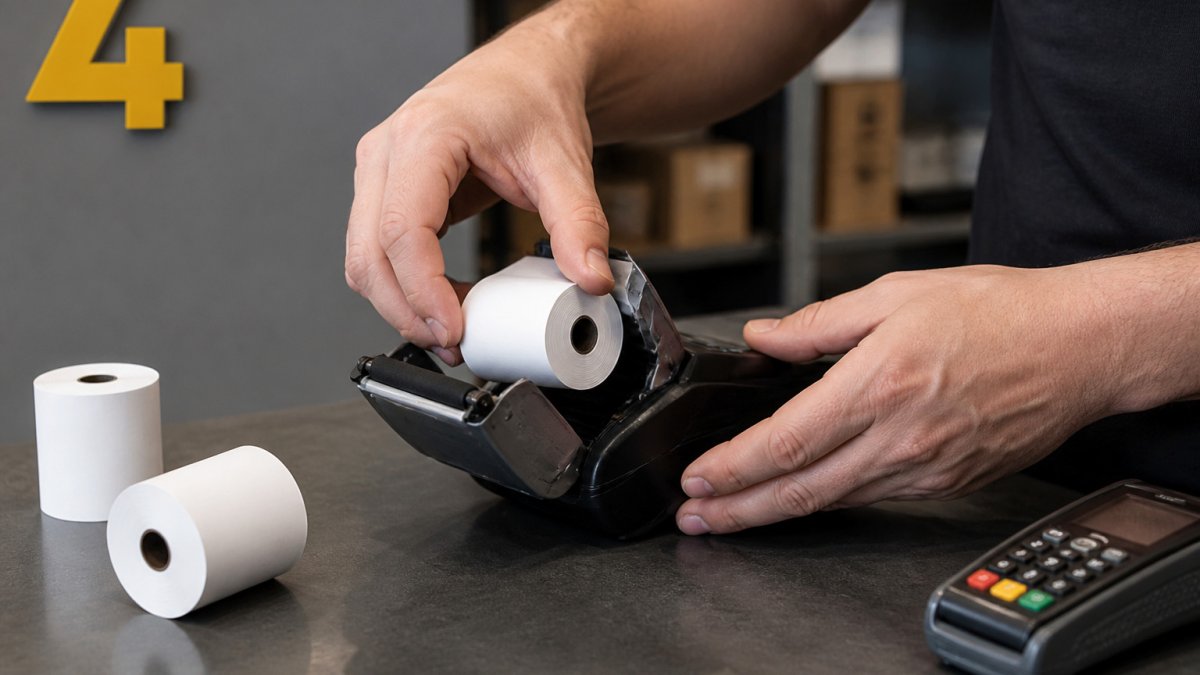
- A card machine with no receipt paper can slow or stop card payments.
- Check that any substitute meets the manufacturer's specification before using it.
- Rank blocked work so customer-facing and payment tasks are resolved first.
- Compare the cost of downtime with the premium for faster delivery before choosing a route.
- Calculate reorder points from weekly use and delivery time, plus a one-to-two-week safety margin.
Table of Contents
- What Running Out of Essential Shop Supplies Actually Costs You
- Immediate Steps When an Essential Supply Runs Out
- Sourcing Replacements Quickly Without Overpaying
- Consumables Versus Durable Tools: What to Keep in Reserve
- Building an Essential Retail Supplies Checklist
- Setting Retail Safety Stock Levels and Reorder Points
- Using Retail Inventory Management Tools and Keeping Your Stock Under Control
- Frequently Asked Questions
What Running Out of Essential Shop Supplies Actually Costs You
Running out of essential shop supplies rarely feels like a crisis at first.
A stockout on a single item can stall the whole checkout, and that stall costs far more than the roll itself.
The damage usually falls into three buckets:
- Lost sales: A card machine with no receipt paper can slow or stop card payments.
- Wasted staff time: People spend minutes hunting for stock, sourcing alternatives, or phoning around.
- Rushed buying: Emergency orders often cost more because you have no time to compare prices.
Most of these costs are hidden. You will not see a line in your accounts that says "lost because we ran out of till rolls," which is why the problem keeps coming back.
Immediate Steps When an Essential Supply Runs Out
When an essential supply runs out, the first ten minutes decide whether you lose a sale, damage equipment, or create a safety risk. Work through this triage checklist in order, and do not skip step three.
- Stop and secure the immediate task. If a card machine has no receipt paper, consider stopping card payments on that terminal rather than letting customers queue while you search. If a cleaning product has run out mid-task, stop the task and isolate the area.
- Confirm the blocked task and its deadline. Write down what cannot proceed, who it affects, and when it must be finished. A missing till roll blocks checkout now; a missing label roll blocks dispatch this afternoon. The deadline tells you how much time you have to source a replacement.
- Decide: pause, substitute, or stop. Use the safety test below. If the substitute is not confirmed safe, the job stops until the correct item arrives.
- Check backup stock before ordering. Look in the back room, under the counter, and in any spare boxes. Keep backup stock in a labelled box so this step takes seconds, not minutes.
- Place the order and record the delivery window. Note the time, the supplier, and the expected arrival so staff know what to expect and when to chase.
- Brief the team. Everyone on shift should know what is short, what the plan is, and who is responsible for chasing the order.
The safety test before you improvise
A substitute that fits physically may still fail. Before using anything in place of an essential supply, confirm three things:
- Specification match: The substitute meets the manufacturer's stated specification for the equipment or task. For thermal paper, that means the correct width and roll diameter for your printer model. A roll that is too wide can jam the mechanism; a roll that is too narrow can fail to advance and damage the print head.
- Compatibility with the process: The substitute does not change how the task works in a way that creates a new risk. Using a different bag for fragile goods may be fine; using a non-food-grade bag for loose food is not.
- No chemical or thermal hazard: Mixing cleaning products or using a household alternative in a commercial setting can create fumes, residue, or a fire risk. If you cannot confirm the substitute is safe, do not use it.
If any of the three checks fails, stop the job. A short delay costs less than a broken machine, a spoiled batch, or an injury.
When to pause trading versus keep going
Not every stockout justifies stopping. Use this simple rule:
- Pause if the shortage affects payment, safety, or legal compliance. No receipt paper on a card terminal, no food-grade packaging for open food, or no safety equipment for a task means the affected activity stops.
- Keep going with a documented workaround if the shortage only slows the task. Writing a manual receipt while the printer is reloaded is acceptable if your record-keeping still meets your obligations. Note the workaround so you can review it later.
- Never improvise on safety-critical items. If the item is required to control a hazard, the job waits.
What to record during a stockout
A short stockout log turns a one-off scramble into useful data. Record the item, the date and time it ran out, the task it blocked, how long the block lasted, and how you resolved it. After three or four entries, patterns appear: the same item runs out on the same day of the week, or a supplier's delivery window is consistently longer than promised.
Sourcing Replacements Quickly Without Overpaying
Fast sourcing is a comparison exercise, not a single habit. When an essential supply runs out, you have four realistic routes, and the right one depends on how long you can wait and what the item costs you per hour of downtime.
Compare the four emergency sourcing routes
| Route | Typical lead time | Best used when | Main trade-off |
|---|---|---|---|
| Borrow from a neighbouring business | Same day | The item is standard and a nearby shop or workshop uses the same specification | Depends on goodwill and their stock; agree a replacement date in writing |
| Buy locally in person | Same day | You need the item within hours and a local stockist carries the correct specification | Limited range and higher unit price than online bulk |
| Order online with next-day delivery | Next working day | The item can wait until the next delivery cycle and you can plan around it | Cut-off times and courier delays; check the delivery terms before ordering |
| Reschedule the affected work | Variable | The task is not time-critical and the correct item is the only safe option | Lost time and possible customer impact; communicate early |
Prioritise urgent work to limit downtime
Downtime is not one block of lost time; it is a queue of tasks that each have a different cost. Rank the blocked work before you source anything:
- Customer-facing and payment tasks first. A checkout that cannot take card payments or issue receipts affects every customer in the queue. Source the item or switch to a documented manual process immediately.
- Tasks with a fixed deadline second. Dispatch cut-off times, delivery slots, and appointment-based work have a hard stop. If the item cannot arrive before the deadline, reschedule the affected orders now rather than hoping.
- Internal and maintenance tasks last. Cleaning, labelling, and workshop jobs can usually wait a day without customer impact.
A common pattern is to treat every stockout as equally urgent. It is not. Ranking the blocked work tells you whether to pay for a faster route or accept a next-day delivery.
Estimate the cost of the stockout before you choose a route
You do not need a formal accounting exercise. A rough comparison is enough to decide whether a premium delivery charge is justified:
- Lost margin per hour: Estimate the sales or billable work the blocked task would have produced in the time it is stopped.
- Staff cost per hour: Count the people who cannot do their normal work while the task is blocked.
- Replacement premium: The difference between the normal price and the fastest available option.
If the lost margin and staff cost together exceed the replacement premium, pay for the faster route. If they do not, take the next-day option and reschedule the affected work.
Keep one trusted supplier as your default
A default supplier is not about loyalty; it is about predictability. You know their stock levels, their cut-off times, their delivery windows, and their pricing. When a stockout hits, you are not comparing unknown suppliers under pressure. Keep a second supplier on file for the items where a single source is a risk, and note both suppliers' delivery terms in your stock list.
Compare unit prices, not pack prices
A larger pack is only better value if you use it before it expires or becomes obsolete. Compare the price per roll, per bag, or per label, and check that the pack size matches your realistic usage. Emergency buying often pushes people towards the largest pack available, which ties up cash and storage space for months.
Consumables Versus Durable Tools: What to Keep in Reserve
Not every item needs the same buffer. Splitting your stock into two groups helps you decide what to keep on hand.
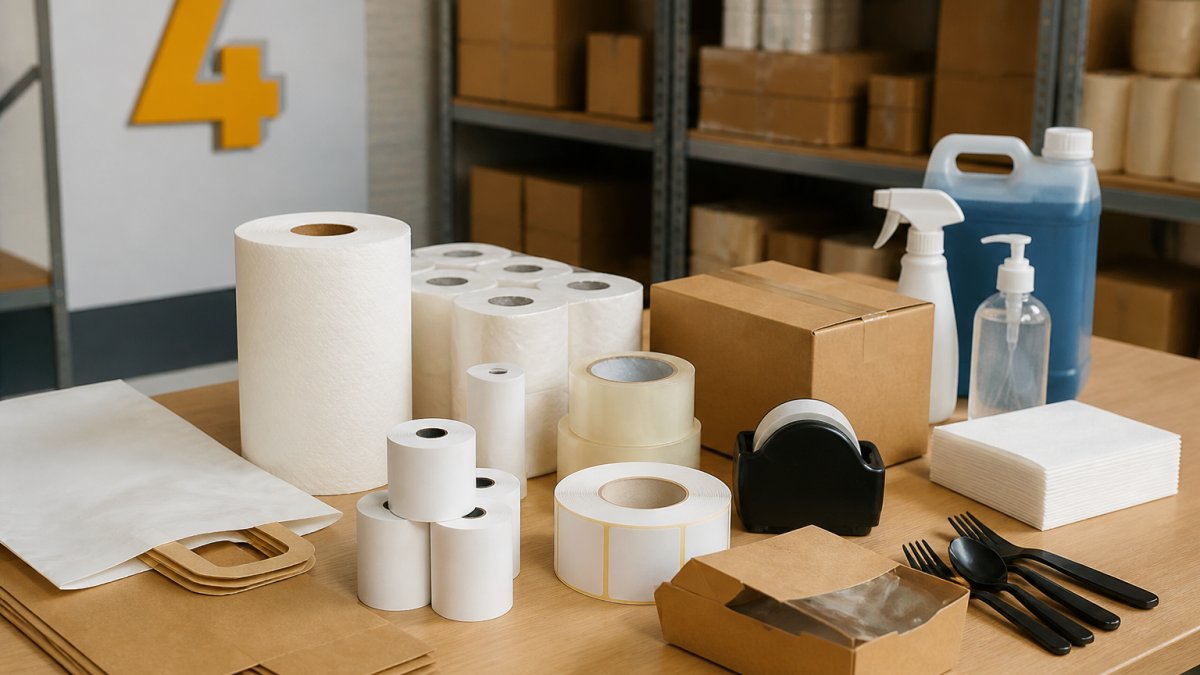
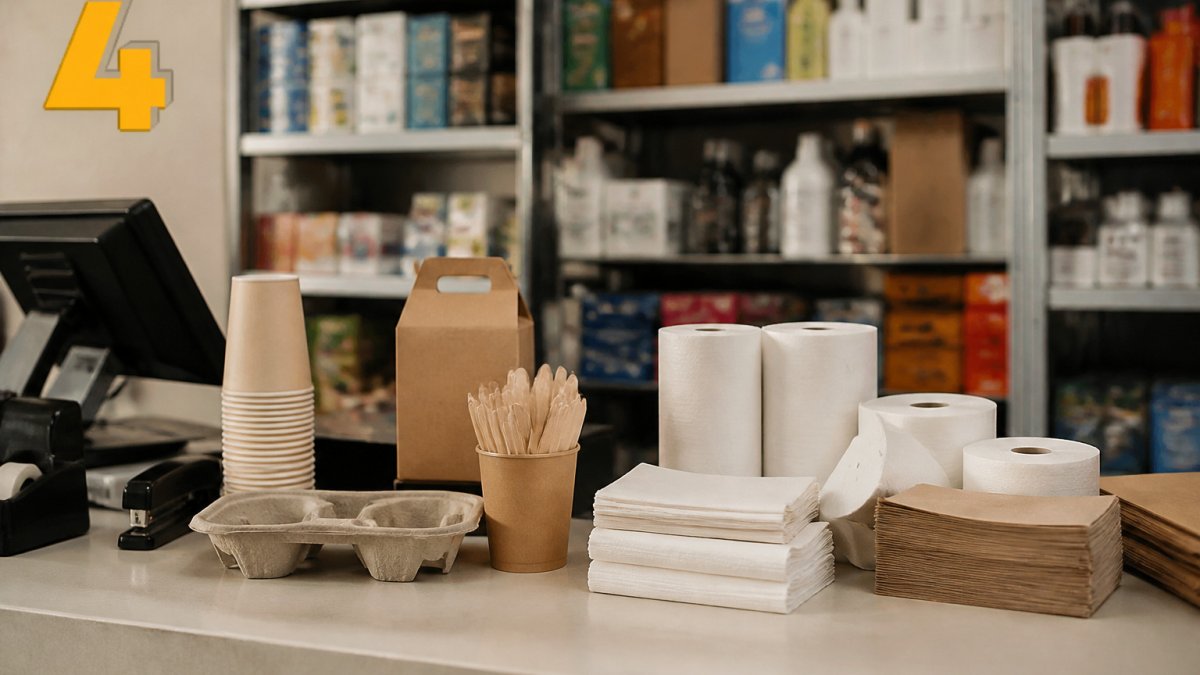
Consumables are items you use up and replace regularly. These include:
- Till rolls and card machine receipt rolls
- Carrier bags and jiffy bags
- Labels and price tags
Durable tools and equipment last longer and fail less often. These include:
- Card machines and printers
- Shelving and stock trolleys
- Scanners and cash drawers
Keep a reserve of consumables that you run through quickly. Durable items usually need a spare only if they are critical to trading, such as a backup printer. Reviewing your usage each month shows which items need more cover.
Building an Essential Retail Supplies Checklist
A written checklist stops small items from slipping through the gaps. Start with what you use every week, then add anything that would stop trading if it ran out.
A simple starter checklist:
- Till rolls (current model width confirmed)
- Card machine receipt rolls (check your terminal's paper size)
- Carrier bags in each size you use
Review the list every quarter. Add new lines when you start selling new products, and remove items you no longer stock. For a fuller view of cost-effective choices, see our guide on 7 Steps to Choose Cost-Effective Shop Consumables.
Setting Retail Safety Stock Levels and Reorder Points
Safety stock is the extra quantity you keep so a delay does not leave you empty. Your reorder point is the stock level that tells you to order now.
Work out your reorder point with this simple method:
- Note how many units you use in an average week.
- Note how long a delivery takes, from order to arrival.
- Multiply weekly use by delivery weeks, then add a safety margin of one to two weeks.
For example, if you use 4 rolls a week and delivery takes 2 days, a reorder point of around 2 weeks of stock gives you a comfortable margin. Adjust the figure to match your own trade.

Holding too much stock ties up cash and takes up space. To learn how to hold enough without overstocking, read Manage Inventory Levels Without Overstocking.
Using Retail Inventory Management Tools and Keeping Your Stock Under Control
Inventory tools help you see stock levels before they become a problem. Even a basic spreadsheet can do the job for a small shop.
A simple setup includes:
- A stock list with item names, current quantities, and reorder points
- A weekly check where you update counts and flag low items
- A supplier note with delivery times and minimum order quantities
If you run a larger operation, a dedicated inventory system can send alerts when stock falls below your reorder point. Choose a tool that matches the size of your trade.
Regular checks turn stockouts from surprises into planned orders.
Frequently Asked Questions
What should you do if a shop runs out of essential supplies?
Act in the first hour. Check whether a nearby stock item, a supplier's same-day option or a temporary substitute can cover the gap without creating a safety or compliance problem. Confirm what the customer or staff member actually needs, then decide whether to pause the affected task, reduce service or source the item urgently. Record what ran out and why, so the next reorder point can be adjusted. Pricing and delivery options depend on quantity, timing and location, so check current terms on Shop4Rolls.ie before ordering.
Which retail supplies should a shop keep in reserve?
Keep reserve stock of items that stop trade when they run out: till rolls, card machine receipt rolls for the terminals you use, bags and packaging you dispatch daily, and any consumable needed for a service you offer. Durable tools can usually be replaced later, but consumables cannot. Use your sales history to set a minimum quantity for each item, and review it after busy periods such as the pre-Christmas trading weeks.
How much safety stock should a small shop keep?
There is no single figure that suits every shop. A common approach is to hold enough of each critical consumable to cover the supplier's lead time plus a margin for demand spikes. If a supplier delivers within one working day and your weekly usage of till rolls is steady, a few weeks of stock may be sufficient. Calculate average daily use, multiply by lead time in days, then add a buffer. Revisit the figure whenever your volumes or supplier terms change.
What should you do if a supplier cannot deliver an urgent order?
Ask the supplier for a firm delivery date in writing, and ask whether an alternative product or a partial delivery is available. At the same time, check whether another supplier can deliver the same item quickly. Avoid unsafe improvised substitutes, especially for anything used with electrical equipment or food handling. Once the immediate gap is covered, review your supplier arrangements so a single delivery failure does not repeat.