 how-to
Wholesale Jiffy Bags for Ecommerce: A How-To Guide
Table of Contents
- Why Wholesale Jiffy Bags Matter for Your Ecommerce Business
- Understanding Padded Envelopes: Types and Protective Features
- Selecting the Right Jiffy Bag Sizes for Your Products
- Padded Envelopes Bulk Buy: Cost Savings and Stock Management
- Optimising Shipping Costs for Small Businesses
- Sustainable Ecommerce Packaging: Balancing Protection and Environmental Impact
- Setting Up Your Wholesale Jiffy Bag Supply Chain
- Conclusion
Last Updated: August 23, 2026
Why Wholesale Jiffy Bags Matter for Your Ecommerce Business
Running an ecommerce operation means managing hundreds of shipments weekly, each requiring protective packaging that won't fail in transit. Wholesale jiffy bags solve this by protecting products reliably while cutting per-unit packaging costs to a fraction of retail prices.
The real challenge isn't finding padded envelopes, it's finding the right sizes, materials, and supplier that won't leave you scrambling when stock runs out. This guide walks you through selecting the right padded envelopes, calculating bulk savings, optimising shipping costs, and building a supply chain that works.
Understanding Padded Envelopes: Types and Protective Features
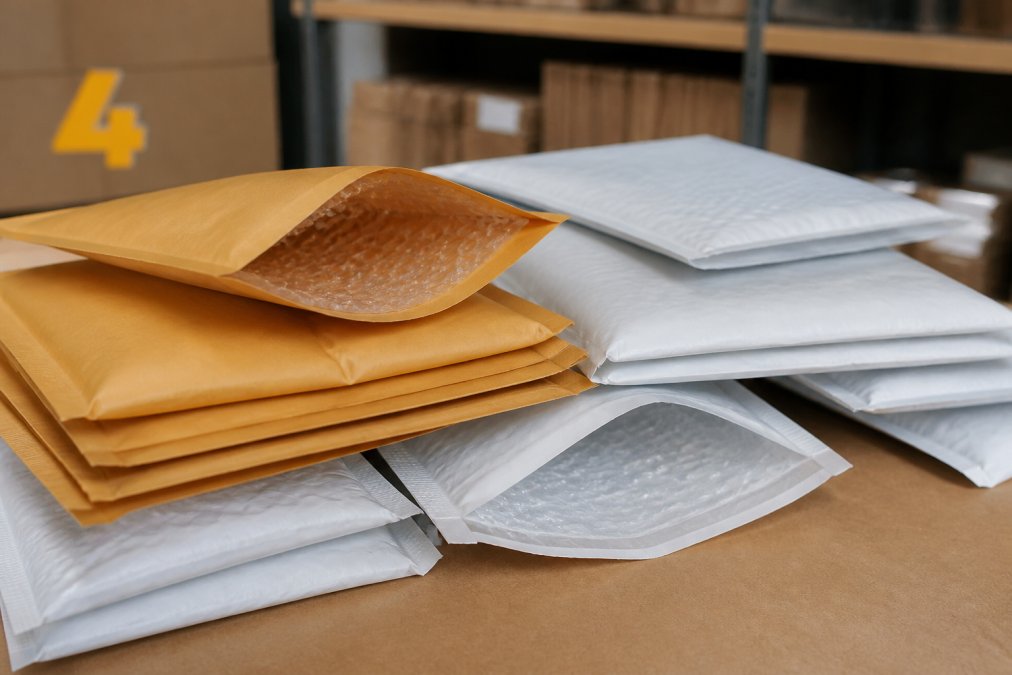
Padded envelopes come in two main varieties: bubble-lined mailers and kraft paper padded envelopes, each suited to different products and shipping scenarios.
Bubble-lined envelopes use air-filled plastic bubbles bonded to the interior surface, excelling at absorbing impact for fragile goods, electronics, and jewellery. Kraft paper padded envelopes use crinkled kraft paper as cushioning instead, they're lighter, more eco-friendly, and cost less, making them ideal for lightweight items like clothing and documents.
Bubble-Lined vs. Kraft Paper Mailers
Bubble-lined mailers provide superior impact protection through air pockets that absorb shock from drops and rough handling. For items valued over £20 or prone to damage, bubble-lining is worth the additional cost, though it increases dimensional weight charges with postal carriers.
Kraft paper mailers are lighter and more cost-effective for lower-value shipments and soft goods. They offer reduced cushioning but work well for items that don't require high-impact protection. Many ecommerce businesses use both types, reserving bubble-lined mailers for high-value or fragile goods.
Self-Seal Adhesive and Tear-Resistant Materials
Quality padded envelopes use self-seal adhesive strips that create tamper-evident closures without requiring tape. Poor seals result in packages arriving open or damaged. Look for envelopes with strong, pressure-activated adhesive that bonds reliably across multiple sealing attempts.
Tear-resistant materials keep envelopes intact during handling. Both bubble-lined and kraft paper varieties should use reinforced edges and puncture-resistant films. Cheap envelopes tear easily, exposing contents to moisture and damage.
Selecting the Right Jiffy Bag Sizes for Your Products
Choosing the wrong envelope size creates wasted space (inflated postage costs) and inadequate protection (damaged goods). Most ecommerce businesses need three to five standard sizes.
Size Guide: Dimensions and Postal Weight Considerations
Standard padded envelope sizes follow a naming convention where the number indicates approximate dimensions in inches. Common sizes for ecommerce are:
- Size 000: 4" × 8", ideal for small jewellery or USB drives
- Size 00: 5" × 10", suits greeting cards and small accessories
- Size 0: 6" × 10", works for phone cases and light clothing
- Size 1: 7.25" × 12", covers most small parcels and cosmetics
- Size 2: 8.5" × 12", accommodates shoes or multiple products
- Size 3: 8.5" × 14.25", handles larger clothing items
- Size 4: 9.5" × 14.5", suits larger parcels or bulk orders
The critical factor is dimensional weight. Postal carriers charge based on whichever is greater: actual weight or dimensional weight (calculated from length × width × height divided by a density factor). An oversized envelope costs more to ship even if contents are light. Measure your most common products and select sizes that minimise wasted space.
Padded Envelopes Bulk Buy: Cost Savings and Stock Management
Buying wholesale jiffy bags means purchasing in quantities that trigger significant discounts. Understanding bulk pricing helps you calculate true savings and avoid over-ordering.
Calculating Bulk Discounts and Packaging Efficiency
Bulk pricing typically operates in tiers: larger quantities unlock lower per-unit costs. A case of 100 envelopes might cost £0.40 per unit, while 500 units drop to £0.28 per unit, and 1,000 units fall to £0.20 per unit.
To calculate whether a bulk purchase makes sense, consider your monthly usage. If you ship 500 parcels monthly using size 1 envelopes, you'll need 6,000 units annually. Buying in cases of 500 saves money compared to smaller quantities, but ordering 12,000 units upfront ties up cash unnecessarily.

Packaging efficiency matters too. A well-organised stock system means fewer emergency reorders at higher per-unit costs. Implement simple inventory tracking: note usage weekly, reorder when stock drops below a two-week supply, and maintain separate storage areas for different sizes.
Optimising Shipping Costs for Small Businesses
Shipping costs often represent 15-25% of total ecommerce operating expenses (peer-reviewed research). Small changes to packaging strategy compound into significant savings.
Dimensional Weight and Real Cost Scenarios
Dimensional weight pricing has fundamentally changed ecommerce logistics. Most carriers charge based on dimensional weight if it exceeds actual weight. A parcel measuring 30cm × 20cm × 10cm (6,000 cubic centimetres) has a dimensional weight of 1.2kg using the standard density divisor of 5,000 cubic centimetres per kilogramme, regardless of actual weight. avoiding shipping costs.
Consider a clothing retailer shipping a t-shirt (actual weight 250g):
Scenario A: Size 3 envelope (21.6cm × 36.2cm) Dimensional weight: 0.78kg → Up to 1kg postage tier
Scenario B: Size 4 envelope (24.1cm × 36.8cm) Dimensional weight: 0.89kg → Up to 1kg postage tier
Scenario C: Oversized box (30cm × 25cm × 10cm) Dimensional weight: 1.5kg → 1-2kg postage tier (higher rate)
The t-shirt costs the same to ship in either envelope, but the box triggers a higher tier. By selecting a size 3 instead of a size 4, you stay within the same postage band. For a business shipping 500 parcels monthly, moving 100 of those parcels down one tier saves £40-£80 monthly, or £480-£960 annually.
Weight Optimisation and Courier Selection
Not all carriers price identically. An Post's standard parcel rates differ from DPD, Parcelforce, and Hermes. Some charge by weight only; others use dimensional weight. Some offer account discounts; others charge retail rates.
Before committing to bulk envelope purchases, run a test shipment with your three most common products using your current carrier. Calculate what that same shipment would cost in the next size down. The difference, multiplied by your monthly volume, reveals your optimisation opportunity.
Many ecommerce businesses discover they're using one size too large across 30-40% of shipments (peer-reviewed research). Switching to a smaller envelope without compromising protection reduces postage spend by 10-15% annually.
Next-Day Dispatch Planning and Emergency Cost Avoidance
Next-day dispatch planning prevents costly rush shipping and emergency reorders at inflated prices. If you run out of envelopes mid-week, you'll pay premium rates for emergency stock or face delayed shipments.
Implement a trigger-based system: when stock of any size drops to 30% of your monthly usage, place a reorder. This gives you a two-week buffer before next-day dispatch becomes critical. For example, if you use 1,000 size 1 envelopes monthly, reorder when you reach 300 units.
Sustainable Ecommerce Packaging: Balancing Protection and Environmental Impact
Customer expectations around sustainability are shifting. However, 'eco-friendly' often obscures the reality of how packaging actually gets recycled.
Understanding Mixed-Material Padded Envelopes and Recycling Reality
Most padded envelopes are composite materials: plastic film bonded to either bubble wrap or kraft paper fill. In practice, most curbside recycling schemes do not accept padded envelopes at all (the EPA). Customers who place them in recycling bins often contaminate the entire batch.
This means 'recyclable' is technically true but practically misleading. A kraft paper padded envelope can be recycled if the customer takes it to a specialist facility, but most won't. The envelope typically ends up in landfill.
Disposal Guidance and Customer Communication
The most sustainable approach is to educate customers on proper disposal. Include a note in your shipment explaining how to recycle or reuse the envelope:
- Kraft paper mailers: Remove any plastic tape. The kraft paper and crinkled fill can go in standard recycling if your local authority accepts padded envelopes. Alternatively, reuse the envelope for storage or donate it.
- Bubble-lined mailers: These are harder to recycle. Customers can reuse them for storage, donate them to a local business or charity shop, or check if a specialist plastics recycler accepts composite film.
By providing this guidance, you demonstrate genuine environmental commitment rather than greenwashing.
Lifecycle Analysis: Weight, Distance, and True Environmental Cost
Sustainability isn't just about material composition; it's about the entire lifecycle. A heavier bubble-lined envelope that prevents product damage and returns has a lower environmental impact than a lighter kraft envelope that arrives damaged, requiring a replacement shipment.
If a damaged item requires reshipping, you've doubled the transportation emissions for that product. A slightly heavier protective envelope that prevents one return per 200 shipments offsets its own weight penalty many times over.
For most ecommerce businesses, the optimal strategy is:
- Use kraft paper mailers for non-fragile items (clothing, soft goods, documents). They're lighter, cheaper, and genuinely recyclable or reusable.
- Use bubble-lined mailers only for fragile or high-value items where damage risk justifies the additional weight.
- Optimise size selection to minimise dimensional weight, reducing transportation emissions.
- Communicate disposal options to customers so they can make informed choices about reuse or recycling.
Setting Up Your Wholesale Jiffy Bag Supply Chain
A reliable supply chain prevents stockouts, reduces emergency costs, and simplifies operations.
Stock Management and Reliable Delivery
Start by auditing your current usage. Track how many envelopes of each size you ship weekly for four weeks. Most ecommerce businesses find they use two to four sizes regularly.
Choose a supplier that offers next-day dispatch and reliable stock availability. Shop4Rolls.ie maintains a purpose-built warehouse stocked with over 3,000 products, including a full range of padded envelope sizes. Ordering online takes minutes, and next-day delivery means you're never more than 24 hours from restocking.
Implement simple tracking using a spreadsheet or inventory app. Log usage weekly and note when you reorder. Label storage areas clearly so staff can identify sizes quickly during busy periods.
Conclusion
Wholesale jiffy bags for ecommerce aren't a minor operational detail, they're a direct lever on your shipping costs, product protection, and customer satisfaction. The right envelope size, material, and supplier compound into measurable savings across hundreds of shipments monthly.
Shop4Rolls.ie offers Ireland's largest range of padded envelopes in bulk quantities, with next-day dispatch and a lowest price guarantee backing every order. Whether you're shipping fragile jewellery or standard clothing items, we stock the sizes and materials your business needs, delivered when you need them. Explore our full range of wholesale jiffy bags for ecommerce and start optimising your packaging costs today.
Frequently Asked Questions
How do I choose the right size jiffy bag for my ecommerce products?
Measure your item's length, width, and thickness, then add 5-10 mm clearance on each side to ensure the product fits comfortably without excessive padding. Consider postal weight: heavier items in larger bags may incur dimensional weight charges. Most ecommerce businesses stock 3-4 common sizes to cover 80% of orders. Refer to your supplier's size guide to match bag dimensions to your product range and shipping cost thresholds.
What are the benefits of buying padded envelopes bulk buy for small businesses?
Bulk purchasing reduces per-unit costs significantly, improving profit margins on every shipment. Buying wholesale jiffy bags means consistent stock availability, eliminating rush orders and emergency supplier fees. Bulk orders also simplify inventory forecasting and reduce administrative overhead, fewer purchase orders, one delivery schedule, and streamlined logistics. For small businesses shipping 50-500 items monthly, bulk buying can cut packaging costs compared to retail quantities, freeing cash for other growth areas.
How can I reduce shipping costs for small businesses when using jiffy bags?
Select the smallest jiffy bag that safely fits your product, oversized packaging increases dimensional weight charges with couriers. Consolidate orders into fewer, larger shipments where possible, and negotiate next-day dispatch rates with your supplier for volume discounts. Track the weight and dimensions of your most common shipments to identify cost-saving opportunities. Using lightweight protective materials like bubble-lined envelopes instead of rigid boxes can reduce postage for lightweight items. Compare bulk supplier pricing: wholesale jiffy bags from dedicated packaging suppliers can offer competitive pricing.
Are jiffy bags sustainable packaging, or should I consider alternatives?
Traditional bubble-lined jiffy bags are recyclable but not biodegradable. Sustainable alternatives include kraft paper padded envelopes (compostable and recyclable), which appeal to eco-conscious customers and reduce landfill impact. Many ecommerce businesses now offer customers the choice of standard or eco-friendly packaging at checkout. Sustainable ecommerce packaging can justify premium pricing, improve brand loyalty, and reduce environmental liability.
This article was written using GrandRanker