 blog
7 Sustainable Packing Tape Alternatives Compared
Last Updated: October 29, 2026
Quick Summary
Sustainable packing tape is usually paper-based, such as kraft or water-activated gummed tape, rather than plastic. Paper tape can go into the same recycling stream as the cardboard box it seals, which removes the plastic contamination that conventional tape creates.
- Judge sustainable packing tape on four factors: material, renewable or recycled content, recyclability and end-of-life.
- Water-activated paper tape bonds to box fibres and forms a strong seal, but needs a dispenser that applies water.
- Check compostable claims against a recognised certification and confirm the adhesive breaks down as well as the backing.
- Compare tapes on cost per parcel, not price per roll, by running a like-for-like trial of at least 50 parcels per type.
- Choose by parcel weight and carton surface first, then by speed and presentation, and order a small trial batch before committing.
Table of Contents
- What Makes Packing Tape Sustainable?
- Paper Packing Tape and Kraft Tape Explained
- Water-Activated Paper Tape: Strength, Dispensers and Trade-Offs
- Compostable Packing Tape: What the Claims Actually Mean
- Testing Performance and Total Cost Across Tape Types
- Choosing the Right Sustainable Tape for Your Shipments
- Order Your Sustainable Tape Stock Through Shop4Rolls.ie
- Frequently Asked Questions
Plastic packing tape has dominated parcel sealing for decades: it is cheap, grips quickly, and most warehouse dispensers are built around it.
Most of the difficulty comes down to three things. Plastic tape bonds quickly to cardboard and is widely used across packing operations. Replacements must match that performance without slowing packing lines, or the delays and transit failures quickly outweigh any saving.
The second issue is dispensing: staff have built muscle memory around existing tape guns, so a new tape often means a new dispenser and training.
This guide works through the main alternatives, what their environmental claims actually mean, and how to judge performance and total cost before you commit.
What Makes Packing Tape Sustainable?
Sustainable packing tape is usually judged on four factors: the material it is made from, whether that material is renewable or recycled, whether it can be recycled alongside the cardboard it seals, and what happens to it at end of life. A tape can score well on one and poorly on another, so check all four rather than relying on a single green label.
Material matters first. Paper or kraft fibre tapes are made from a renewable resource, while conventional tapes use plastic backing.
Recycled content and bio-based resins are also worth checking.
Finally, consider the whole parcel. Sealing a paper box with plastic tape undermines the box's recyclability, while a paper-based tape keeps the packaging in one recycling stream, often the simplest improvement a business can make.
Paper Packing Tape and Kraft Tape Explained
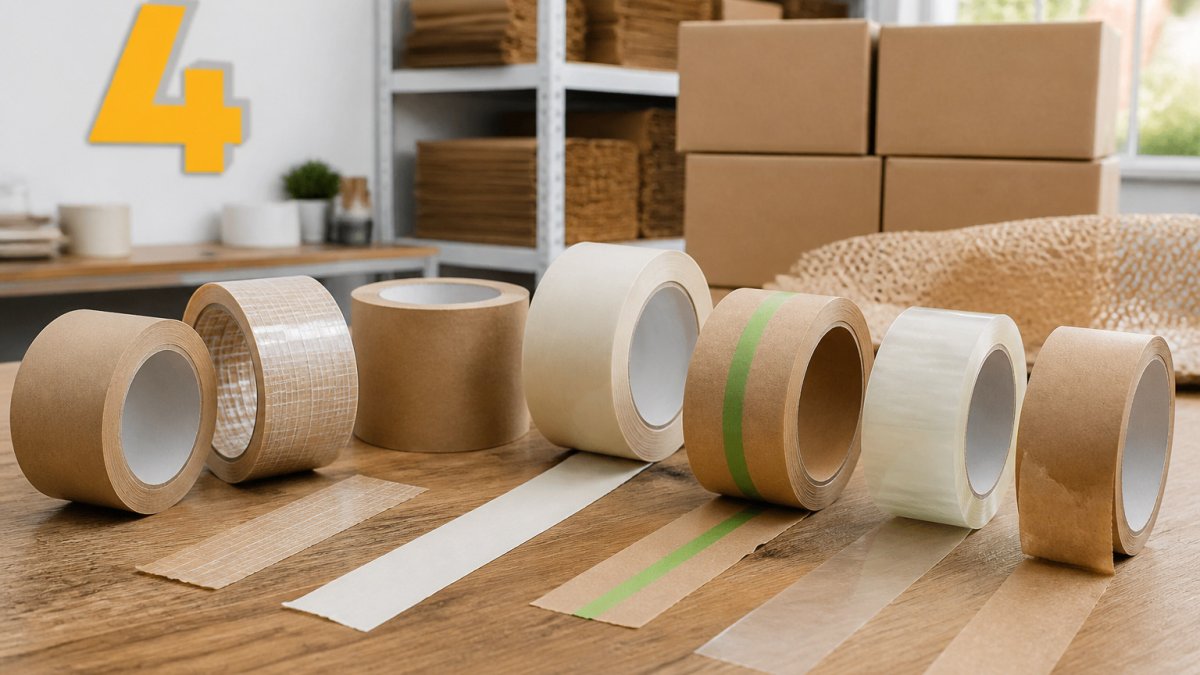
Paper and kraft tapes are the most common sustainable alternative. They are made from kraft paper, the strong brown paper used for many corrugated boxes, coated with an adhesive.
Kraft tape is often reinforced with fibres for added strength, which makes it suitable for heavier boxes.
The trade-off is that performance depends heavily on the product and the box. Paper tape can feel less secure on coated or very smooth cardboard, so test it on your own boxes before rolling it out across the business.
Water-Activated Paper Tape: Strength, Dispensers and Trade-Offs
Water-activated paper tape, sometimes called gummed tape, uses a starch-based adhesive that bonds only when moistened.
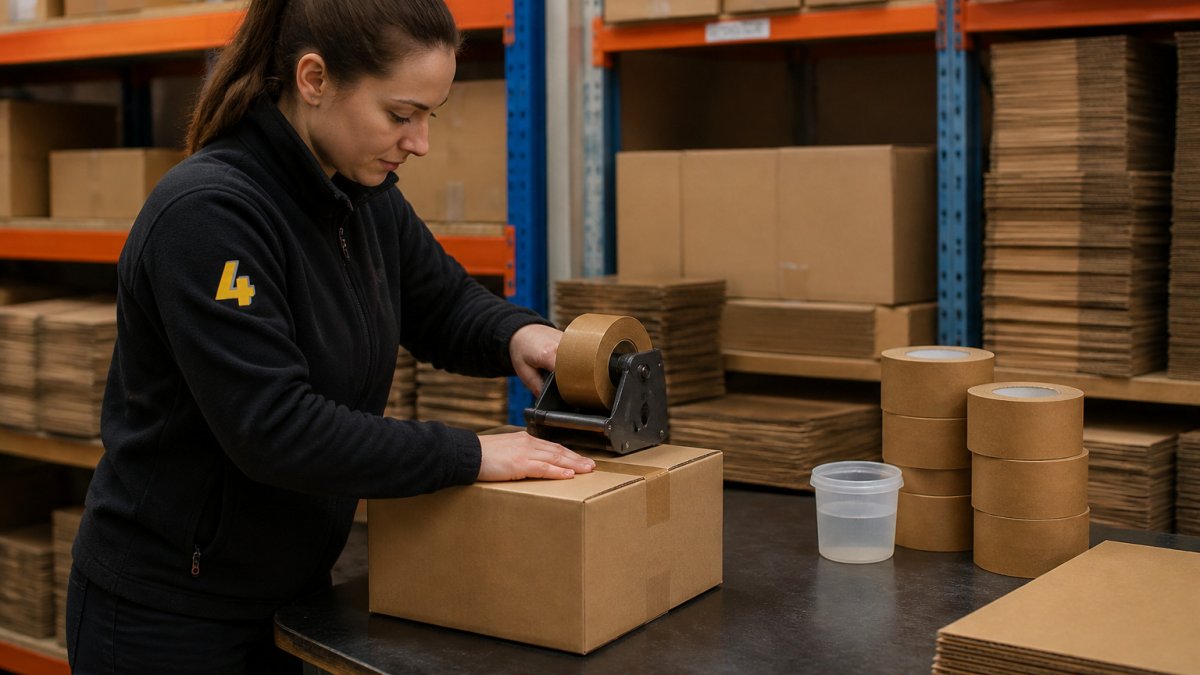
It needs a dispenser that applies water. Manual dispensers are inexpensive and easy to learn, while electric versions speed up high-volume packing.
The main trade-offs are speed and running costs.
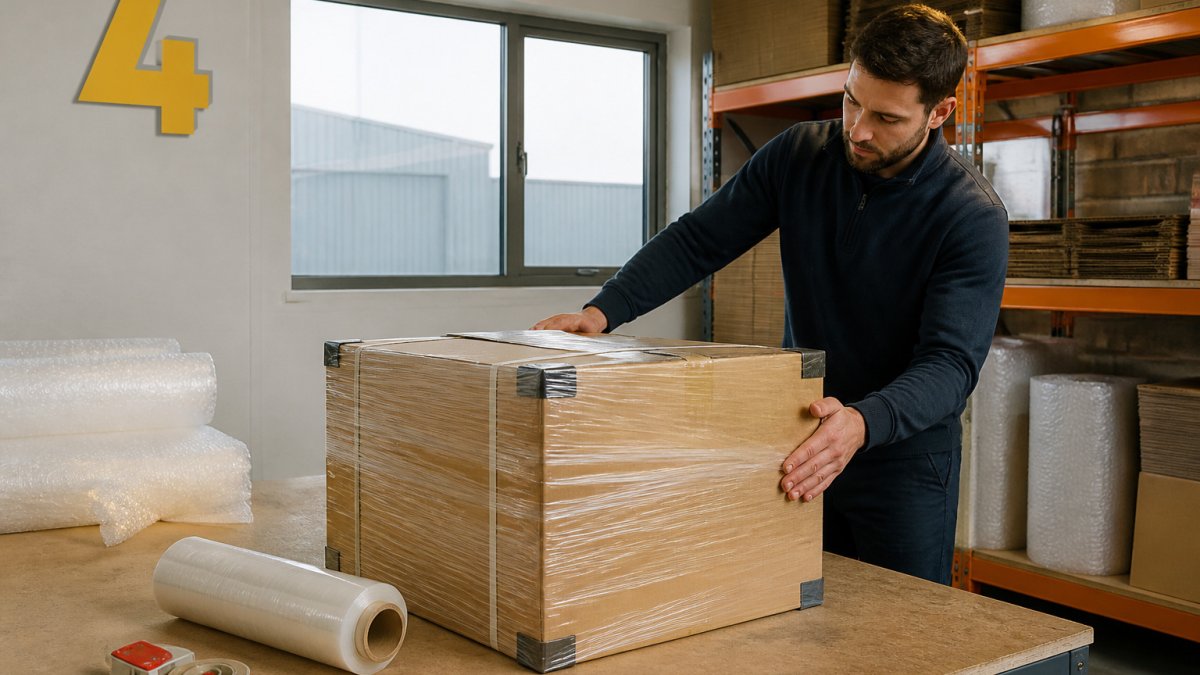
A warehouse packer applying brown paper tape to a cardboard parcel on a packing bench, with a water-activated dispenser beside the box.
Compostable Packing Tape: What the Claims Actually Mean
"Compostable" is one of the most abused terms in packaging, so be precise. A compostable product breaks down into natural components under specific conditions.
Look for recognised certifications rather than general wording. A label such as "eco-friendly" or "plant-based" tells you little on its own.
Be realistic about disposal. For a fuller comparison of compostable and recyclable materials, see Compostable vs Recyclable Mailers for E-Commerce.
Recyclability and Compatibility with Paper Packaging
Recyclability depends on what the tape is attached to and what the local recycling system accepts.
Compatibility also depends on the adhesive. Solvent-based adhesives can affect recycling processes, so water-based or hot-melt options are generally preferable for paper recycling. Check the product specification before assuming compatibility.
A useful habit is to ask whether the box and tape can be separated easily by the end user.
Testing Performance and Total Cost Across Tape Types
Price per roll tells you almost nothing about what a tape will cost your business over a year. What matters is how much tape each parcel consumes, how often a seal fails, how long application takes, and what you spend on dispensers, training and waste. A tape costing a few cents more per roll can easily be the cheaper option once failures and labour are counted.
Run a like-for-like trial
A useful trial compares at least two tape types under identical conditions: same carton sizes, products, packing bench and, ideally, staff. Seal a minimum of 50 parcels per tape type so occasional failures do not skew the result. Record four things per parcel: application time (stopwatch a batch of ten and divide), tape used per parcel, seal failures at 24 hours and at dispatch, and any customer complaints about damaged or opened parcels in the following weeks.
A simple trial sheet with columns for tape type, parcel weight, carton surface (plain kraft, coated, recycled), application time, tape length used and failure notes will give you enough data to compare fairly. Run the trial across at least two carton types if your range includes both light mailers and heavy double-wall boxes, because paper tapes behave differently on smooth coated surfaces than on standard corrugated.
What to measure and why
Adhesion and seal integrity are best judged by a simple peel and shake test. After sealing, leave the parcel for 24 hours, then attempt to lift the tape edge with a fingernail.
Temperature and humidity matter more than most buyers expect. Water-activated tape can take longer to set in a cold or humid packing area, and pressure-sensitive paper tapes may lose initial tack on very cold cardboard.
Total cost of ownership, line by line
Build a cost per parcel rather than a cost per roll. The main lines are:
- Tape used per parcel (length × price per metre, not price per roll)
- Dispenser cost, amortised over its expected life
- Water, cleaning and maintenance for water-activated systems
- Labour time per parcel (application seconds × hourly rate)
- Failure cost: replacement goods, reshipping and customer service time
- Waste disposal or recycling cost for tape that cannot go in the paper stream
A common pattern is that water-activated tape uses less length per seal than pressure-sensitive tape because it bonds to the carton fibres and does not need overlap layers for security. That can offset a higher roll price. Equally, a cheap pressure-sensitive tape that needs two or three layers on a heavy box may use more metres per parcel than a stronger tape applied once.
Interpreting the results
If a tape fails more than about one parcel in a hundred in your trial, treat it as unsuitable for that carton type regardless of price. If application time rises by more than a few seconds per parcel at high volume, the labour cost will usually outweigh any roll saving. And if the tape cannot go into the same recycling stream as the carton, add the disposal cost and customer confusion to the comparison.
Choosing the Right Sustainable Tape for Your Shipments
Most guides say the right tape depends on what you send, true, but not useful at the packing bench. A practical selection comes down to four questions: parcel weight, carton surface, shipping conditions and fulfilment volume. Work through them in that order and the shortlist usually narrows to one or two options.
Start with parcel weight and carton type
Light parcels under about 2 kg in single-wall cartons are well served by standard pressure-sensitive paper tape: it applies quickly with a standard dispenser and goes into the paper stream with the box.
Carton surface matters as much as weight. Coated or very smooth printed cartons can reject pressure-sensitive adhesives, especially in cold conditions; there, water-activated tape or a pressure-sensitive tape formulated for coated board will hold better.
Match the tape to shipping conditions
If parcels travel through courier networks with repeated handling and temperature swings, prioritise seal integrity over application speed. Water-activated tape performs well here because the bond strengthens as it dries. If parcels are stored in humid conditions before dispatch, allow extra set time for water-activated tape or choose a pressure-sensitive paper tape with a strong initial tack. For next-day or same-day dispatch where packing speed is critical, pressure-sensitive paper tape usually wins on throughput.
Factor in fulfilment volume and presentation
Low-volume sellers packing a few dozen parcels a day can use a manual water-activated dispenser or a standard tape gun without slowing down. High-volume operations packing hundreds a day should weigh the labour cost of water-activated tape against its security benefits; an electric dispenser can close much of the speed gap but needs a water supply and regular cleaning. If the unboxing experience matters, kraft paper tape and custom-printed paper tape give a natural finish that matches a paper-based brand, while plastic tapes look out of place on a paper parcel.
A simple selection framework
| Shipment profile | First choice | Alternative |
|---|---|---|
| Light parcels, single-wall cartons, high volume | Pressure-sensitive paper tape | Standard kraft paper tape |
| Medium parcels, double-wall cartons | Reinforced kraft paper tape | Water-activated kraft tape |
| Heavy, fragile or high-value parcels | Water-activated kraft tape | Reinforced kraft tape with extra coverage |
| Coated or printed cartons | Water-activated kraft tape | Pressure-sensitive tape for coated board |
| Brand-led unboxing, low volume | Printed kraft paper tape | Water-activated kraft tape |
Trial before you commit
Whichever route you take, order a small quantity and run a short trial on your own cartons before committing to a bulk order. Review the results after the first month, including any transit damage or customer feedback, and adjust if needed. The right tape for your business seals reliably, fits your packing speed and keeps the parcel in a single recycling stream.
Order Your Sustainable Tape Stock Through Shop4Rolls.ie
If you are ready to move to a more sustainable tape, Shop4Rolls.ie can help you source it alongside the rest of your packaging and operational supplies. Pricing depends on quantity, delivery and the specific product, so check current prices and request a quote on our website before ordering.
Frequently Asked Questions
What is the most sustainable alternative to plastic packing tape?
Water-activated kraft paper tape is one option to consider, because it is made from paper and is typically recyclable with cardboard. Pressure-sensitive paper tape is a simpler option that works with standard dispensers but usually offers less tensile strength. The right choice depends on parcel weight, how often you seal boxes, and whether your dispatch area can accommodate a water dispenser. Test a roll on your own packaging before switching across the whole operation.
Is paper packing tape recyclable with cardboard?
Most paper packing tapes can go into the same recycling stream as corrugated cardboard, provided the adhesive is water-based and the tape is not heavily laminated. Check the product specification for the adhesive type and any recyclability statement. Water-activated tapes generally fit this stream well, while some pressure-sensitive tapes with synthetic adhesives may be less suitable. Where a tape is not clearly marked, your local recycling collector can confirm what is accepted.
What is the difference between kraft paper tape and water-activated tape?
Kraft paper tape is a material description: a paper backing, usually brown, that can be either pressure-sensitive or water-activated. Water-activated tape is a type of adhesive system that needs moistening before it bonds, which typically gives a stronger, tamper-evident seal on heavy boxes. Pressure-sensitive kraft tape applies dry and is faster to use, but may not hold as firmly under load. Many suppliers sell both types, so check the adhesive method before ordering.
Is compostable packing tape suitable for shipping parcels?
Compostable packing tape can seal parcels effectively, but compostability is not the same as performance. Confirm the tape's tensile strength and adhesion ratings against the weight of your boxes, and check whether the compostability claim is backed by a recognised certification. Home composting conditions are usually far less controlled than industrial facilities, so a compostable label does not guarantee the tape will break down in a garden compost bin. Ask your supplier for specification sheets before relying on the claim.