 blog
Cardboard Boxes vs Mailing Bags: A Guide for Small Retailers
Last Updated: October 23, 2026
Quick Summary
Cardboard boxes mailing bags each serve different purposes for small retailers. Cardboard boxes provide rigid protection for fragile and heavy items while creating branding opportunities, whereas mailing bags save costs and storage space for lightweight, flexible products like clothing. The best choice depends on what you're shipping and your total operational costs, including postage, labour, and damage rates.
- Mailing bags cost 10-15% less per unit than cardboard boxes but often lose this advantage through higher dimensional weight postage charges.
- Cardboard boxes are the only practical choice for fragile items like glassware and electronics; mailing bags cannot provide adequate compression protection.
- Mailing bags compress flat and require dramatically less warehouse storage than cardboard boxes, a major advantage for space-constrained retailers.
- Cardboard boxes offer branding and unboxing experience opportunities that mailing bags cannot match, creating customer loyalty touchpoints.
- Many successful retailers use both packaging types strategically: bags for lightweight items and boxes for heavier or fragile goods.
Table of Contents
- Cardboard Boxes vs Mailing Bags: Key Differences
- Packaging for Fragile Items: Which Option Wins?
- Are Mailing Bags Cheaper Than Boxes?
- Cardboard Boxes for Shipping: Protection and Branding
- Recyclable Packaging Options for Retailers
- Choosing the Right Packaging by Product Type
- Storage, Operations, and Total Cost of Ownership
- Making the Switch: What Small Retailers Should Know
- Frequently Asked Questions
Cardboard Boxes vs Mailing Bags: Key Differences
When you're running a small retail business, choosing between cardboard boxes mailing bags isn't just about preference, it shapes your shipping costs, customer experience, and operational efficiency. The right choice depends on what you're actually shipping.
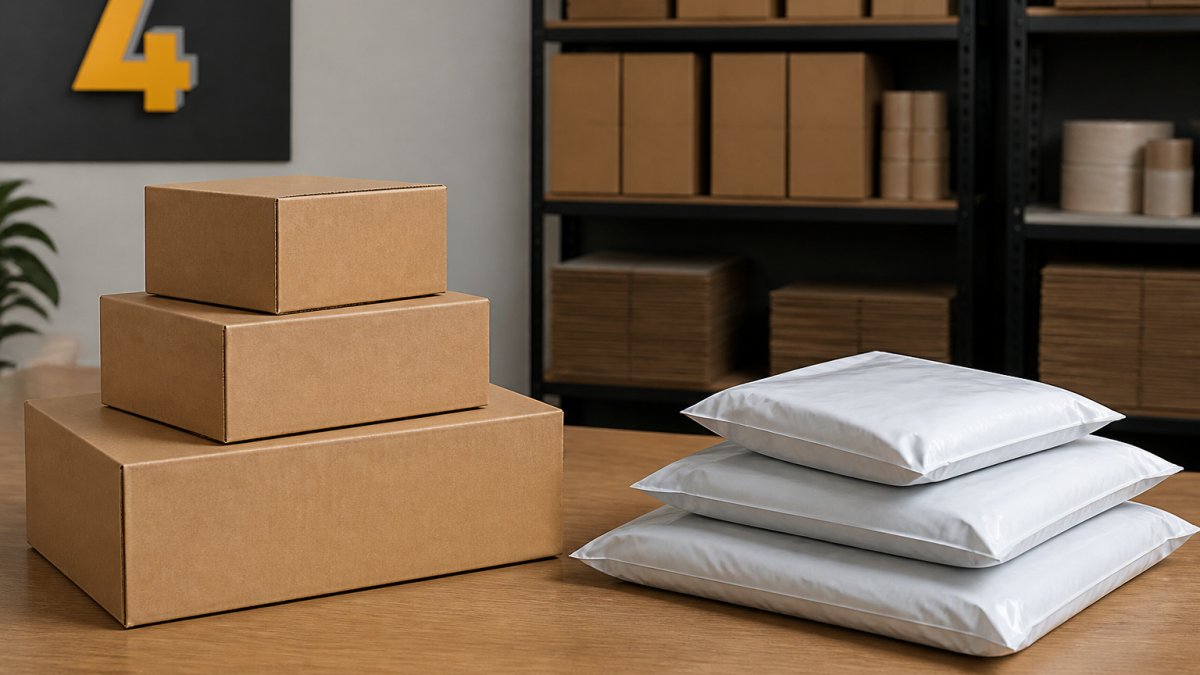
The core difference is structural. Cardboard boxes provide rigid protection from all angles. Mailing bags, typically polythene or poly mailers, are flexible and conform to their contents. One isn't universally better than the other. Each serves specific product types and business constraints.
Construction and durability
Cardboard boxes come in different strengths, typically measured by flute type and wall thickness. Single-walled corrugated cardboard offers basic protection. Double-walled versions provide significantly more compression resistance and impact protection.
Mailing bags, usually made from polythene or poly materials, offer puncture resistance but limited compression strength. They compress under weight, which can damage contents if items inside aren't properly cushioned.
For durability over time, cardboard boxes maintain structural integrity if kept dry. Moisture weakens cardboard significantly. Mailing bags resist moisture better but can degrade under prolonged UV exposure or extreme temperatures. Both materials are recyclable, though cardboard recycling is more established in Ireland.
Storage and handling
Cardboard boxes take up consistent, stackable space. You can predict your warehouse footprint precisely. Empty boxes nest together for storage efficiency, but assembled boxes occupy fixed volume.
Mailing bags compress flat, dramatically reducing storage requirements. A pallet of flat mailing bags occupies a fraction of the space needed for equivalent cardboard boxes. For small retailers with limited warehouse space, this is often the deciding factor.
Packing time differs too. Bags require less assembly, no folding, taping, or construction. You fill, seal, and ship. Boxes need assembly, which adds labour time per order. For high-volume operations, this compounds quickly.
Packaging for Fragile Items: Which Option Wins?
Fragile items, glassware, ceramics, electronics, demand protection cardboard boxes provide. The rigid structure prevents crushing. The ability to add void fill (bubble wrap, packing peanuts, kraft paper) inside a box creates layers of shock absorption that mailing bags cannot match.
If you're shipping fragile goods, cardboard boxes are the only practical choice. Mailing bags might work for soft, padded items, but anything breakable needs the structural support a box offers.
Retailers shipping fragile items often see returns and complaints spike when they switch to bags for cost reasons. The savings disappear once you factor in replacement costs and refunds.
Are Mailing Bags Cheaper Than Boxes?
This is where the decision gets complicated. The answer depends on three variables: material and unit costs, postage charges, and your total operational picture.
Material and unit costs
Mailing bags generally cost less per unit than cardboard boxes of comparable size. A basic polythene mailing bag might cost 10-15% less than a cardboard box. For retailers shipping hundreds of orders weekly, that difference accumulates.
However, cost-per-unit is misleading. You need to compare the total cost of shipping an actual product. A mailing bag suitable for a garment might cost less than a small cardboard box, but if you're shipping multiple items together, you might need multiple bags or a larger box, changing the math entirely.
Postage and dimensional weight
This is where mailing bags often lose their cost advantage. Many carriers, including An Post and international services, charge based on dimensional weight, the space a package occupies, not just its actual weight.
A bulky item in a mailing bag takes up significant dimensional space. The same item in a cardboard box might compress slightly or pack more efficiently, resulting in a lower dimensional weight charge. For lightweight, low-density items (clothing, soft goods), mailing bags win on postage.
The postage difference often exceeds the material cost savings. A retailer might save €0.15 on bag costs but pay an extra €0.40 in dimensional weight charges.
| Packaging Type | Unit Cost | Best For Postage | Typical Use |
|---|---|---|---|
| Polythene mailing bags | Lower per unit | Lightweight, compact items | Clothing, documents, soft goods |
| Cardboard boxes (single-wall) | Moderate | Mixed-density items | General retail, some fragile items |
| Cardboard boxes (double-wall) | Higher per unit | Heavy, bulky, fragile items | Electronics, glassware, machinery |
Cardboard Boxes for Shipping: Protection and Branding
Cardboard boxes offer two advantages beyond protection: durability in transit and branding opportunity.
A branded cardboard box creates a professional unboxing experience. Customers remember opening a well-presented package. Mailing bags are functional but forgettable.
The protection advantage extends beyond fragile items.
For retailers building brand loyalty, the cardboard box is a touchpoint. You can print your logo, include a thank-you note, or add a small gift.
Shop4Rolls.ie stocks a range of cardboard boxes designed for retail shipping. The variety allows you to right-size packaging for each order, minimising void fill costs and postage charges.
Recyclable Packaging Options for Retailers
Both cardboard boxes and mailing bags can be recyclable, but the reality is more nuanced. Ireland's waste management regulations outline recycling requirements for packaging materials.
Cardboard is widely accepted in Irish kerbside recycling programmes. Mailing bags made from polythene are more complicated.
If sustainability matters to your brand or your customers, cardboard boxes are the cleaner choice. You can source recycled cardboard boxes and promote their recyclability.
Some retailers use compostable mailing bags as a middle ground. These cost more than standard polythene but offer environmental benefits.
For a how to reduce retail packaging costs guide, exploring recyclable options alongside cost reduction strategies helps you balance sustainability with profitability.
Choosing the Right Packaging by Product Type
The decision framework is straightforward once you categorise your products.
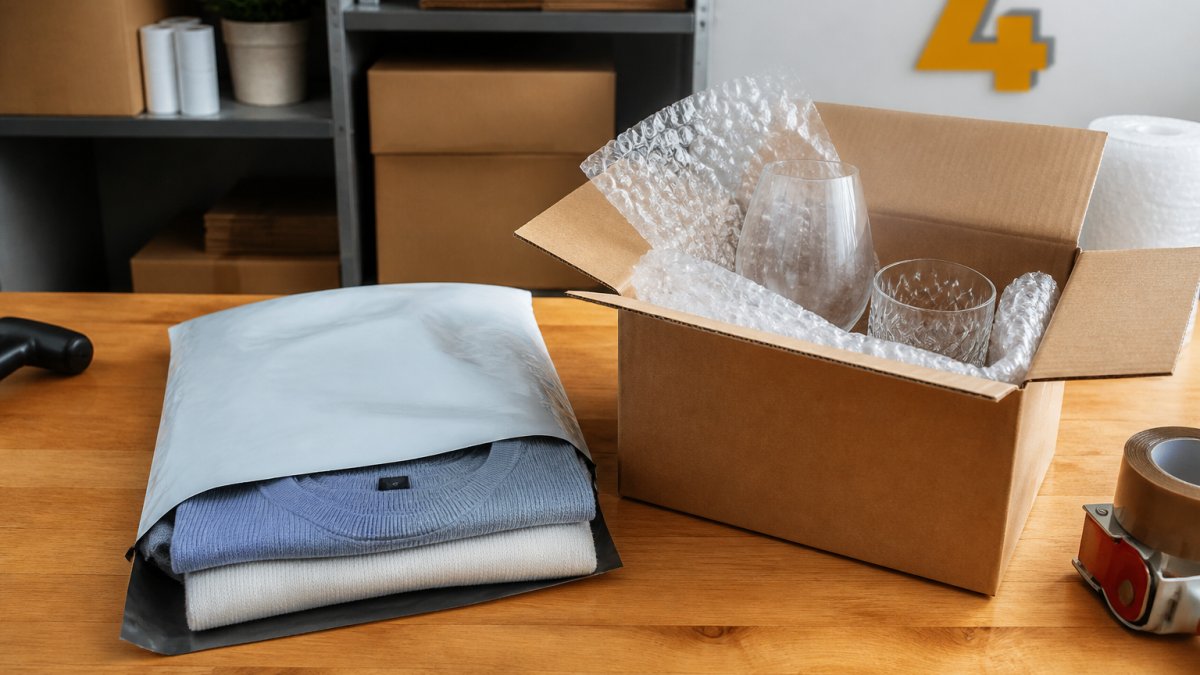
Lightweight and flexible products
Clothing, textiles, soft goods, and documents ship well in mailing bags. These items don't require rigid protection, and the dimensional weight penalty is minimal because they're already low-density.
Retailers selling primarily clothing or apparel almost always choose mailing bags. The cost advantage is real, and customer expectations align with receiving a bag rather than a box.
For these products, mailing bags are the obvious choice. The only exception is if branding and unboxing experience are critical to your positioning.
Heavy, bulky, or irregularly shaped items
Electronics, machinery, tools, and other dense items need cardboard boxes. The compression resistance of a box prevents damage. The dimensional weight calculation often favours boxes for these items because they compress slightly or pack efficiently.
Irregularly shaped items, items that don't fit standard dimensions, also benefit from boxes. You can pack them securely with void fill, whereas mailing bags would require custom sizing or multiple bags.
Retailers shipping heavy or fragile goods have no practical alternative to cardboard boxes. The protection and postage advantages outweigh the higher material cost.
Storage, Operations, and Total Cost of Ownership
Making the right choice requires looking beyond unit cost to total cost of ownership.
Warehouse space and inventory management
Mailing bags consume dramatically less storage space than cardboard boxes. For a small retailer with limited warehouse capacity, this can be transformative. You can hold more inventory in the same footprint.
Cardboard boxes, especially when assembled and stored, consume significant space. However, flat boxes nest efficiently. The space question depends on whether you store boxes flat or assembled.
Most retailers store boxes flat and assemble them on demand. This approach balances space efficiency with assembly speed. Mailing bags are always flat, so they win on storage efficiency.
If your warehouse space is constrained, mailing bags for appropriate product types free up room for inventory, reducing your overall operational footprint.
Packing time and fulfillment efficiency
Mailing bags are faster to pack. No assembly, no taping, minimal construction. For high-volume retailers, this time savings matters. Faster fulfillment means quicker turnaround on orders and lower labour costs per shipment.
Cardboard boxes require assembly time. For a retailer processing 100 orders daily, that's significant labour. However, the branding and protection benefits might justify the time investment.
The efficiency trade-off is real but often overstated. A trained packer can assemble a cardboard box in 20-30 seconds. At scale, this adds up, but it's not prohibitive for most small retailers.
Shop4Rolls.ie offers flat boxes, giving you flexibility to choose based on your operation's needs.
Making the Switch: What Small Retailers Should Know
If you're considering switching from one packaging type to another, plan the transition carefully.
Test with a subset of orders first.
Communicate with your team. If you're switching from boxes to bags, ensure your packing staff understand the new process.
Update your carrier settings. Different packaging types may affect dimensional weight calculations.
Consider a hybrid approach. Many successful retailers use both. Lightweight items ship in mailing bags. Heavier or fragile items ship in cardboard boxes.
For sourcing packaging supplies reliably, the postal boxes size and strength guide provides detailed specifications to help you select the right cardboard boxes for your product mix. If you're exploring cost-effective options, cheap shipping boxes for small businesses outlines affordable cardboard solutions. For polythene alternatives, the polythene bags shipping guide walks through bag selection criteria.
Choosing between cardboard boxes and mailing bags is fundamentally about matching packaging to your products and operations.
Frequently Asked Questions
Is it cheaper to mail something in a cardboard box or a mailing bag?
Cost depends on several factors. Mailing bags typically cost less per unit than cardboard boxes, and lighter packaging can reduce dimensional weight charges with carriers. However, if a product requires additional cushioning or risks damage in a bag, the cost of replacements, returns, and customer refunds may outweigh the packaging saving. Compare your actual postage rates, product damage history, and return costs rather than unit price alone. Shop4Rolls.ie can help you find the right mix for your business.
When should a retailer use a mailing bag instead of a cardboard box?
Use mailing bags for lightweight, flexible, non-fragile products such as clothing, soft goods, and low-risk items where impact resistance is not critical. Bags work well when you want to reduce postage weight and storage space. Choose cardboard boxes for fragile items, heavy goods, bulky products, or anything requiring compression resistance. Consider your product mix, carrier rules, and whether your customers expect a premium unboxing experience, boxes often reinforce brand presentation better than bags.
What packaging offers better protection for fragile products?
Corrugated cardboard boxes offer superior protection for fragile items because they provide compression resistance, impact absorption, and room for cushioning materials such as bubble wrap and void fill. Mailing bags offer minimal protection and should not be used for breakable goods. If you ship fragile items regularly, double-walled cardboard and proper cushioning are worth the extra cost to prevent damage claims and returns that harm your reputation and bottom line.
How can small retailers choose the right packaging for each order?
Create a simple decision framework: assess product fragility, weight, shape, and value. Lightweight, flexible, non-fragile items suit mailing bags; fragile, heavy, bulky, or high-value items require cardboard boxes. Factor in postage costs, storage space, and your brand image. Many retailers use both, bags for low-risk orders and boxes for premium or high-value shipments. Shop4Rolls.ie stocks a full range of both options, allowing you to source everything in one place and test what works best for your business.